
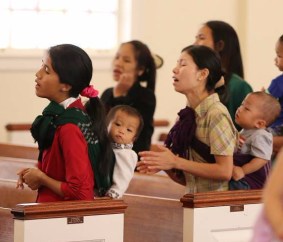
That fateful Sunday, we also attended was the Burmese Zo Immanuel Church. The Zo are the hill people of Burma, and they speak one dialect the fifty or so dialects spoken that that region. The service was in the sanctuary with about forty people in attendance. At the front of the sanctuary a projector had been set up with a screen shining slides and lyrics for songs. When I did research later, I found dozens of images of young people singing solo at the microphone and only a few images of young people or children singing as a group. Moreover, there seemed to be a large number of youth and children in the congregation as active participants.
Throughout worship, half a dozen young children ran laps down the aisle, crossed in front of the worshipers, and then ran back down the side to the back door in what appeared to be a fantastically fun game of chase. At one point, while the pastor was delivering remarks in between songs, he clothes-lined a small girl and hoisted her onto the stage. Plopping her down in front of the microphone he gave her some kind of instructions. Immediately, the girl recited something memorized to the worshipers, possible a Bible verse.
Online, I found more videos of children and youth leading worship. They have had young girls dance on stage to English worship recordings. They have also had what appeared to be the entire youth group assembled on stage singing in their native langue like a youth choir. Every so often, people would sing in English as well. The use of both English and the native langue, traditional and popular contemporary Christian worship songs points to a kind of cross-cultural worship experience. This congregation’s plasticity aided it in cultivating a vibrant ministry with youth and children, only to be outmatched by the Burundian service going on right under their feet.
Downstairs, we joined 120 others in the service hosted by the Light Mission Pentecostal
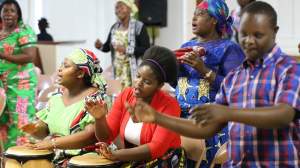
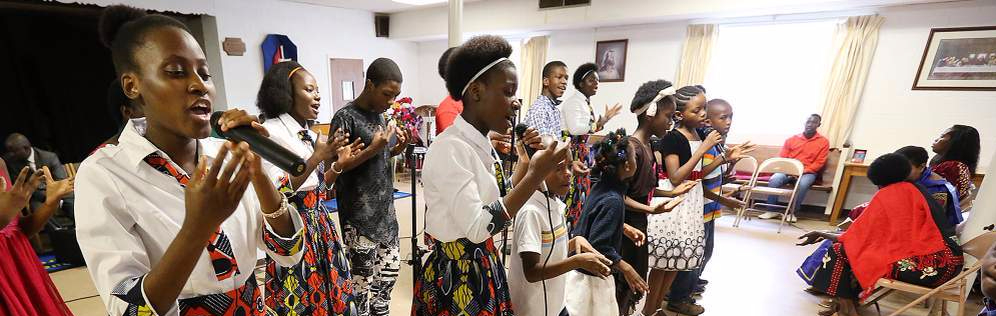
Church from Burundi already underway. A young woman sat down next when the sermon began anyway and began to translate as best as possible. Our translator told us that this service typically lasts for about four hours. We sat amid colorful native dress and western suites as a choir danced and sang in front of us. Several people craned Smartphone’s in the air to capture the visual. Loud guitar, rhythmic drums, and keyboard accompanied the well rehearsed young people, and in the congregation could be seen some older women with homemade shakers joining along where they sat. Most of the dancers were dressed in bright prints and women wore elaborate head wraps.
When the choir concluded, two men in suites approached the pulpit under the blessing of an older gentleman. The older gentleman was explained to be the real head pastor, but the two younger men would be preaching in his stead that morning. The sermon was preached in Kerndi and quickly translated into Swahili for the worshipers. Lines were then summarized rather skillfully by our impromptu translator. She told us later that many people in the congregation are on standby to be translators since the congregation has begun to attract other African refugees who may not understand Kirundi or Swahili. Indeed, this was the biggest gathering we had been to that day and the congregation had only been meeting there for three years. It is true that the rapid growth in Christianity is in the Pentecostal sphere.
The text for the sermon was the Valley of Dry Bones from Ezekiel 28. The message was one of radical hope and the power of the Holy Spirit. The theme of the Holy Spirit seemed rather fitting for a Pentecostal congregation. The pastors said that when you are in the power of the Holy Spirit then people can see God in you. You can be available and empowered to help other people. The sermon then touched on 1 Corinthians’ 13:4-8 as the worshipers were reminded that the power of the Spirit is love which will never end.
When the sermon concluded, a rug was brought out from the hall way and laid out in front of the pulpit. There then came the call to the altar for payer and repentance. The people began to sing and call out in disorganized songs as the musician tried to capture the melody. A few people came forward and prostrated themselves in front of the pastors and several elders. They leaders lifted up their hands over those on the floor and began to pray all at once. The congregation joined in with song and prayer as those bowed on the floor kept their faces low. The altar call finished and the pastors called for more song and rejoicing.
The choir jumped up and began to dance in a free form style. People clapped their hands and gathered in the aisle moving around one another with huge smiles and laughter. Some young men sat in the back observing but not getting too close. As if to tip us up, shouts of “alleluia” were met quickly with “amen!” so my fiancé and I quickly adjusted to make sure we were taking full advantage of the only part of the language we knew. After the celebration, there was more preaching and singing filling up roughly four straight hours of worship, but we made are exit fully exhausted from our full day of international worship.
Opportunities for Cross-Cultural and Trans-Cultural engagement between all of the different congregations are being strategically cultivated by Rev. Karen Lyons of the Methodist church. The two most open congregations are the Eritreans and the Burundians because they have been there the longest. All of the refugees tend to be a little bit wary of interacting with outsiders, and, in light of current political climate, the struggle for people in Clarkson has become even more challenging. Rev Lyons makes visits to the other services and has invited them into community partnerships in which the UMC members and participate in open table discussion with refugees to offer support and help them assimilate in to the culture. On the first Sunday of the month, the Burundians and Eritreans join the traditional service for communion and part of worship. The non-English speaking choirs perform and some hymns are sung together. Rev. Lyon calls this service “a glimpse of heaven.”
The arrangement of so many culturally diverse people sharing space has had some challenges; especially when I come to the care of the building and of the children. Pastor Lyon will sometimes feels led to offer constructive criticism to the other pastors, but she has since agreed with them that no criticism will take place on Sunday. Sunday is a day of celebration for everyone in the building, and all issues that need to be discussed can happen during the week. When I attended, every non-English speaking service had children who were running in and out of the service. I thought it was endearing at the time and possibly just a feature of non-Western culture. When I spoke with Rev. Lyons, she said that the members of the Methodist church really desire more structure for the children. They are concerned about the care of the building and the safety of older members and the children themselves. Rev. Lyons started organizing Sunday school with the congregations, but as soon has her native volunteers turned over control to the refugees the program fell apart. Nevertheless, children are valued in this diverse, inter-cultural community. The church hosts a successful Vacation Bible School with nearly all refugee children, and of course the whole building is used for the Fugee Academy during the week.
The diverse and flourishing community of Clarkston United Methodist represents a new way of organizing worship. In one space there are people praising God with dramatically different stories, backgrounds, and cultures. Sunday worshiper transcends cultural and civic norms as believers share in an act of people assembly and offer new “expressions of Christian unity across time, space, culture, and confession” (Nairobi Statement). Rev. Lyon said it best, for it is indeed a glimpse of heaven on earth.
Featured Image by Curtis Compton, The Atlanta Journal-Constitution
Oct. 9, 2016
 Kena Hawkins Newkirk