
Lessons from Ancient Corinth
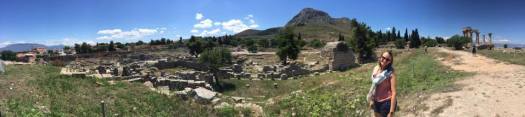
When William and I were in Athens, we decided to take a bus ride along the Aegean coast from Attica to the Peloponnese. We crossed the canal that divided two landmasses and arrived at the Ancient Corinth Archeological site.
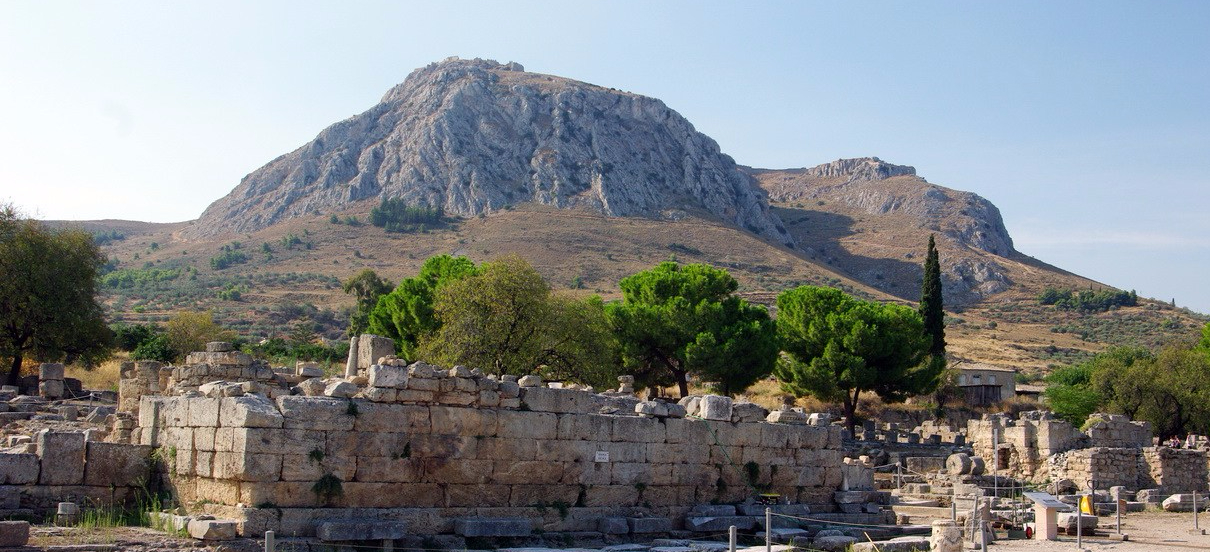
The site is further inland than modern Corinth, clustered at the foot of a great mountain where the Cortina Acropolis stands with muddled ruins of a former temple to Aphrodite. The main road the ancients used led up to the city from the Port Cenchrea bellow and is still mostly intact. Visitors to the city would disembark from their ships and travel up to the road and through the massive gates. Passing through the towering columns, visitors would be met with a bustling street filled with shops, bathhouses, and fountains flanking either side of the dramatic road. The collection of rocks which stand there now was once Corinth’s agora where major city business and trade took place.
William and I wandered around the ruins speculating what each little shop and room could have been. We wondered where the shop was that Paul worked making tents with Aquila and Priscilla? Where could the ancient synagogue have been where Paul preached and baptized?
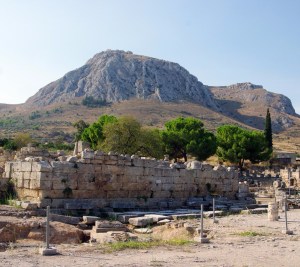
Some areas had informational signs pointing out highlights such as the Temple of Apollo and government buildings. There was one small sign on a large raised marble ledge, which could be seen at a distance if one were to enter from the main gate. This structure was the ancient Bema of the Corinth where city leaders and philosophers would address the people and sit in judgment over criminal matters and social disputes.
Acts 18 describes Paul’s 18-month stay in Corinth. His ministry there is characterized as rather successful: many were converted, people were baptized, and a church was founded from some of the Jewish inhabitants of the city.
However, things didn’t always go so smoothly. Eventually, some followers of Judaism in the city attacked Paul and accused the followers of Jesus and brought them to trial in front of the proconsul of the city named Gallio. Paul and other believers were dragged before the Bema for the whole city to witness. After a short trial, the city leader dismissed the charges, but the people were still enraged. The enraged crowd enacted their own mob justice beating Sosthenes, a follower of Jesus and leader in the synagogue, in front of the Bema.
In the first lines of Paul’s first letter to the Corinthians, Sosthenes is mentioned as a co-author in the epistle. This suggests that although Sosthenes was beaten and Paul was put on trial in Corinth, both men stood firm in their faith, continued to spread the Gospel, and still cared about the wellbeing of the persecuted believers in Corinth.
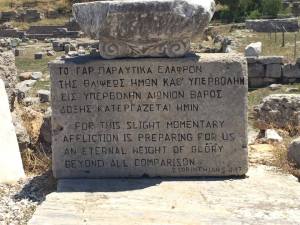
If you visit ancient Corinth, you can actually climb up and stand on the Bema from were Paul was judge and Sosthenes beaten. From the platform you can see clear across the agora over the gates and to the port down by the sea bellow. The view is captivating. People on vacations are always chasing beautiful views, and William and I are no exception. But, the view from the Bema is different. The vista not only contains beauty, but also gravity. And if you turn to your right you’ll see a building block with a verse from one of Paul’s letters.
“For this light momentary affliction is preparing for us an eternal weight of glory beyond all comparison.” – 2 Corinthians 4:17
The moment I mounted the Bema, I was suddenly aware of the boldness and courage it took for Paul and other early Christians to preach the Gospel of Jesus. Every eye trained on them when they spoke. Some people were eager to find a reason to do them harm, and some eager to believe. Paul and Sosthenes risked so much in loyalty to God’s calling on their lives, and I wonder if I could ever have the same conviction.
We are all surrounded by powers and social norms that push us to hide our beliefs and disregard Christ message of mercy and justice. It is part of the human condition to prefer the path of least resistance.
The final feet of the Roman road that Paul first took to get to Corinth ended at the foot of the Bema. The path was well paved and not too difficult to traverse. Yet, it is the last few feet, right before the Bema, where Paul struggled the most in his Corinthian ministry. If Paul had not made it the final few yards, the faith would not have progressed. If Paul had a given up during the most difficult part of his ministry then Love and mercy would not have been preached. God’s message would never have reached the entire city, only those in the synagogue, and the full impact of God’s message would never have been realized.
The “weight of glory” is not a comfortable thing. The command to make disciples and do the work of the kingdom can call us in way we’d never expect. Reaching out to the hurting and unloved; standing up for justice; enduring suffering in honest faith, and making weak and oppressed voices heard. These are challenging yet utterly glorious burdens that we bear as disciples of Jesus.
Being a follower of Jesus is challenging because it demands we go the distance to be faithful disciples. We must follow the journey to its conclusion even though we may travel through the valley of the shadow of death. We may stumble along the way, but our determination and courage must outweigh our fear and anxiety for God is with us. The weight of glory is great, but it indeed worth it!
 Kena Hawkins Newkirk