

While at Candler, I took a class entitled Exile and Restoration, and it was hands-down my favorite class which I took there. I’m fascinated by the Exile of Israel and Judah, especially because throughout the fierce suffering and difficulty ,the people of Israel emerged as faithful followers of YHWH. I am especially fascinated by Jeremiah and his career as a prophet at the end of the Israel monarchy.
My favorite story from this time period is the story of Jeremiah’s purchase of a field in Chapter 32. When the City of Jerusalem is at its lowest point, about to be captured by Babylon, and Jeremiah himself is under house arrest, God commands Jeremiah to purchase a field back in his hometown of Anathoth as the rightful redeemer of the property.
The redeemer of a property is referred to as “go-el,” and is most likely a reference to rights of land ownership detailed in Leviticus 25 and the year of Jubilee. It was the obligation of the “go-el” to make sure that ancestral property which may have been sold made it back in to the family’s possession.
In that time, two copies of the deed were usually drawn up in a legal transaction. One which was left open for reference, and one which was sealed and stored away in order to insure that the hand-written contract was undisturbed. This document was typically sealed with a stamp of clay called a “bulla.”[1] Contrary to practice, Jeremiah commands his secretary named Baruch to store both copies in an “earthenware vessel.”
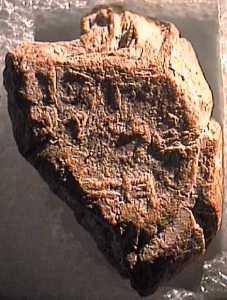
Why did the prophet seal both documents? With Jeremiah imprisioned and Jerusalem on the brink of falling, the prophet really never had any hope of ever taking possession of the purchased land for himself.
Yet, there are striking implications for the purchase of land situated in the middle of a war zone.
First, Jeremiah understands that land is the context by which one experiences the transcendent. It may seem foolish to value property in this way, but such notions were developed through generations of holy experiences. The land is where ancestors are buried, livelihood is maintained, and memories were created.
Today, the same could be said for a neighborhood church or a family farm. People cannot experience God apart from the material world, and whatever material thing is becomes holy through those experiences of the divine.
Second, when viewed in its larger context, Jeremiah’s sign-act points out that God has a plan for Israel’s redemption is in the works even before the city gates are breached. Jeremiah 32:15 says:
For thus says the Lord of hosts, the God of Israel: Houses and fields and vineyards shall again be bought in this land.
To the modern reader, Jeremiah’s obedience in buying the land seems ludicrous. Prisoners and refugees typically don’t spend money buying more property in the war zone. In uncertain times, people tend to invest in silver and gold, not a vacant lot.
Finally, the sign act is supposed to rally the people of Judah and prepare them for the struggle ahead. Kathleen O’Connor comments that Jeremiah is trying to “marshal the energies and hopes of the people of Judah to resume life, to rebuild their identity, and to face a future that disaster has obliterated.” [2]
It is this act of radical hope which suggests that Jeremiah is confident that God already has plans to redeem his people. Jeremiah’s theology of hope is astonishing and should evoke in the reader the same sense of uncomfortable and humble awe which the prophet himself experienced.
From the very first, God has been in the business of redemption. Even before Eve and Adam set foot outside the garden there was a plan in place to bring them back to the promised land. Even before you or I were born, Christ loved us, lived and died for us, rose again that we live with him in the promised land.
The lesson of Jeremiah’s property deal is not just that God has a plan for redemption, but also that we are called to make investments in our own restoration even when things seem bleak. Jeremiah was faithful to do God’s work in buying the field even when others viewed him as foolish. The prophet never saw the payoff for his land purchase, but the payoff for his obedience was immediately felt as he inspired hope in his fellow Jews.
Prayers in the midst of pain, tithing in midst of need, singing in the midst of suffering, acting with kindness in the midst of injustice. All of these are ways we are foolishly faithful in living out our lives of discipleship. By acting like Jeremiah we can inspire hope as well as confusion. As we do the work which God calls us to do, we must be mindful of Jeremiah’s example and hopeful for the fulfillment of our redemption in God’s Heavenly Kingdom.
[1] Jack R. Lundbom, Jeremiah Among the Prophet.,( Eugene, Oregon: Cascade Books, 2012), 118.
[2] Kathleen M. O’Connor, Jeremiah: Pain and Promise. (Augsburg: Fortress Publishers, 2012), 724.
 Kena Hawkins Newkirk