

The last few days have been a wild and confusing ride for residence south of Atlanta. A few weeks ago it was announced that a white supremacist rally would be held in the city of Newnan, Georgia not far from where I currently work. I was in El Salvador when the announcement was made, and I remember the words of the 13-year-old girl who is a member of our mission team. “Why can’t they just leave us alone. “
I spoke with church leaders in the area, and they were asked by law enforcement to host police officers in their building but not get involved. Instead, they held a worship service counter to the protesters down the road.
Later in the evening, Neo-Nazi groups burned swastikas on a hill side in Temple, GA.
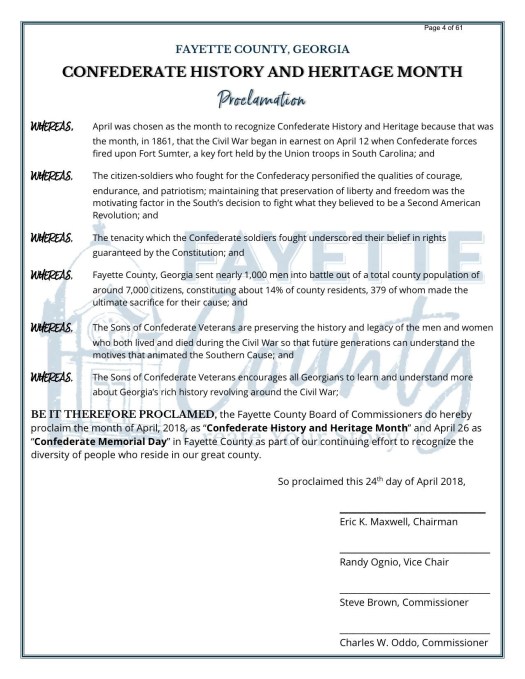
Then this week, on the heels of the rally, the Sons of the Confederacy organization pushed forward proclamations in the surrounding municipalities requesting a month dedicated to honoring Confederate History and Heritage. The timing of course could not be ignored but the language was worse. The proclamation, which you can read in the featured image, whitewashes the civil rights atrocities which led to the Civil War. It is also down right deceptive claimining that the confederacy waged war for “the preservation of liberty and freedom,” blatantly ignoring the fact that the liberty and freedom which was fought for by the Confederacy was ability to steal the liberty and freedom from African Slaves.
To those who would argue otherwise, it seems like it should go without saying that The Georgian Declaration of Succession lists the following as their chief grievances:
The prohibition of slavery in the Territories, hostility to it everywhere, the equality of the black and white races, disregard of all constitutional guarantees in its favor.
In addition they list the North’s failure “to surrender fugitives from labor,” and the issue that a “ [slave-holding] citizen cannot travel the highway with his servant who may voluntarily accompany him, without being declared by law a felon and being subjected to infamous punishments.”
Although the Declaration of Succession was full of reference to slavery, the Proclamation of Confederate History and Heritage made no mention.
In Griffin Georgia on March 27, the proclamation was passed in a shameful display. During the debate, former Commissioner Larry Johnson used the n-word several times with only censure and objection from the one person, one of the two current Black commissioners, Rodney McCord.
This incident is all the more frustrating because the city of Griffin has been the location for IMPACT, the youth mission week hosted by Square Foot Ministries. The youth of Fayetteville First UMC have developed a heart for the community of Griffin through this mission program.
Yesterday, the proclamation came to in Fayette County. When the document was released the names of the four white county commissioners were listed, intentionally excluding the only Black commissioner.
To be honest, I did the bare minimum to stand up to this injustice. I sent a few emails made a few posts on social media and went to a rally. But I was thankful for the opportunity to do even this little.
As a youth minister, I fear that I might be criticized for my activism. However, the lens of all my ethical choices is shaped by what I believe would benefit the younger generation the most. I tell my boss all the time, and I am intentionally biased towards the interest and spiritual development of young people inside and outside our congregation.
A 2016 Newsweek article surveyed over 700 teenagers with the following result:
The most compelling findings show that race and discrimination are crucial issues for teens today. In 1966, 44 percent of American teens thought racial discrimination would be a problem for their generation. Now nearly twice as many—82 percent—feel the same way. The outlook is more alarming among black teens: Ninety-one percent think discrimination is here to stay, up from 33 percent in 1966.
It is indeed an older generation’s mentality to allow language such as that featured in this proclamation to continue. No generation is a monolith, no generation speaks with a single voice. However, I could not in good conscience teach our students on Wednesday about the love of Christ and doing what’s right if I do not live the gospel on Tuesday when it was so easy for me to do so.
How am I to tell a student to resist peer pressure if I do not resist the peer pressure of racism? How am I to tell a student to reach out to the unloved at school if I do not stand with persons of color humiliated by local laws? How am I to tell a student to love God if I am unwilling to love God’s people?
Some have thrown up their hands in disappointment that this was a political exercise and no place for the church. However, I cannot think of a worse fate for the church or a more unappealing institution for young people, if the church ceased to be of consequence in advocating for love, unity, and justice.
 Kena Hawkins Newkirk