Peace – Tree of Jesse

A shoot shall come out from the stump of Jesse, and a branch shall grow out of his roots. – Isaiah 11:1 (NRSV)

What a crazy verse to start out week two of advent. If you haven’t heard this verse before it’s commonly read in churches in the weeks leading up to Christmas. Though it’s meaning might be hidden from us, the Jewish people of Jesus time considered this a prophecy about their future king.

The key to understanding this verse is to know who in the world this Jesse guy is! If you remember your Old Testament, Jesse is King David’s father. David was the best king Israel ever had, and his family ruled Judah for hundreds of years before the kingdom was destroyed by Babylon. When the text talks about the “stump of Jesse,” it’s referring to David’s family tree, the royal family of God’s people.

Now, if you remember your New Testament, you’ll know that Jesus comes from the house and line of David. He is born in David’s hometown of Bethlehem and is called the King of the Jews. Jesus is Jesse’s great-great-great-great-great grandson, or something like that. The people of Judea had waited for generations for God to regrow the royal family tree, and Jesus is that shoot growing up from Jesse’s stump. In fact, there’s a lot of kingly language in this passage.

The Hebrew word for “shoot” can also mean “scepter.” It’s a play on words connecting the symbols of kingship with an image of new growth. Jesus is the shoot rising up to claim the throne of David, ready and eager to extend new life for us.

There’s a tradition in some churches to take bare branches and cover them with ornaments representing Jesus. They call these decorations ‘Jesse trees,’ after this passage. Trees are a big part of the Christmas celebration. Maybe you have one in your home right now. We use evergreen trees to remind us of God’s ever-present love for us, even in times of darkness and uncertainty.

Peace – Prince of Peace

For to us a child is born, to us a son is given, and the government will be on his shoulders. And he will be called Wonderful Counselor, Mighty God, Everlasting Father, Prince of Peace. – Isaiah 9:7 (NRSV)

Long ago, when kings and queens were being introduced, they would collect many titles or nicknames for themselves to sound impressive. You might be familiar with names like Catherine the Great or Ivan the Terrible of Russia. But rulers had more exciting names too. Edward I of England was known by the name The Hammer of the Scots, which sounds kind of cool.

Today, these sorts of nicknames are typically reserved for professional athletes like football players or basketball players. The best nicknames are found among pro wrestlers. Think ‘Stone Cold’ Steve Austin, Dwayne ‘The Rock’ Johnson, or ‘Macho Man’ Randy Savage.

These names are supposed to mesmerize fans and intimidate opponents. The nicknames given to our rulers in the past, did the same thing. Titles like “the Great” or “the Terrible” or “The Hammer of the Scots” were supposed to sound mighty and unapproachable. We are supposed to be captivated and frightened by them.

This verse from Isaiah lists a bunch of nicknames for Jesus, and they seem very different from the nicknames of our worldly rulers and wrestlers. The title “Wonderful Counselor” does not sound scary; it sounds inspiring and personal. What if we were to rewrite Jesus’s name with the phrase ‘Mighty God.’ It might sound something like Jesus Christ, the Mighty God. Now, that does sound awe-inspiring.

Perhaps the most confusing of these titles is ‘Prince of Peace.’ I cannot think of any worldly ruler or even modern athlete who wishes to be called ‘Prince of Peace.’ It tends to be against the human instinct to advocate for peace, even when it is the thing we need most.

Jesus comes into this world sporting the title ‘Prince of Peace.’ Jesus turns the earthly model of leadership on its head. He does not rule by force and terror but through faith and love. He preaches “blessed are the peacemakers,” and through his death and resurrection, he brings peace between humanity and God.

Take time today to reflect on the nicknames of Jesus. Which one means the most to you?

Peace – The Comfort of God

Comfort, O Comfort my people, says your God. – Isaiah 40:1 (NRSV)

This passage is spoken over the people of Israel at the end of the Exile. Is read in God’s own voice, and he is calling out to Israel to give them comfort at the end of their trial. It’s an important verse in the book of Isaiah because it presents a huge shift in the message of the book. In fact, some people call the following few chapters the “Book of Comfort” because the tone is one of support and encouragement.

When you think of the word ‘comfort’ what images come into your mind. Maybe you think about a warm safe blanket on a cold rainy night. Maybe you imagine a good hug from a dear friend that you received just at the right moment.

There are lots of things we use to inspire comfort during this time of year. Hot cocoa in a good mug after a long day. Bright lights on our homes when the night lasts so long. Bells that spark music when we least expect it.

The Christmas season is definitely a time when we need comfort. Comfort food, comforting friends, and comfortable clothes on those cold winter nights. You, or those close to you, might need a little extra comfort during this season, especially when we remember all the people who cannot celebrate this season with us.

Today, take time to reflect on the images of comfort which surround you. Candles, hugs, and Christmas cards are full of warm wishes and messages of comfort. Resist the urge to get caught up in the stress and materialism of our world and embrace the Sabbath rest of God.

Find your favorite image of comfort and place it in a prominent place. Put a candle on your desk at home or a Christmas card on your bathroom mirror. God wants you to enjoy his comfort this season, and if you get the chance, offer someone else a little comfort too!

Hope – The Thrill of Hope

But those who wait for the Lord shall renew their strength, they shall mount up with wings like eagles they shall run and not be weary, they shall walk and not faint. – Isaiah 40:31 (NRSV)

This year has felt like a marathon. There has been so much stress and anxiety, bitterness and obstacles. Nothing has been normal. I feel like if I hear the phrase “uncertain times” one more time then I am going to explode. We really need some certain times if you ask me. We need new energy. We need some encouragement.

In Hebrew, the word “wait” can also mean “hope.” We talked about the connection between waiting and hoping in our last devotion. We discussed how God calls us to practice hope with patience and imagination. But, this verse introduces another element to hope which God promised to provide: strength.

Waiting can take a lot of energy out of you. Without God’s intervention we can become discouraged or exhausted by the circumstances in which we find ourselves. But God promised if you wait for him, if you put your hope in him, he will renew your strength. It is a message of endless endurance and profound support. Isaiah presents us with a heroic image of a runner who never gets tired and paints us a picture of a majestic bird soaring above all troubles.

This verse reminds me of where we find hope in our Christmas hymns. There’s a line in “O, Holy Night” which goes “A thrill of hope, the weary world rejoices, For yonder breaks, a new and glorious morn.” I love the idea that hope is thrilling. There’s an energy and strength behind hope which makes it feel like electricity animating our very bones.

The hope of God is not a weak and fragile thing. God’s hope is dynamic and strong. It energizes us in the midst of “uncertain times.” It makes us agile enough to overcome the most challenging of obstacles. God’s hope is thrilling and brings joy to all the world.

Maybe this seems unattainable to you. Maybe you are weary from a year of uncertainty. Engage God in conversation. Ask for the strength and thrill of hope this Advent.

Hope – How to be Good at Hope

From ages past no one has heard, no ear has perceived, no eye has seen any God besides you, who works for those who wait for him. – Isaiah 64:4 (NRSV)

What a mysterious passage! This verse sets up an interesting theological idea. The first half of the verse talks about how amazing and powerful God is. From generation to generation there has never been anyone more marvelous than our God. God is the creator of the world and savior of all humankind.

This week in advent, we are focusing on the spiritual discipline of hope. Being good at hope (and yes, you can be good at hope) means you must have two things: Patience and Imagination. Consider what it means to be patience. Nobody hopes for things they already have, rather we have to wait for the things we are hoping for. Verse four says that God only works for those who wait on him, not the people who rush to get things done their own way. But we shouldn’t just sit around waiting on God to work without any idea of what we are looking for.

Think about it this way: there was once a little girl who was participating in a scavenger hunt. As she wandered through the yard she got more and more upset because she couldn’t find any of the clues that her parents hid for her. Finally, she gives up and asks for help. When her brother comes over, he easily finds one of the clues and hands it to the little girl. She was shocked! The little girl had walked past the clue a dozen times, but she didn’t realize that’s what she was supposed to be looking for. She lacked the imagination to see what was right in front of her.

Today’s passage calls us to practice hope with patience and imagination. We are not supposed to wait around doing nothing and expecting God to act. We must remember what our God is like and then live into the expectation of what God will do. Take time today to ask God for the right combination of patience and imagination.

Hope – That God Would Shake Things Up

Make your name known to your adversaries, so that the nations might tremble at your presence! – Isaiah 64:2 (NRSV)

This has been a pretty crazy year with the pandemic, celebrity deaths, and a vicious presidential election. We’ve seen politicians on all sides behave badly and struggle to provide good leadership for our country.

The way we do school and church has changed in ways we couldn’t imagine. We missed big events and milestones all in the hope that we can keep each other safe and healthy. 2020 has been tough; if 2020 was a food it would be toothpaste covered orange slices. But this verse is one we need for today. It’s about hoping for a better future.

In the second half of this verse, Isaiah asked that God might make the nations of the world tremble. He doesn’t specify which nations, he probably means all nations. It’s tough to say what is going on exactly, but it’s a pretty good bet that it has not been a good year. If we think about the historical context, this was likely written during the exile when all of Israel was under the thumb of foreign enemies. For Israel, things were rough, and it felt like the whole world was turning against God. So, what does Isaiah want? He’s not interested in maintaining the status quo. Isaiah wants God to shake things up!

Advent is the beginning of the church calendar, and this prayer seems to be a wish list for God to do new and exciting things with the new year. Remember that this week in Advent we are focusing on hope. As Christians, we are called to live with the hope and anticipation that God is still working in the world.

Imagine what the new year will be like for just a minute. How would you like for God to shake things up in our world? How would you like God to shake things up in your community or your school. Take some time today to ask God to shake things up. Tell him what you might want this to look like.

Allow the hope of Christ to shape your vision for the future during this Advent season. Rest in the hope that God wants to shake things up!

Hope – God on Stage

Oh, that you would tear open the heavens and come down, so that the mountains would quake at your presence. – Isaiah 64:1 (NRSV)

This verse is a passionate prayer that God would interrupt the whole world. The imagery is violent and startling. If God were to act like this, then there would be no denying who was in charge. The speaker is asking God to storm on to the stage in the middle of the play. God is the director. God is in charge. If things are going awry then it is God who should jump in and make things right.

But, if any director were to jump onstage in the middle of the play, then the play would be over. The only time you see the director is at the curtain call. Instead, God chose to enter the play as an actor. He came to us as a little child. A helpless baby born in a barn to a poor family.

Why might God have chosen this particular method? Why would God hold off on the big flashy entrance and come to earth as a humble child? Well, one reason might be that if God came with thunder and lightning, there would be no need for faith. Everyone would be forced to acknowledge God as King, and God would not be sure who really wanted an authentic relationship with him.

God might also be trying to teach us something about who Jesus is and who we are supposed to be. We are not supposed to go through the world throwing our weight around and lording over people. As Jesus followers, we are to be humble like Jesus, treating everyone as our neighbor.

Now, this prayer from Isaiah is still really helpful. It is a hopeful cry for God to act. Whenever you see terrible things on the news or you’ve experienced some evil, we should pray asking God to intervene in a big way. The amazing thing about God is that He is planning on coming back in a big way to right all wrongs and save His people. God has promised to someday jump on stage and make things right. When we reach the curtain call of this life God will make a big appearance and things will be made right.

Hope – Preparing the Way

A voice cries out: “In the wilderness prepare the way of the Lord, make straight in the desert a highway for our God. – Isaiah 40:3 (NRSV)

Maybe you have heard this passage before. It is repeated in the gospels and used to describe the ministry of John the Baptist. John was a prophet sent ahead of Jesus to prepare the way for him. He lived in the wilderness near the Jordan river and people came from all around to hear him and be baptized. John called people to repent and get their hearts right because he knew that the Messiah of God was coming soon.

Advent is the season before Christmas in which we are supposed to prepare our hearts for Christ just like John did two thousand years ago. We are invited to take time for reflection and prayer. We are called to cultivate anticipation in our souls through worship and studying the Bible. We are encouraged to sit quietly and remember what Jesus means for our lives.

The thing is, while God is asking us to prepare our hearts for Jesus, the world is asking us to prepare our homes for Christmas. There are gifts to buy, halls the deck, presents to wrap, lights to string, cookies to bake, and carols to sing. There is so much to keep us busy and distracted that we might miss Jesus when he shows up.

So how should we prepare our hearts for Jesus this Advent? Here’s a few ideas: participate in some charity work in your community, attend a special Christmas service with your family, or spend some extra time in prayer or reading your Bible alone or with some close friends.

Believe me, Christmas morning is so much sweeter when we welcome the day having prepared for Jesus.

An Election That’s Skin Deep

I keep hearing that we are living in unprecedented times. A global pandemic plus a presidential election amid some of the most divisive times in our country’s history.

While it’s true, times are incredibly tricky; they are not without precedent. Countries have experienced pestilence, politics, and protests for generations. It has been worse.

The Spanish Flu killed more people than World War I, and we’re likely only fairing better due to advancements in health care, testing, tracing, and social distancing. My husband, a history enthusiast, recently reminded me that ancient Rome handled political disagreements with a sharp knife and a dump in the Tiber River. And there was a time in this country that protests for civil rights boiled over into Civil War.

Lately, I’ve been looking into the Wesley tradition for some practical advice on conducting myself during this election season. John Wesley was once asked about how to handle voting, and this was his short response:

I met those of our society who had voted in the ensuing election and advised them
1. To vote, without fee or reward, for the person they judged most worthy
2. To speak no evil of the person they voted against, and
3. To take care, their spirits were not sharpened against those that voted on the other side.

While this is a helpful outline for keeping discourse civil and voting once’s conscience, it has many holes. How does one define “most worthy?” Should I vote for the person whose policies benefit me the most or benefits society the most? Then again, “worthy” sounds like a judgment of character, not policy.

And what about speaking “no evil.” Sounds easy enough, but does that mean saying only good things to the exclusion of the truth?

Perhaps the most challenging piece of this advice is not to take things personally. To stay friends with people who voted differently than you did. This, I think, is the crux of the matter. As a privileged white woman, while this is challenging for me, it might not be impossible. And I’ve heard this wisdom a lot in the past. While we can disagree politically, we can still be friends personally.

However, politicians have turned so many personal issues into political issues. Government policies have blurred the lines between what is political and what is personal. Most divisive issues in the political landscape affect people on deeply personal levels. Policies around gay marriage, abortion, race relations have an impact that reaches deeper than our skin. Even issues like health care and war are issues of life and death.

I tend to think this is intentional. It’s easier for politicians to divide and conquer than unite and lead. We are being manipulated over a handful of issues and vote out of fear. If you watch political ads on tv, you’d think the world would implode if the opposing candidate won the election.

Nevertheless, how is it possible to address these personal things so dispassionately? How are we to remain friends with people who want to legislate beyond the boundaries of our bodies? How have politicians made us so so concerned with policing each other’s bodies? And since when does the government’s jurisdiction reach extend beyond our skin?

I appreciate the people who subscribe to Wesley’s third piece of advice, to remain friends with those of differing political beliefs. I’m not saying I disagree with Wesley, but we must realize how monumental this task may be.

For some people, it might mean simply agreeing to disagree. But for others it means forgiving a personal injury.

It might mean forgiving someone who voted in support of a policy that violates your own humanity. It might even be a policy that threatens your very life. Some might argue that I am dramatic, but I am merely trying my best to put myself in another person’s shoes.

Governments are fallible. Laws and policies that were once celebrated as just are now condemned as cruel. As a country, I pray we continue to seek Liberty, and Justice for all, knowing we’ll frequently fall short. When we do, I hope we do more than agree to disagree. I hope we forgive and ask for forgiveness. I can think of no better mark of Christ in politics.


Jonah’s Baptism

There’s a lot that supposedly happens during a baptism theologically. A person is adopted into the Kingdom of God, marked according to the covenant by the Holy Spirit, washed of sin, and raised to new life with Jesus.

I’ve seen plenty of baptisms. I’ve seen babies get baptized, and I’ve seen new believers get baptized. I’ve seen people sprinkled with water in church and dunked in lakes on camp retreats. I’ve recited the liturgy more times than I can count.

But none of these things prepared me to witness the baptism of my son. It was the most profound experience of God’s grace I have encountered in years. The last few weeks, I had been searching for the right words to describe this moment when I was presented with Luke 3:21-22 during a recent Bible study:

When all the people were being baptized, Jesus was baptized too. And as he was praying, heaven was opened  and the Holy Spirit descended on him in bodily form like a dove. And a voice came from heaven: “You are my Son, whom I love; with you I am well pleased.”

Reading this passage brought me a new kind of joy and understanding.

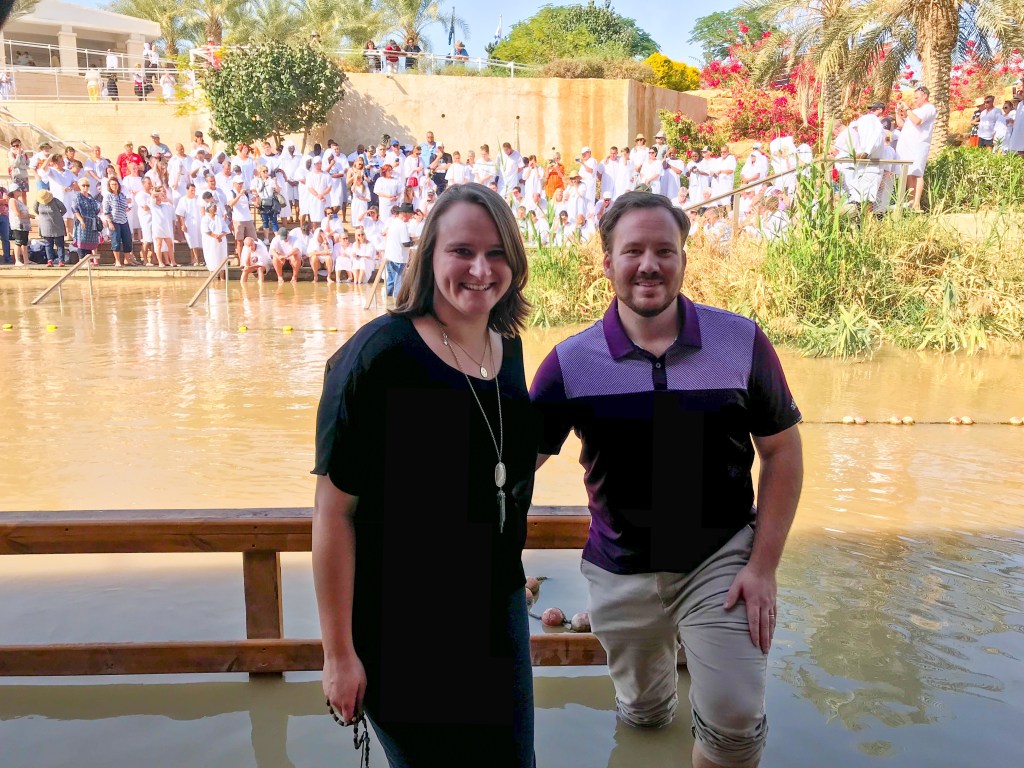
Last November, William and I traveled to Jesus’ baptism site by the Jordan River. The river has moved locations over the years and now runs about a hundred yards East of the traditional spot due to earthquakes and irrigation from farming. You can still visit the ruins of the Byzantine church built there to commemorate the former location.

When William and I visited, our Jordanian tour guide took a particular interest in us. We chatted with him a good bit. When it came time for the tour to move along, he told us to hang back so we could duck under the rope and walk down into the dried-up river bed typically off-limits to tourists.

“Go down the steps, look to Jerusalem and make a wish,” he said with a wink. I couldn’t believe our good fortune.

When we were alone, we walked down into the river bed. There are massive marble steps, and a foundation once supported a canopy, and you can see the groves where water used to flow. We then turned our eyes toward Jerusalem and prayed for our unborn child. I was ten weeks pregnant at the time.

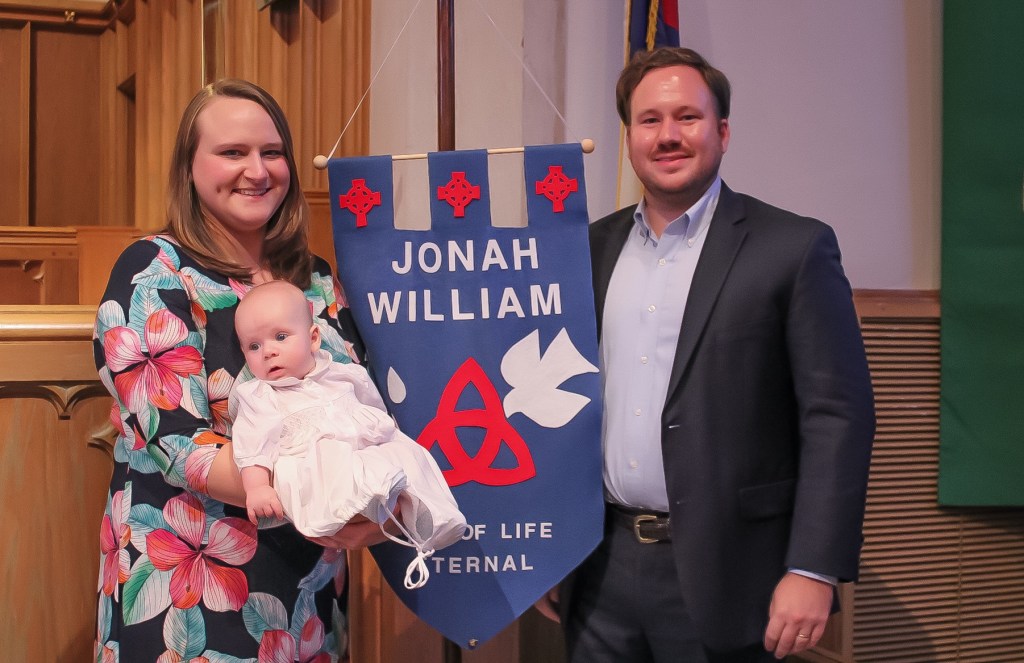
When Jonah was baptized, we mixed a few tablespoons of water from the Jordan River into the baptismal font. I thought of that day in Jordan, praying for the baby I hadn’t met yet. And when the water touched his head, I thought to myself, “this is my son, who I love, in whom I’m well pleased.”

I am so thankful for everyone who has supported Baby Jonah in his faith journey so far, and I look forward to all the love he will experience in the family of faith.

At his baptism, I was so thankful to know that the love of God extends to him and to see God’s love spread over him in the sacrament of baptism. I imagine that the words spoken by God over Jesus Christ were spoken over Jonah when the water was brushed over his head.

I wonder if God spoke those words over me at my baptism, and I wonder if God is still speaking these words over everyone who abides in Christ. “This is my daughter,” “This is my son,” “whom I love, with whom I am well pleased.”

I pray that each day, Jonah will rise with the knowledge that he is God’s beloved, that there is nothing he can do to earn the gift of grace, and that God finds pleasure when lives authentically in Christ.