
Trusting with Both Hands

“Many proclaim themselves loyal, but who can find one worthy of trust?”

‭‭Proverbs‬ ‭20:6‬ ‭NRSV‬‬

Lately FFUMC Youth, we’ve been discussing Wisdom, so I’ve been looking back over some of my favorite proverbs. Trust is something you hope to find in a good friend, but especially a spouse. I’m blessed to be surrounded by good, trustworthy people, but it seems to be a waning personal virtue. Mostly, I only hear the word associated with Fortune 500 companies and the government, and primarily it’s used to talk about how untrustworthy these entities are.

Trust between regular people isn’t really talked about much. People are flaky nowadays, and I’m no exception. We consider ourselves loyal and trustworthy, but we disrespect others when we cancel plans or fail to show up for the small things. We talk behind each other’s back, and we prioritize our own agendas.

Sometimes, we even take a little pride or humor in it. Bragging about canceling plans or gossiping in the background.

Whenever I think about trust, I think of one moment in particular. At the rehearsal for our wedding, our coordinator made a huge deal about how we should walk up the steps to the altar. I wore a chapel length train and cathedral length vale, so it was Williams job to hold my hand and elbow to make sure I slip. We practiced this several times to make sure.

It just so happened, as we left our reception late that night after all the dancing and carrying-on, William prevented me from slipping and falling again. We were in the middle of running through the tunnel of sparklers and cheering guests when he stopped me, holding my hand and my elbow, and told me to step down off the curb before I tripped and fell.

For those of you who were there, you know my grandparents were not as observant.

However, that simple gesture, that small act of helping me down a step is one of the highlights of my wedding day. It illuminated a feeling of trust within me. It was far more critical than a tunnel of sparklers, as impressive and fun as that was!

Who are the people that look out for you? Who are the people that you trust, and do you trust them too?

Trust isn’t built on grand gestures. It’s built, brick by brick, with small incremental acts of dependability. Showing up, doing what we say we will do, and holding on with both hands. Whole-hearted commitment in the little things builds a healthy relationship, between friends or family or spouses. And when that house is built strong in the small stuff, then the storms of life will never be able to shake it.

A Bad Business Model – The Parable of the Lost Sheep

Photo by Sam Carter on Unsplash

 Suppose one of you has a hundred sheep and loses one of them. Doesn’t he leave the ninety-nine in the open country and go after the lost sheep until he finds it? – Luke 15:4

When I was hired on at Fayetteville First UMC, the name of their Wednesday night youth program was 1:99.  This was a reference to the Parable of the Lost Sheep found in Luke 15.  The title served as a reminder to the students every week that no matter what they did, whatever went on in their lives, Jesus was looking to bring them back.

I’ve since updated the name and changed the branding mostly in anticipation of the new youth space.  Sometimes you just need a fresh look.  But the idea is still vital to our youth, and really this parable is still important to me.

Actually, it’s rather convicting and ludicrous to me.

In the story, Jesus seems to suggest that leaving 99 faithful sheep unattended in the wilderness is the logical answer, so the good shepherd can chase after one wayward sheep.  Honestly, that doesn’t make good business sense.

But it reminds me of something I read recently in an article about a new church plant.  On their wall they had painted a little reminder to their congregation:

We care more about the people we reach than the people we keep. 

Wow. What a gutsy move.

As I scrolled through the article, I wondered how that sign impacted the church congregation every day.  I wondered how it influenced the visitors.  They really didn’t expand on the sign, so I was left to wonder, but I was still impressed.

In a lot of churches, I am not sure our attention and resources are directed toward primarily reaching the people outside.  Mostly, we tend to take care of each other, which is lovely.  There is something to be said for that.  In fact, Jesus said something about it, “by this everyone will know that you are my disciples, if you love one another,” John 13:35.

However, loving one another does not mean we get to keep to ourselves.  It’s a hard and difficult truth to realize that you cannot retire from the Great Commission.  It’s a lifelong commitment.

I can already tell you, it’s not a good business model to focus the resouces and energies of the church on the people who are not even members yet, but to some extent, it seems like a faithful business model.

And really, we’re called to be faithful disciples.

Lifting Your Head Makes all the Difference – A Lesson from Istanbul

…straighten up and lift up your heads, because your redemption is drawing near. 

Luke 21:28

There are a lot of mosques in Turkey.  Maybe that seems a little obvious a statement, and I seem foolish for mentioning it.  I did expect there to be quite a lot of mosques in Turkey.  I mean I have seen the Turkish flag, and it was the seat of the Ottoman Caliphate for nearly 500 years.

The mosques in Turkey are spectacular; covered in brilliant calligraphy and mesmerizing medallion artwork for which they Ottoman Turks became famous.  The Koran prohibits depictions of faces, so abstract flowers and patterns are standard decor in places of prayer, as are the impressive minarets which are used to announce the five times daily prayers.

To the Turks we spoke to, it seemed important that these calls sound; however, we saw very few local observing prayers. Mostly, it was Muslim tourists who had traveled to Turkey to site-see just like us, further underscoring modern Turkey’s secular nature.

AEAEC028-A345-4CED-9D65-FEBE6B3E8312

The thing is, for nearly 1000 years, the area now known as Turkey was full of churches. This seems unfair until you remember that 1000ish years before that the city was full of pagan temples.

It’s funny. Many of the pagan temples were torn down and the materials used to build churches or public works. Then under the Ottomans, many of the churches were torn down or converted into mosques.

In Istanbul, there were only a few standing buildings from the Byzantine period were salvaged as church-museums, most notably the Hagia Sophia and Hagia Irene. There are one or two more which are condemned buildings and a few more that are in states of ruin.

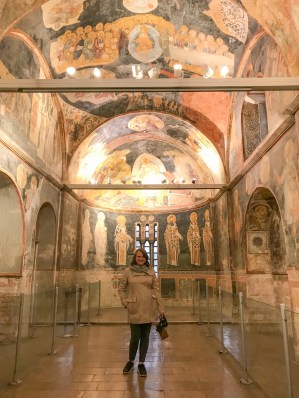
The one pictured above is called The Church of the Holy Saviour in Chora. It has the second most mosaics and frescoes from Byzantine era in Istanbul, and really there were very few which survived the Ottomans and the earthquakes.

I don’t mind telling you that I found this place utterly overwhelming.

IMG_6566I spent about an hour, mouth agape, head thrown back, in awe at these glorious images. The life and ministry of Jesus were tiled into the edifice with brilliant gold accenting.  There was also an area which presented the life of Mary.

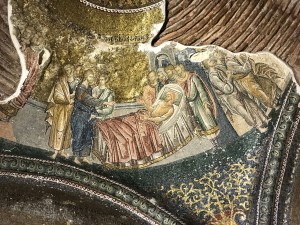
However, It was the frescoes which I found the most breathtaking.  The one pictured above is of the Anastasis, the Easter Theological term for the resurrection of Jesus and his. This chapel area is covered in depictions of Christ’s resurrection, second coming, the resurrection of the faithful and the final judgment.

What I love about this image is that Jesus has shattered chains surrounding his feet.  He grabs the wrists of Adam and Eve who are being wrenched from their burial coffins.

And their faces seem to suggest they surprised and actually a bit reluctant.

In the course of our journey through mosques and ruins and museums, it was a surprise to me to find Jesus, Adam, and Eve rising before me, chains broken, battle won, death defeated.  I plastered my eyes upwards; glued to the resurrected Christ moving heavenward with his beloved children.  The atmosphere in that church was glorious.  Even in ruins and buzzing with tourists you could feel the triumph of Christ over death.

It felt so much different than every other place we had been.

IMG_6543The etymology of the term Muslim is ‘one who submits’ which means Islamic Holy Places are designed to bring you down and inward. For example, even in the grandest mosques in Istanbul, there were low hanging lamps to make the room feel lower.  There is of course carpet so that kneeling for prayer is better facilitated. Every time we entered a mosque I was supposed to veil my head (which I did not mind at all), but it was another way to draw one inward.


There are many Christian places and traditions which capitalize on the idea of submission and conformity. It could be conformity to a worship style or monastic order or even the use of Scripture.

However, if in our conformity we are not moved to the hope of resurrection, then that conformity is not something that is from Jesus.  Jesus claims these beautifull life-giving things which surprised those around him.

Things like:

  • I am the Resurrection and the Life… John 11:25
  • The Lord has anointed me to proclaim Good News to the poor. Luke 4:19
  • Come to me, all you who are weary and burdened, and I will give you rest. Matthew 11:28

These sayings are designed to send the heart soaring, just like the frescos in the Chora Church.  In Christ, we have the hope of glory, the hope of salvation.

We hold a promise that the end is not the end, and that means we can hold our heads a little higher.

What Makes a Leader – A Response

This is a response to the political climate on Saturday, October 6th, 2018. 

A person may think their own ways are right, but the LORD weighs the heart.

Proverbs 21:2

It is quite timely that I have just emerged from a week-long vacation followed by a life-giving conference designed to empower leaders.  Otherwise, I might have been far too disenchanted to engage the past few weeks event. I sat down to blog today about both of these events and ended up saving those drafts to post later.

I strive to look at political events through the lens of a disciple of Jesus, but I can never shake implications that I am also a leader in the local church specifically with young people.  I am that particular kind of disciple. I work and vote and study because I love Jesus who has entrusted me with a ministry to young people.

And the tangled story of our new Supreme Court Justice took place in the years when he was a young person.   It took place with girls who are the same age as the students I work with. That’s heartwrenching for me, as I hope it is for many of us.

There is a lot that could be said about the dangers of a party lifestyle. It’s a culture that’s been around for decades if not centuries past. People party and people have taken parting to extremes since before Jesus. To be sure, sexual assault is not excessive partying; it is a crime, not a vice. Yet the two do frequently appear together.

I have been in ministry with teenagers, college students, and adults who have been a part of all sides of this culture.  People who were aggressors, alcoholics, victims, survivors, who all began with the intention of having a good time. People whose lifestyle forced them to recovery or counseling, and people who simply grew up and walked away.

I am not here to judge anyone.  The church isn’t here to judge anyone. The past is indeed the past, as are the tragic events of which our new Supreme Court Justice has been accused.  The events of the past do not matter in a court of law or to me as a Christian, but something else does matter: character.

The fact is, our culture has incredibly low standards for leadership.  We do not ask what kind of a person someone is, we only ask what they have done and what they will do. For some reason, we believe this is now a better or more reliable measure than character.

During the 2016 Presidential election, I remember the great argument from Christians who recognized Trump’s moral failings made excuses to continue to vote Republican because they wanted a conservative Supreme Court Justice appointed. They wanted particular action taken in the future, and I suppose they got what they wanted at the expense of character.

I also remember going into my high school girls Bible study the morning after the election.  One of my girls said something I still carry with me: “well, I don’t like that we have a bully for a president, but I guess that’s where we are.”

That moment crushed me.

We may never know if what happened at a drunken party in 1982; although, I personally think the assault likely.  But as terrible as it sounds the certainty of this event really does not matter as far as the nation is concerned.

What we do know and can know in 2018 is the character of our newest Justice.

He could have admitted to many things when being interrogated.  He was questioned about drinking, partying, and sexual encounters, and he admitted very little. Instead, when proof based questions were put to him, he frequently evaded them with a prideful and entitled attitude.  He misdirected Senators by pointing out to what he did in school, sports, church or volunteering.

He demonstrated none of the humility of someone acknowledging the wrongs of their past, or even the ability to believe he could be wrong. It is unfortunate that it had to come about in such a public spectacle, but the stakes are high therefore his character should have been higher.

Leadership is not only about what you did or did not do, neither should we choose our leaders solely based on what they say they will do and not do.

Good leadership is essentially a moral act; it stems from a person’s character.

Moreover, we must choose leaders based on their character because we do not know what the future holds.  A good leader is able to navigate through any unforeseen challenge because they have the internal compass and emotional skills to do so.  They do not railroad their will but synthesize their vision with the environment around them.

This is why God looks on the heart, even choose his leaders this way.  God does not want a leader who will do things only his or her own way.  I know many church leaders with difficult pasts. Today they are church leaders because they have character.  They are humble, honest, and open.  They have addressed the sins and pains of the past and do not use their record of accomplishments as an excuse or justification for anything.

I am a disciple of Jesus who has been given a ministry with young people. Today, nearly two years later, I wonder what that young girl from my old Bible study would say today.  I wonder how she would access the character of the man whose decisions will shape the country of her future.  I wonder what these leaders are teaching her.


Fighting for Good News

There’s nothing like the feeling of home. Recently, I was actually able to share my new house with my family from Raleigh, and really, it’s the people who make it feel like home. That is, unless you get into an argument.

Now, my family loves to argue, not fight, argue. Which can be a bit of an adjustment for anyone trying to spend time with us. Most of the time we keep things civil, and even when things get out of hand we always forgive each other. We’ve also learned to stay away from some topics, at least during holidays.

In Luke 4, Jesus returns home for his first big sermon in his hometown synagogue, and things turn into a fight pretty quickly. One has to assume, Jesus knew what he was getting into.

News has spread across the country about his preaching and healing, and when we pick up the story in verse 16 he his leading worship in his hometown. He is handed a scrolls and the passage says:

The scroll of the prophet Isaiah was given to him. He unrolled the scroll and found the place where it was written, “The Spirit of the Lord is upon me, because he has anointed me to proclaim good news to the poor. He has sent me to proclaim liberty to the captives and recovering of sight to the blind, to set at liberty those who are oppressed, to proclaim the year of the Lord’s favor.” And he rolled up the scroll and gave it back to the attendant and sat down. And the eyes of all in the synagogue were fixed on him. And he began to say to them, “Today this Scripture has been fulfilled in your hearing.””

‭‭Luke‬ ‭4:17-21‬ ‭ESV‬‬

I love the power behind this text, and I love the familiarity of a weekly worship service in which Jesus seems to be situated. At first, I tend to read my own Sunday morning church experience into the ancient Jewish synagogue setting. The people are gathered together in their customary fashion in the local place of worship, and this is a bit of a special service because Jesus has come home to preach.

However, Jesus is reading from a scroll, not a book as we do today. A book makes it quite easy to flip through pages and find a certain passage. It takes seconds to find chapter and verse compared to an ancient scroll. It is much easier to read a scroll in order, which is typically how scrolls are read in Ancient worship.

In fact, in modern Jewish worship the Torah is only read in order throughout the Jewish calendar year. The cantor or rabbi opens the Torah a little bit at a time sliding the parchment from one post to the other. These posts are called the eitz chaim or “trees of life.”

Now, The Scroll of Isaiah is not the Torah, but for him to have found a particular passage he would have to unravel yards and yards of parchment, and it would be quite cumbersome and unceremonious to do during worship.

Yet, it seems this is what Jesus does. He shows up like a big shot in his hometown and disrupts worship to read a well known messianic passage in front of people who have known him all his life. In no uncertain terms he tells them he is the messiah, the anointed one, for that is what messiah means.

Moreover, he shatters their idea of what the messiah should be because he doesn’t finish reading the passage in Isaiah! He stops mid-sentence deliberately subverting their expectations. Isaiah 61:2-3a reads:

…to proclaim the year of the Lord ‘s favor,

and the day of vengeance of our God;

to comfort all who mourn;

‭‭Isaiah‬ ‭61:2‬ ‭ESV‬‬

According to the hometown audience, Jesus forgot the best part of the passage. Isaiah 61 goes on to talk about comforting Israel and rebuilding after the exile. But Jesus stops short of this and does not mention “the day of vengeance.” The “Year of the Lord’s Favor” is not just favoring the Jews.

Rather, Jesus is sent by God to minister to the poor, the captive, the blind, and the oppressed. God’s favor extends to the marginalized not necessarily those who customarily go to worship each week.

Jesus’s ‘sermon’ in Luke reinforces this point, and his hometown is so enraged that they try to kill him.

This passage is easily one of my favorites and one of the most difficult for us regular worshipers to cope with. Most days, I believe I’m entitled to the Lord’s favor, and, to be honest, these days I really do feel favored.

The issues arise when we forget that God’s favor should be good news to those on the fringes of society. It should be good news to those who are poor and oppressed. And, it should be good news to those who may not be sitting in church on Sunday. Who might not be in our group.

I pray that my selfishness would not hinder the proclamation of the Messiah’s gospel to reach the captive, oppressed, and broken in order to bring them into the light.

Fishing for Fish

Photo by Michael Yero on Unsplash

Do you ever wonder why Jesus does thing the way he does things? I mean, are you ever reading scripture, and do you ever stop and ask the question “why did it happen this way rather than any other possible way?”

In Matthew 17:24-27, Jesus and the disciples’ travels once again bring them back to Capernaum, that fishing village on the Sea of Gellelie which is the hometown of the disciple Matthew and close to another fishing village of Bethsaida, hometown to Peter, Andrew, James, and John.  Early in the Book of Matthew, Jesus began his public ministry here preaching and performing miracles.

Now that Jesus is back in town he again draws the attention of tax collectors:

24 After Jesus and his disciples arrived in Capernaum, the collectors of the two-drachma temple tax came to Peter and asked, “Doesn’t your teacher pay the temple tax?” 25 “Yes, he does,” he replied. When Peter came into the house, Jesus was the first to speak. “What do you think, Simon?” he asked. “From whom do the kings of the earth collect duty and taxes—from their own children or from others?” 26 “From others,” Peter answered.  “Then the children are exempt,” Jesus said to him. 27 “But so that we may not cause offense, go to the lake and throw out your line. Take the first fish you catch; open its mouth and you will find a four-drachma coin. Take it and give it to them for my tax and yours.”

These guys seem really preoccupied with money in this passage, but it should be noted that the tax wasn’t too steep, only about two days wages.  Yet, for Peter and the rest of the disciples, who had quit their regular jobs to wander from town-to-town following a would-be-messiah, any amount of money was a lot of money.

When these religious tax collectors sought them out and accused Jesus of not paying-up, they essentially accused all of them of being irreligious, of having no faith, of dishonoring God.  That probably didn’t sit well with Peter, but he stands resolute insisting that Jesus does pay the Temple tax (although, hadn’t yet?).

Once Jesus comes back from wherever he was, he begins to ask Peter questions. We can gather from the conversation that Jesus does not believe that either himself or the rest of his disciples need pay this temple tax. This rag-tag group has been wanding from around for months living off of the good graces of God and others.  For Jesus, the Son of God, to pay a tax to God does indeed seem ludicrous for those who understand.

However, the real teachable moment comes when Jesus says  “but so that we might not cause offense…” Jesus understands that two-drachma is not something to get worked up over.  Jesus does not actually want to get into an argument over principle. The Son of God exercises wisdom and illustrates to his disciples the importance of choosing which battles to fight. Even though the money should not need to be paid, the money is still going to a good cause  The situation is foolish but harmless.

Moreover, Jesus crafts this whimsical miracle for a specific purpose as well! Peter is a poor out of work fisherman who cannot himself pay the temple tax, and he cannot pay the fee because he has spent all of his working days following Jesus in discipleship.  If Jesus had never called him away from his nets, then Peter would likely not be in this situation.  He would have been able to pay.

Now, Jesus could have conjured up the necessary coins from behind Peter’s ear to pay the tax.  I’ve seen people do this all the time today, and it would have been much more straightforward.

But Jesus, exercising even greater wisdom, sends Peter fishing.  He sends him to make money using the skills Peter knows best. He sends him back, just for a moment, to be a fisher of fish.

In this way,  Peter’s dignity is fortified  He provides for both Jesus and himself using the skills he’d practiced his whole life.  For months, Jesus had been teaching Peter how to fish for people, but for one afternoon, Peter served God’s Kingdom another time by merely fishing for fish.

I pray these two friends enjoyed this silly but wise moment together, and I hope Peter cherished Jesus’s request for him to again fish for fish.  Maybe someday, each of us may use our expertise in just such a humorous way.

God of the Whirlwind

Recently, I was trying to imagine what it would be like if I were in the boat with the rest of Jesus’s disciples when he walked on water.

In the story, you do get several words that suggest it was quite a frightening experience. For one it says the disciples were “afraid,” and for another, it says the disciples thought they “saw a ghost.” It seems they were so scared they were crying out. They were screaming.

This story is a curious one because, to be frank, it seems like Jesus is showing off. With Jesus’s other miracles there appears to be a better reason. Most miracles are usually about helping people like healing the sick or feeding of the 5000.

When Jesus walks on water, it seems like a fancy way to get from Point A to Point B. Is it just that the son of God is trying to impress his friends?

Maybe that is not how you feel about it. But I was trying to imagine how the disciples felt after Jesus climbed into the boat and said that their feelings of terror were a result of “little faith.” When I try to imagine the disciples’ feelings, I recall the most terrifying moment of my life. It happened just last fall traveling home from a wedding in North Carolina mountains.

William had finally agreed to let me drive on our five-hour road trip home. As he was dozing in the passenger seat, suddenly, out of nowhere an old black Jeep launched itself into oncoming traffic just a few cars ahead on the interstate.

I watched the jeep slam into the vehicles ahead of me, and I began to pump my brakes and lay on my horn. I didn’t want anybody to hit me from behind as I started to dodge shredded pieces of car and chunks of bumpers.

By the grace of God, no one was hurt. We found out after that the woman driving the Jeep was high and drove onto the interstate the wrong way from the offramp totaling several cars.

That moment was laced with adrenaline and high with emotion. The moment after was defined by a massive emotional crash which had me on edge for the rest of the day. When I read that the disciples were so terrified they were crying out, I don’t think we should not take those words lightly.

When Jesus walks on water towards his disciples across the sea of Galilee, it is a moment of terrifying power, and it is remarkable that amid the fear, the waves, and the night, Peter should even fathom to say the words ‘if it is you Lord call me out upon the waters.’

What sort of faith is this? And what kind of confidence does Jesus require of us that he calls even Peter’s actions “little”?

Finally, what kind of God is this? This Jesus of power and glory who walks on water?

Honestly, I don’t know for sure, but I do wonder if what Jesus meant by the term “little.” For example, did he mean little as in small and in impressive or did he mean little as in childlike and endearing.

The Biblical text is again void of details, but for the first time I think Jesus was actually being loving in thing moment.

As we enjoy the peace and blessings of discipleship, we should never forget the glory and power of our God. This God who walks on water, who can conjuring up real fear and trembling, will also extend a hand to us and invite us on the water too.

Finally, we may also need go be reminded that our faith, however gallant, will always pale in comparison to the grace offered to us in Jesus Christ.

Hidden in Plain Sight

“He told them another parable: “The kingdom of heaven is like a mustard seed, which a man took and planted in his field. Though it is the smallest of all seeds, yet when it grows, it is the largest of garden plants and becomes a tree, so that the birds come and perch in its branches.” He told them still another parable: “The kingdom of heaven is like yeast that a woman took and mixed into about sixty pounds of flour until it was worked all through the dough.”

Jesus spoke all these things to the crowd in parables; he did not say anything to them without using a parable. So was fulfilled what was spoken through the prophet: “I will open my mouth in parables, I will utter things hidden since the creation of the world.””

‭‭- Matthew‬ ‭13:31-35‬ ‭NIV‬‬

In Matthew’s gospel, the parable of the mustard seed and the parable of the yeast are set right beside each other. I was reading these two passages earlier trying to compare them and find a few points a similarity. Of course, there is one big point of similarity if you think about it.

For most modern readers, the biggest point of similarity is that we really don’t have a lot of interaction with either mustard seeds or yeast. I have, in fact, never used yeast. Also, the spice set I received as a wedding gift actually came with mustard seeds, and I have never used them.

But I’ve been affected by yeast and mustard seeds. I’ve eaten bread and, though I am not a nesting bird, I have enjoyed mustard.

Now, there are people that interact with yeast and mustard. One such person in my brother.

At our last social gathering, my brother brought scratch made yeast rolls and cinnamon rolls which he baked fresh in my oven and presented to all the guests. The result was delicious. However, he’s pretty much the only person I know who works with yeast, and even he only does this on special occasions.

Most of the time we all just buy bread. We just experience the satisfying finished product. We never see the process.

Even in the ancient world, if you were not the baker then you likely did not see the yeast working with your own eyes.

As far as mustard seeds go, honestly, I don’t know anyone who grows mustard plants. Although, I’m sure these people do exist. From what I understand about mustard plants, most gardeners consider them an unruly plant, a weed if you will. And from what I understand about weeds, if the gardener in the story had caught sight of the sprout earlier then the would have probably pulled it out by the root.

You see, in these stories both the yeast and seed spread quickly, rise without much notice, and, in a short amount of time, mature enough to satisfy the needs of God’s creatures. They provide habitat for birds and sustenance for people.

For those who don’t pay attention, you will never see yeast at work. You will never see it warm and grow. You will never realize that bread is a miracle.

For those who don’t keep an eye on their garden, you will never notice the mustard plant at work. Although, if you did see it you might even mistake the plant for a nuisance.

God hides the work of the Kingdom from those who would not appreciate it. Jesus speaks in parables to hide the mysteries of God in plain sight.

If you’re watching closely you can see the new Kingdom of God springing up all around you. Like a weed growing in your own garden, it just cannot be stomped out. Like yeast baked into your own meal, it rises up bringing the whole world with it.

I pray Jesus gives us eyes to see this new Kingdom and hands to till the soil and strength the kneed the bread so that one day all needs might be satisfied. Amen.

Marriage Update

I really like being married. I feel like my schedule is indeed hectic and frequently unpredictable. Being married means, for the most part, I am guaranteed at a least a little bit of time when my husband each day.

Lately, that time has been spent falling asleep rewatching one episode of Downton Abbey. (Well, I’m rewatching, it’s William’s first watch through.) This is not really quality time, but it is together time.

This week I was listening to a radio intewfoew from the author of a new book on Adam and Eve. I hav not read the book, and honestly probably won’t in the future, but the author has one of he most amazing philosophies about marriage that I have heard.

He says that the biggest difference between marriage and dating is that in marriage the default is always a win. When you’re dating, every bump in the road, every challenge brings to mind a moment of doubt. There is no covenant between you and your partner, so at any point one obstacle is allowed to be too great for you to overcome.

Ideally, marriage is the opposite. In a true covenant relationship any challenge, obstacle, argument, difference, or down-right fight should have a predetermined conclusion. However long it takes, however upset you have become, however dark the night there is always the promise that your love will win the day.

I love my husband, and I would never have married him if I thought there was any shimmer of doubt that we could overcome anything together. I would never have married him if I wasn’t willing to commit to work through all of our issues and challenges.

I hope most people enter into marriage with that mindset. But we are all human.

I love this idea of marriage because I believe it is a beautiful example of the gospel. For those of us who follow Jesus, we can enter into any dark and desperate situation with the hope and assurance that death does not have the last word! We don’t have to fear the darkness because dawn comes in the morning.

And this covenant we have through Jesus is not humanly fallible. It is not subject to the sin and weaknesses of earthly hearts, but is ensured by the blessings of the Holy Spirit.

I really like being married, and this short message from the guy on the radio reminded me how wonderful a blessing and how crucial a responsibility it is to care for my marriage. And ya know what, I really like being a Christian. I love that ‘death has lost its sting.’ I love that I have the assurance of joy in the morning. I love that love wins no matter what.

Racism South of Atlanta

The last few days have been a wild and confusing ride for residence south of Atlanta. A few weeks ago it was announced that a white supremacist rally would be held in the city of Newnan, Georgia not far from where I currently work. I was in El Salvador when the announcement was made, and I remember the words of the 13-year-old girl who is a member of our mission team. “Why can’t they just leave us alone. “

I spoke with church leaders in the area, and they were asked by law enforcement to host police officers in their building but not get involved. Instead, they held a worship service counter to the protesters down the road.

Later in the evening, Neo-Nazi groups burned swastikas on a hill side in Temple, GA.

Then this week, on the heels of the rally, the Sons of the Confederacy organization pushed forward proclamations in the surrounding municipalities requesting a month dedicated to honoring Confederate History and Heritage. The timing of course could not be ignored but the language was worse. The proclamation, which you can read in the featured image, whitewashes the civil rights atrocities which led to the Civil War. It is also down right deceptive claimining that the confederacy waged war for “the preservation of liberty and freedom,” blatantly ignoring the fact that the liberty and freedom which was fought for by the Confederacy was ability to steal the liberty and freedom from African Slaves.

To those who would argue otherwise, it seems like it should go without saying that The Georgian Declaration of Succession lists the following as their chief grievances:

The prohibition of slavery in the Territories, hostility to it everywhere, the equality of the black and white races, disregard of all constitutional guarantees in its favor.

In addition they list the North’s failure “to surrender fugitives from labor,” and the issue that a “ [slave-holding] citizen cannot travel the highway with his servant who may voluntarily accompany him, without being declared by law a felon and being subjected to infamous punishments.”

Although the Declaration of Succession was full of reference to slavery, the Proclamation of Confederate History and Heritage made no mention.

In Griffin Georgia on March 27, the proclamation was passed in a shameful display. During the debate, former Commissioner Larry Johnson used the n-word several times with only censure and objection from the one person, one of the two current Black commissioners, Rodney McCord.

This incident is all the more frustrating because the city of Griffin has been the location for IMPACT, the youth mission week hosted by Square Foot Ministries. The youth of Fayetteville First UMC have developed a heart for the community of Griffin through this mission program.

Yesterday, the proclamation came to in Fayette County. When the document was released the names of the four white county commissioners were listed, intentionally excluding the only Black commissioner.

To be honest, I did the bare minimum to stand up to this injustice. I sent a few emails made a few posts on social media and went to a rally. But I was thankful for the opportunity to do even this little.

As a youth minister, I fear that I might be criticized for my activism. However, the lens of all my ethical choices is shaped by what I believe would benefit the younger generation the most. I tell my boss all the time, and I am intentionally biased towards the interest and spiritual development of young people inside and outside our congregation.

A 2016 Newsweek article surveyed over 700 teenagers with the following result:

The most compelling findings show that race and discrimination are crucial issues for teens today. In 1966, 44 percent of American teens thought racial discrimination would be a problem for their generation. Now nearly twice as many—82 percent—feel the same way. The outlook is more alarming among black teens: Ninety-one percent think discrimination is here to stay, up from 33 percent in 1966.

It is indeed an older generation’s mentality to allow language such as that featured in this proclamation to continue. No generation is a monolith, no generation speaks with a single voice. However, I could not in good conscience teach our students on Wednesday about the love of Christ and doing what’s right if I do not live the gospel on Tuesday when it was so easy for me to do so.

How am I to tell a student to resist peer pressure if I do not resist the peer pressure of racism? How am I to tell a student to reach out to the unloved at school if I do not stand with persons of color humiliated by local laws? How am I to tell a student to love God if I am unwilling to love God’s people?

Some have thrown up their hands in disappointment that this was a political exercise and no place for the church. However, I cannot think of a worse fate for the church or a more unappealing institution for young people, if the church ceased to be of consequence in advocating for love, unity, and justice.