
Meeting Great Grandma

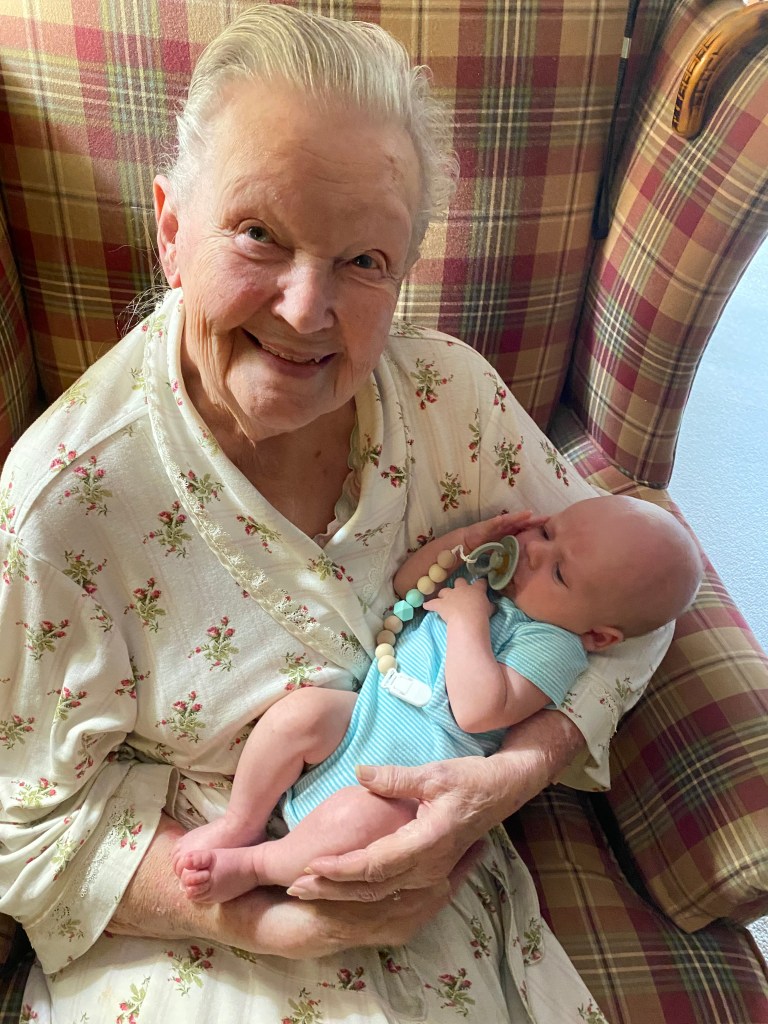
A couple of weeks ago, we took Baby Jonah to meet his great-grandmother for the first time. Dorothy Newkirk is 92 years young and lives not far from us.

Like many seniors, she lives alone, and like many seniors, she occasionally struggles with her memory.

We volunteered to deliver her weekly groceries and bring the baby along for a short visit. While there, William did a few chores, and I hung out with her while she held the baby.

Curious, the ways aging affects our memory. On her kitchen table, she had displayed a list of great-grandchildren’s names. She was so happy to meet Baby Jonah, but she kept asking the same questions over and over.

She asked me, “Is he a good baby?” serval times. She also volunteered more than once that her son, Williams’ father, was a good baby, but that her daughter cried frequently.

“Is he a good baby?” She would ask. “By that, I mean, does he sleep well at night? Does he cry a lot?”

“Lyle loved babies.” She said over and over. She told me several times that if it were up to her late husband, they would have had a baby every year and a half.

I could see waves of joy and nostalgia pass over her as she revisited, again and again, these thoughts. Her son was a “good baby.” Her daughter cried a lot. Her husband loved babies and wanted more children, at least once every year and a half.

Some people might feel frustrated that she would repeat herself, and maybe if we’d been there all day, it would have bothered us. But at the moment, it felt like her repeated words served as a chorus, reminding me what was important.

It hit home when she would laughingly say, “I bet you don’t get anything done at home. Don’t worry about all that. Just enjoy it.”

I went home, turning this comment over in my mind. ‘You won’t get anything done…don’t worry, just enjoy it.’ I wasn’t sure if I should agree or disagree. Of course, I’m not getting much done! Caring for an infant takes up so much time. I don’t have time for much else.

On the other hand, you wouldn’t believe the amount of stuff I get done. I’m caring for a tiny human being, and he requires endless hours of feeding, changing, bathing, holding, and play. And this tiny human being will become a full grown adult with his own personality and responsibilities.

Regardless, the repetition of these few comments made them sink deeper into my heart. Repetition is used frequently by God in the Bible to underscore the importance of a message and prompt careful reflection.

In 1 Kings 19:11-18, God asks the prophet Elijah multiple times “what are you doing here?”

In John 21, Jesus asks Peter multiple times, “do you love me?”

And each Sunday morning, we act, called on the repetition of the Apostles Creed and the Lord’s Prayer.

My life has changed radically over the last few months, which I expected. But I didn’t expect everyone else’s life to change radically too. I have found some comfort in the repetition of small things: that first-morning playtime, the end of day bath, the meal I share with my husband just after we put Jonah to bed. There is meaning in the repetition. There are lessons in the redundancy.

These are certainly not exciting times, but there is certainly something we can learn. Our lives today are unique, and I’m trying to learn what God would teach me from life’s current rhythm. I hope you have your eyes and ears open to lean something from God too.

On The Night You Were Born

The night you were born was exactly three years after your dad and I were married. Before the doctors came in to deliver you, I passed your dad an anniversary card.

I suppose you were the gift.

When we first met, you were red, splotchy, and screaming. It was an interesting first impression.

That evening they brought you back into our room after the doctors checked you out. They rolled you into the room while we were finally eating dinner. They told us your results look good, and then the nurses left. We were alone with you for the first time.

At this point, it occurred to me that we had no idea what we were doing.

And then you began to cry.

Still numb and sore from delivery, I couldn’t move to help while your father sprang into action. He changed your first diaper.

It was late, and we tried to get some sleep. We wheeled your cart between my bed and the sofa where your father was sleeping. You both drifted off, but I stayed awake looking at you and imagining what this would be like.

I decided that parenting would be like a pilgrimaged. It would be a long journey with high mountains to conquer and low valleys to enjoy. There would be a lot of surprises along the way, and there’s no chance of us anticipating every little thing.

But, like a pilgrimage, it would be a long experience. We will learn a lot, and there will be plenty of joys and sorrows along the way.

So along this journey we promise you a few things:

When you are happy, we will be happy for you. When you are hurt, we will mourn.

When you fall, we will help you get back up and help you learn how to walk again.

When you’re lost, we will come find you. When you wander off the path, we will wait for you. When you mess up, we will forgive you. When you triumph, we will celebrate you.

We will teach the things you need to know, and even somethings we just like teaching.

We will surround you with other pilgrims, family and friends, to support and cherish you. Some will stay with you the whole journey and some just for a few miles.

We will provide you with everything you need, somethings you simply want, and a few things you don’t want but should have anyway.

We will be a soft place to rest, but never a place to become complacent. We will encourage you, empower you, and find things that inspire you.

We will show you how much we love each other, so you understand how much we love you.

And we will raise you up in the faith, giving you a head start on the journey God has planned especially for you.

After a while, you began to cry. Again, your father got up to change you. Then I nursed you.

Jonah, we love you. We look forward to this journey with you. Thank you for making us parents.

Curfew & Quarantine

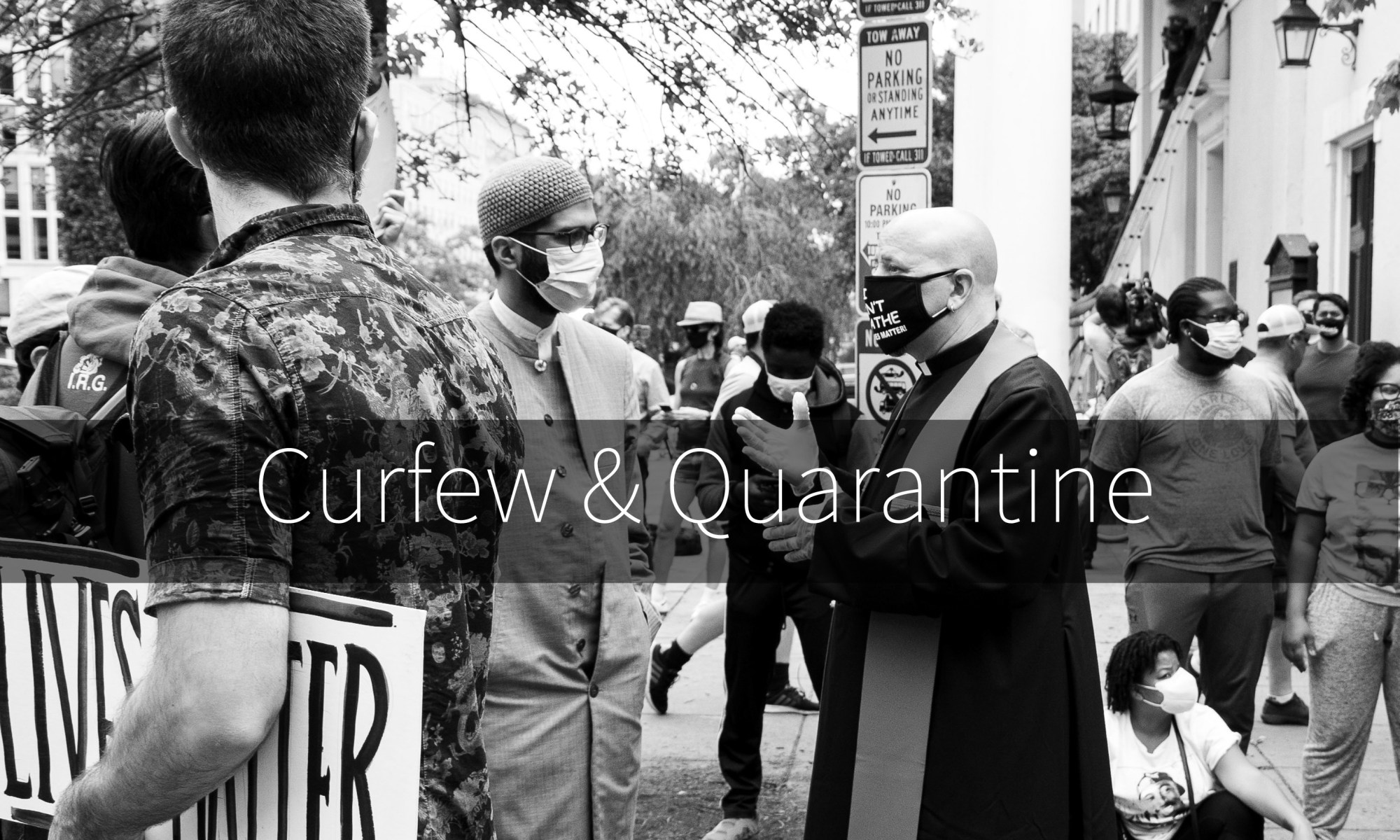
Black Lives Matter Protest in DC, 6/2/2020. (Instagram: @koshuphotography)

On Saturday morning, William and I completed our online Zoom birthing class. In addition to all of the standard information, we were also informed about all the COVID-19 protocol. By the end of the course, I started feeling the pressure to get everything in order, especially packing our hospital bag.

One implication of COVID is that food options are limited at hospitals now. Vending machines carry germs, and the gifts shops are closed. So we were advised to pack a lot more snack options. I also needed a baby thermometer and some postpartum supplies. I don’t get out much, usually just the doctor’s office, but I decided to mask up and head to Target, where I could get everything on my list.

Not long after I arrived, an announcement came on telling us Target would be closed in 30 minutes. It was only a little after 6 pm, but I thought maybe this was some new COVID protocol to clean the store. While I was there, three more announcements came on urgently, telling us to leave the store. While I grabbed my last snack items at the back of the store, I had three associates urge me to go to the front. There, every register was opened to rush people out the door. That’s when I realized they were preparing for protesters. This was the first night of curfew, and I wouldn’t get the push notification from the government for a few more hours.

But there I was standing in line, crazy pregnant, mask on, and now being rushed out the door by security, associates and police and told to head home.

For a brief moment, I felt sorry for myself. Looking around at the craziness, the scene was dystopian, borderline apocalyptic. I was mad that I couldn’t have a normal pregnancy. I have been practically homebound for months to keep my baby safe from COVID. Then, the first time I dare go out to get supplies for the hospital and postpartum, I’m rushed out the door in a panic.

For a brief moment, I felt sorry for myself.

But then I started to think about all the ways I need to prepare to raise and to teach my child, not just feed and clothe him. The protests are a reminder to me that hatred and bigotry are not learned. Racism is taught and often legislated. It’s a choice.

But apathy and ignorance are also a choice. White people can choose to raise their kids away from issues of race and justice because they have that option. People of color do not.

I have been very encouraged by the number of my former students who have been taking part in peaceful protesting and educating themselves on civil rights issues. I have also begun to think about how I will raise my son to be engaged in matters of social and racial justice. I am thankful there are resources available for kids of a young age. I am also grateful that I have a partner who is dedicated to these issues as well.

Quarantine and curfew have not been ideal. I’ve had fewer opportunities to buy cute onesies and satisfy pregnancy cravings. But I have a lifetime opportunity to raise a child in the faith of Jesus, full of compassion and justice, who sees everyone as a child of God with sacred worth. I pray for the man he will become, and I am thankful for the opportunity.

Resources for Educating Children on Racial Justice from The UMC Publishing House

Praying for a Child

“For this child I prayed; and the Lord has granted me the petition that I made to him.
‭‭1 Samuel‬ ‭1:27-28‬ ‭NRSV‬‬

A few weeks ago, I was blessed to celebrate our growing family through the wonder that is modern technology. Because gathering in person is not considered safe, my mother and friends hosted a virtual baby shower on Zoom.

It worked quite well! Though I had been looking forward to all the dainty hors d’oeuvres, which tend to be found at traditional showers, it was beautiful to see so many smiling faces from all over the country.

I was most blessed by the prayers and well wishes offered by each person who called in.

Towards the end of the weekend, I received a last-minute gift that didn’t make it to the actual party. It is a hand-lettered Bible verse preserved in a simple frame. The passage is from 1 Samuel, and the speaker is a woman named Hannah, mother to the prophet Samuel.

Many women in the Old Testament struggled to conceive children, as many still do today. But what was unique in Hannah’s situation is the kind of fervent prayer she offers to God in petitioning for her child.

Hannah’s is the first instance in scripture in which someone prays silently. It was such an unusual phenomenon at the time that the priest nearby thinks she is out of her mind drunk.

Hannah understands, in a way no one before she had understood, that God is big enough to hear unspoken prayers. She is so earnest and anxious in her petition that the sound of her voice fails, and she simply pours out her soul to God.

It is her concern for her child that drives her. And though my unborn child has been prayed for, I look forward to all the ways that he will be prayed for throughout his life.

Prayers for children, either with a child born or unborn, grown or half-grown, adopted or even not yet convinced, seem to be characterized by the same earnestness and anxiousness found in Hannah’s prayer. A parent’s heart cares so deeply.

God, our Father, cares so deeply. Though we might not always audibly hear his voice, his desire is for us and our wellbeing, like any good parent.

Hannah thanked God for answering her prayer. And today, I thank Hannah for showing me how to pray.

A Prayer for an Unusual Easter

Easter is not how we imagined it this year. It’s not how we usually do things. But, Lord, you have mercy for all of us just the same. You have joy for us just the same. You have glory for us just the same.

For those who have kept the fast this season, for those who have lapsed, and for those who have given up more than they ever expected, Lord, we thank you.

For those who put that extra effort to make things seem a little more normal, a little more cheerful, a little more beautiful, Lord, we thank you.

For those who dress in their Sunday best and gather the family around to stream the Easter service, Lord, we thank you.

For those who stay in their pajamas and sing hymns in front of their computer screens, Lord, we thank you.

For those who are tired and reluctant to celebrate the resurrection while still feeling trapped in the tomb of isolation, Lord, we thank you.

For those who have brightened this world with chalk drawings, encouraging posters, contactless gifts, and parades, Lord, we thank you.

For those whose fingers are tired from sewing masks, hands are fatigued from writing letters, and arms are exhausted from the lack of hugs, Lord, we thank you.

For those who have worked to supply, feed, treat, serve, and protect the rest of us, Lord, we thank you.

For those on the front lines of healing this terrible virus, who are risking their life and health to keep people alive, Lord, we thank you.

For every other day of this challenge, we come to you with prayers we desperately need to be answered, with hurts than need healing, with anxiety that needs soothing. But today, Lord, we come to you to give thanks for what you have done on the cross for us, and what you are already doing in this world for us.

For in your sacrifice we have victory! In your triumph we have life! Death, which lurks around every corner, has lost its sting on this day, and we can now taste eternity.

Christ is risen, and the angels rejoice! Christ is risen, and life reigns! Christ is risen, and not one dead remains in a tomb!

We give thanks, and we celebrate that you walked out of that tomb. And we know, dear Lord, that we, too, will walk out of this and every tomb that comes our way.

Amen.

Living in the Labyrinth – Honest Thoughts on Quarantine Life

I don’t have to tell you that the last week and a half has been rather extraordinary. It’s not every generation that a crisis disrupts the entire human population. Like many others, I am now homebound, leaving the house only to walk the dog and occasionally go to the grocery store. My calendar full of ministry and social events has dwindled to nearly nothing.

Making things worse, the news is full of alarmist predictions and panicked uncertainty. There is a delicate balance to be struck between being informed and being overwhelmed.

Making things more confusing social media seems overburdened with opinions of all sorts, voices shouting to be heard over one another. I’ve seen many people jump at the chance to offer encouraging words and distracting activities. The occasional positive anecdote punctuates the opinionated post. I have started to think that sifting through for the cheerful stories isn’t worth the effort.

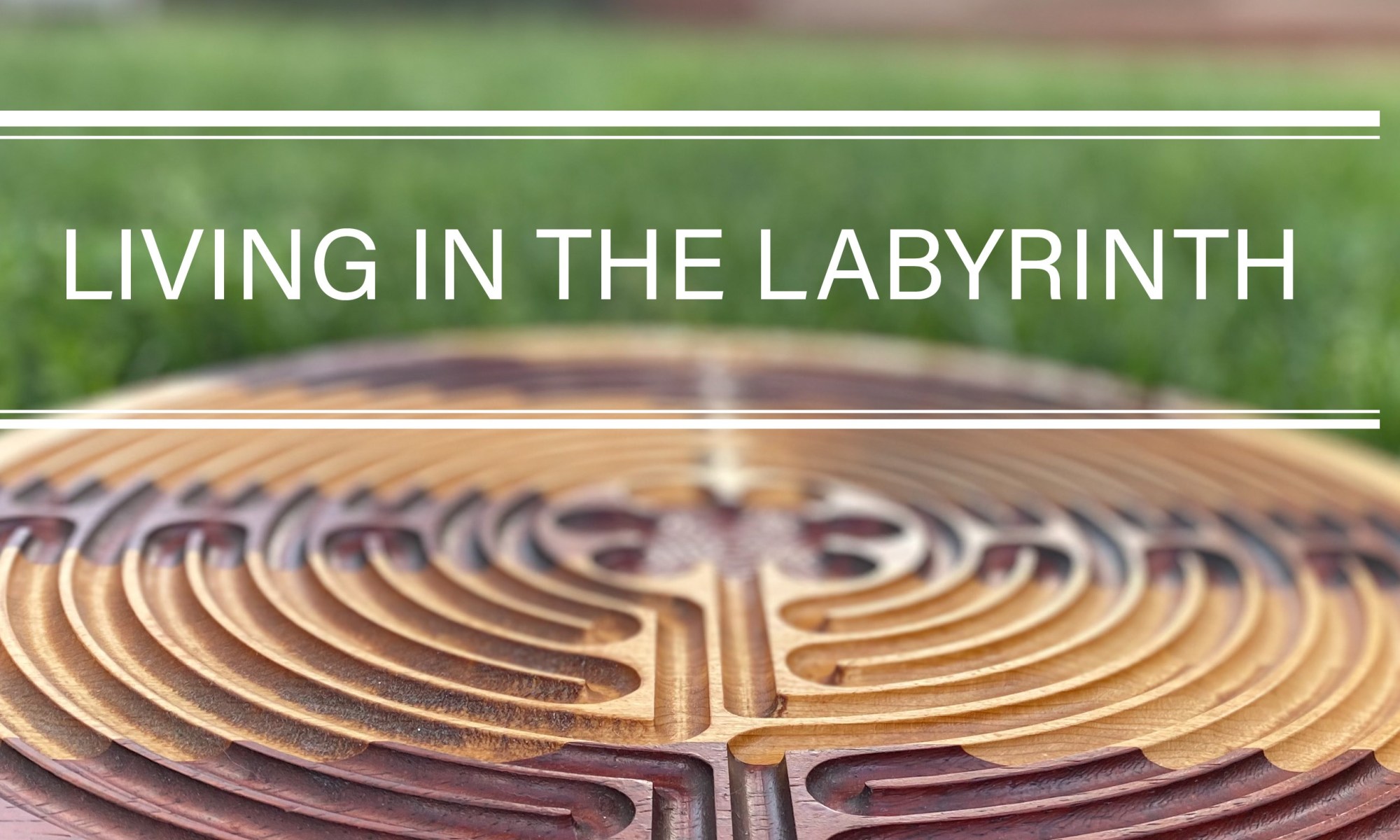
A week ago, we received in the mail a wooden finger labyrinth made by talented woodworking, pastor friend of Williams. I was thrilled by the surprise gift, and it got me thinking that lately, my life feels a lot more like a labyrinth.

A labyrinth, unlike a maze, has only a single path you can follow. There are no false paths or dead ends, and there are only one entrance and exit.

Like a labyrinth, I begin and end my day in the same place. I only navigate the relatively small area of my home, weaving back and forth from room to room. I have just a few tasks to do and a lot of time in which to do them, which leaves a lot of time for thinking.

Sometimes these thoughts are positive and optimistic. Sometimes my thoughts are of thanksgiving for those on the frontlines of healthcare. Sometimes I am encouraged by the positive messages and creative encouragement from friends online.

However, I still feel the need to lament. I don’t want to get stuck in a place of darkness or hopelessness, but I want to be honest about my feelings and not just gloss over them with forced happiness.

But I am sad. I want permission to be sad, and I know others are sad too. There are brides that have postponed their weddings, seniors that have missed out on prom, new mothers who are not allowed visitors, churches that won’t have Easter egg hunts.

We all understand that these sacrifices are necessary to keep people safe. But they are still sacrifices, and they do hurt.

We need space to feel the hurt and loss caused by this crisis, and the labyrinth, either real or imagined, provides a limited space to lament. The labyrinth allows us to travel inward, in order to dwell on those things that are deep and meaningful. On the way in, we can spend in mourning what we have lost and acknowledged our feelings. We can speak our fears aloud to God, as petty and as foolish as they may seem.

We can spend some time on these things, but we’re not supposed to get stuck there. We have to move back out.

On the way out, we are encouraged to celebrate God’s goodness. We can begin to celebrate more time at home, the flowers of springtime, and the opportunity to learn and do new things.

If you need the space to mourn, extend yourself some grace. Embrace the labyrinth in which many of us now live. Be sad if you need to and let those around you be sad too. Then, when you’re done, take a breath and find your way back out again.

A Job Well Done

I studied religion in college, and one professor, in particular, was especially challenging. His tests were difficult, and his standards were high. Moreover, he was the most respected professor in the department.

His wisdom and dry wit gave him a certain Yoda-like quality. This impression was only enhanced by his age and a medical condition which made him dependent on a motorized scooter and microphone to teach.

In our class on John, we were assigned an exegesis paper as our final project. I immediately went to the library to get all the books I would need before the stacks were cleared out by my classmates.

I stuffed a dozen books in a sack, then proceeds to carry the sack around for a month, squeezing in reading and writing in every spare moment. I had never before worked so hard on an assignment, and I was incredibly anxious the day I turned it in.

A week or so later I visited my professors office to receive my final grade and look over my notes. I was elated to find a final grade of 98 scrolled in the corner of my well worn essay. But nothing compared to the smile he game me when he said the words ”Kena, your paper was splendid!”

That moment was a mix of relief, joy and pride. I left his office misty eyed, and I have often thought of his simple words and kind smile.

In Matthew, Jesus tells a similar story about servants of a rich man who were entrusted with gold to invest. Two of the servants were successful and received from the master loving praise: Well done, good and faithful servant!

Like the master in Jesus’s story, my professor’s words were powerful. The praise was not just critical because it was positive, but because it was earned through hard work and came from some with authority and great respect.

In our world of likes, upvotes, and comments, others are continually judging us. It’s difficult to sift through the voices and strive for the praise that matters, but it is so worth the challenge to hear words praise from someone who knows what they are talking about.

Are You Listening?

A few weeks ago, I had the pleasure of getting to know our confirmation on retreat to Saint Simons Island. It’s a long, wonderful weekend spent learning about spiritual gifts and bonding through team building.

I taught our young glass several new games and led them in writing their class creed. Each new session of recreation or education was, of course, met with enthusiasm and frequently a lot of extra chatter.

It’s a tradition for this group to have an intimate time of sharing at the end of the weekend, and for this retreat, that means taking turns talking about each other’s spiritual gifts. Adults and leaders participate too, and when it was my turn, one young girl said something very insightful.

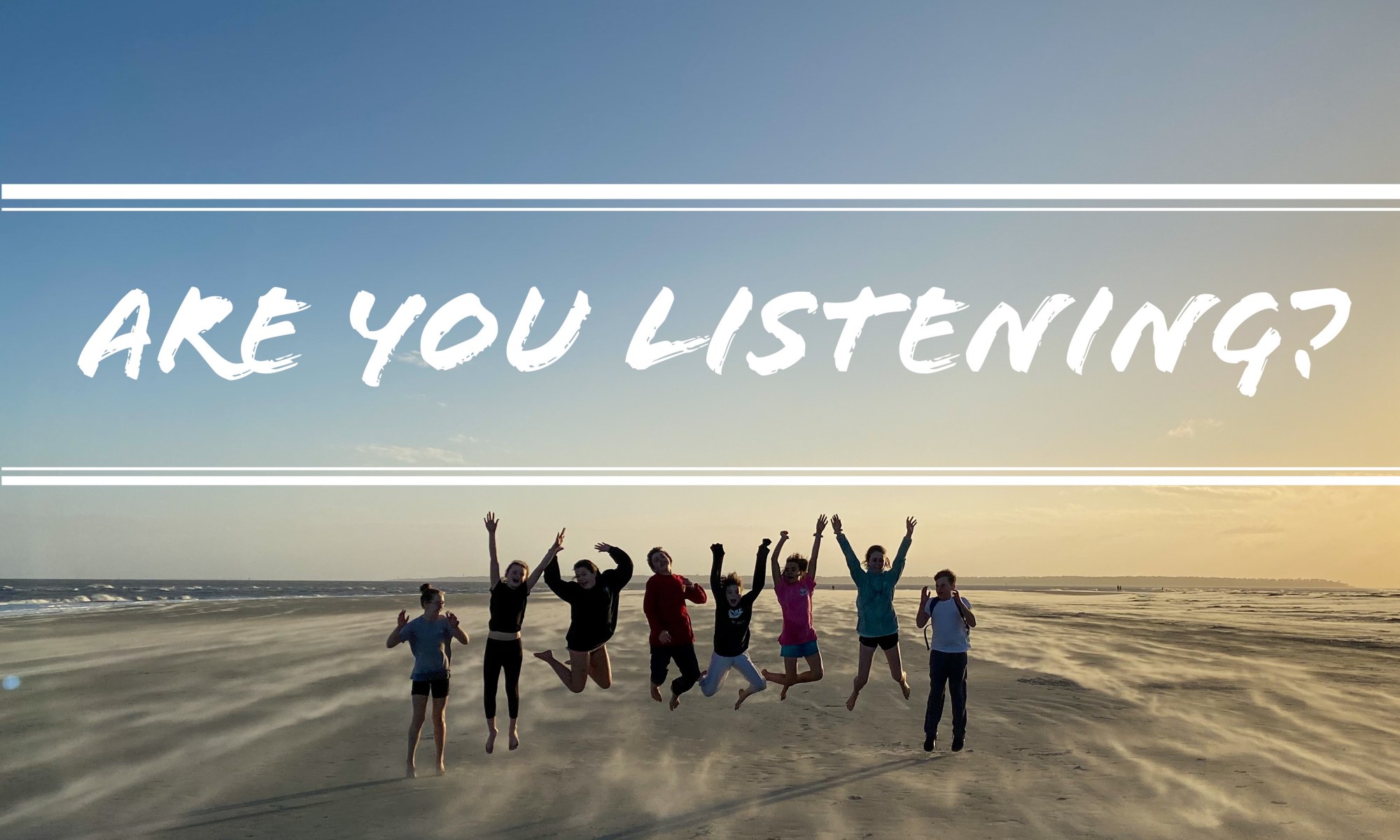
“I think you’re a good teacher, Kena, ” she said. “And I like how you say to us ’are you listening’ when your teaching because it makes me think ’am I listening?’ And then I think ’no, I’m not.’ So then I listen!”

I was both amused and amazed by the young girls honestly. Every teacher has a trick or phrase they use to get the room’s attention. Though I had only meant to use the phrase to quiet the rowdy bunch gently, it had sparked a brief moment of introspection for her, which I thought was rather interesting.

It’s funny when Jesus had one of those teacher phrases too. Over and over, he uses the phrase: If anyone has ears to hear, let him hear.

Mostly, when I read, I skip over that phrase. It sits as a kind of filler text before or after relevant teaching. But entering into this season of lent I am struck by my tendency not to listen. Not to listen to God and not to listen to other human beings.

Among other spiritual disciplines, I’ve decided to make that small question my internal refrain for the season on Lent. The phrase “are you listening?” will sit as a gentle reminder to be open to the things of God instead of preoccupied with my agenda.

I am thankful for my student’s reminder that we do indeed have ears to hear if we would simply quiet down.

Happy 100th to Prohibition

100 years ago, on January 17th, 1920, the 18th Amendment to the US Constitution went into effect prohibiting the sale and consumption of all “intoxicating beverages”

Prohibition was a fascinating experiment pointing to very different attitudes which are now a minority in our country today.

Alcohol abuse became chronic in this country towards in the 19th Century because of the increasing availability of high gravity liquor.

Prohibition began first as a religious than as a women’s rights movement. Many women lived in fear and in want because of the reckless behavior of their drinking husbands.

Interestingly, the women’s vote wouldn’t come until after prohibition.

One thing I find fascinating is that the process of federally implantation prohibition culminated in an actual constitutional amendment. The social change came through the protests, meetings, and arguments of prohibitionists convincing the voters and elected representatives to pass a new law.

Today, most social change seems to be pushed through the judicial branch, with special attention being placed on finagling the right judges to make decisions. 

The 13 years of prohibition would see the blossoming of organized crime, an abundance of government corruption, and, by the end, essentially the same amount of alcohol consumption.

The church in America, for the most part, stood on the “dry” side of the debate, signaling to the country that alcohol consumption of any kind was utterly immoral. Many Prohibitionists did indeed feel they were specifically called by God to destroy the institutions of alcohol in order to save people’s souls.

It seems strange today, when so much of the Biblical narrative, and the history of Christian worship, is oriented around alcohol. Jesus’ first miracle in The Book of John is not just to turn water into wine, but to provide good quality wine to people who were already wasted.

To be sure, there are also lessons and warnings in the Bible against the overindulgence in festive beverages, specifically as it manifests as habitual drunkenness. Also, there are still Christian groups who are staunchly anti-drinking. I myself went to a Baptist university which was a ”dry campus.”

However, I believe there is a lesson to be learned in the experiment of prohibition for the church today.

I believe the church should be cautious of drawing a hard line in the sand on moral issues. When we as believers take a hard stance we tend to excommunicate anyone who does not toe the line. There are hard lines we should observe, but they still must be approached with a healthy dose of humility, with an eye towards the actions and teachings of Jesus.

Jesus was constantly confronted by religious authorities who chastised him for not taking a hard line. Healing on the sabbath, eating with sinners, even consorting with foreigners were all hard lines that Jesus crossed for the good of the Kingdom.

The church has indeed changed. I serve a congregation with a highly active AA program which also hosts several Bible studies at a growler shop. I’ve also been to more that one church service that meets in a bar.

Overall, I would advise any Christian to be wary of feeling morally superior when so much of our world is not black and white, but shades of gray.


On the subject of amendments, as recently as January 15th, Virginia became the 38th state to ratify the Equal Rights Amendment guaranteeing  women and men equal protection and treatment under the law. The vote gave the amendmentenough state support to have become law had the deadline not expired in 1982.

Why Jesus was Really Born in Bethlehem

Ok, so I don’t actually know the real reason that Jesus was born in Bethlehem. But it’s a part of the Christmas story I think is worth exploring because the reason given in scripture is historically problematic.

Let’s take a look at the text in question from Luke 2:

In those days Caesar Augustus issued a decree that a census should be taken of the entire Roman world. (This was the first census that took place while Quirinius was governor of Syria.) And everyone went to their own town to register. So Joseph also went up from the town of Nazareth in Galilee to Judea, to Bethlehem the town of David, because he belonged to the house and line of David. 

So here’s the good news, there IS historical evidence of a census taking place. According to the 2nd Century history Josephus, in 6 CE Herod Archelaus, a puppet king in Judea, was ousted and Quirinius was made governer for the new consolidated province of Judea. As the newly appointed governor, he was assigned to carry out a tax census.

However, there are some problems with Luke’s account.  It was not a “census of the entire Roman world,” as the text would suggest. The Romans were pretty good record keepers, and, as far as records show, that kind of census really didn’t happen.

Luke 1:5 places the pregnancy of Mary and her cousin Elizabeth under the reign of Herod the Great. Herod the Great’s reign ended in 4 CE, two years before the alleged census took place. Matthew 2:1 also places the location of Jesus’ birth in Bethlehem under the reign of Herod the Great.

Some people chalk this up to a historical misrepresentation or mistake in the Bible. The coming Messiah needed to be born in Bethlehem to confirm the prophecy of Micah 5:2. The census might be an attempt to explain why a man who grew up in Nazareth was actually born Bethlehem.

And maybe he was actually born in Nazareth. That is mostly likely.

But I wonder if there is another reason that Mary, an unwed pregnant woman, might find it a good idea to take some time away from her hometown.

I would imagine that, as Mary began to show the people in Nazareth would have begun to talk. It might have been a welcome change for the Holy Family to go away for a while, somewhere new, somewhere not many people would know them.

It might have even been a reprieve to retreat to the relative privacy of the barn outback. At least the only prying eyes would be animals, and they probably wouldn’t be very judgemental.

A lot of the Nativity story has been characterized as a hardship for Mary and Joseph. The requirement to travel, the location of birth in a barn, but I do wonder how much of a retreat it would have been to a woman living as a cultural pariah to be alone in a new land with God.

Learn more about the historicity of the Nativity story here.