Eden People – The Magi of Epiphany

In the beginning, God created the heavens, the earth, and a garden somewhere in the East. Genesis 2 tells us the garden of Eden, the original heaven on earth, was established in the East.

Now in the book of Matthew, we have mysterious, wise men hailing from the
East. They worship a single God, believe in a coming Messiah, and look forward to a reordering of this world where good triumphs over evil. Unlike the priests and leaders hanging out in Jerusalem, these men are not beholden to the power and brutality of worldly leaders. These men move through this world confidently, seeking truth, following a star across the night sky like Israel once followed a pillar of fire through the wilderness. Their faith is strong, and their expectations are high.

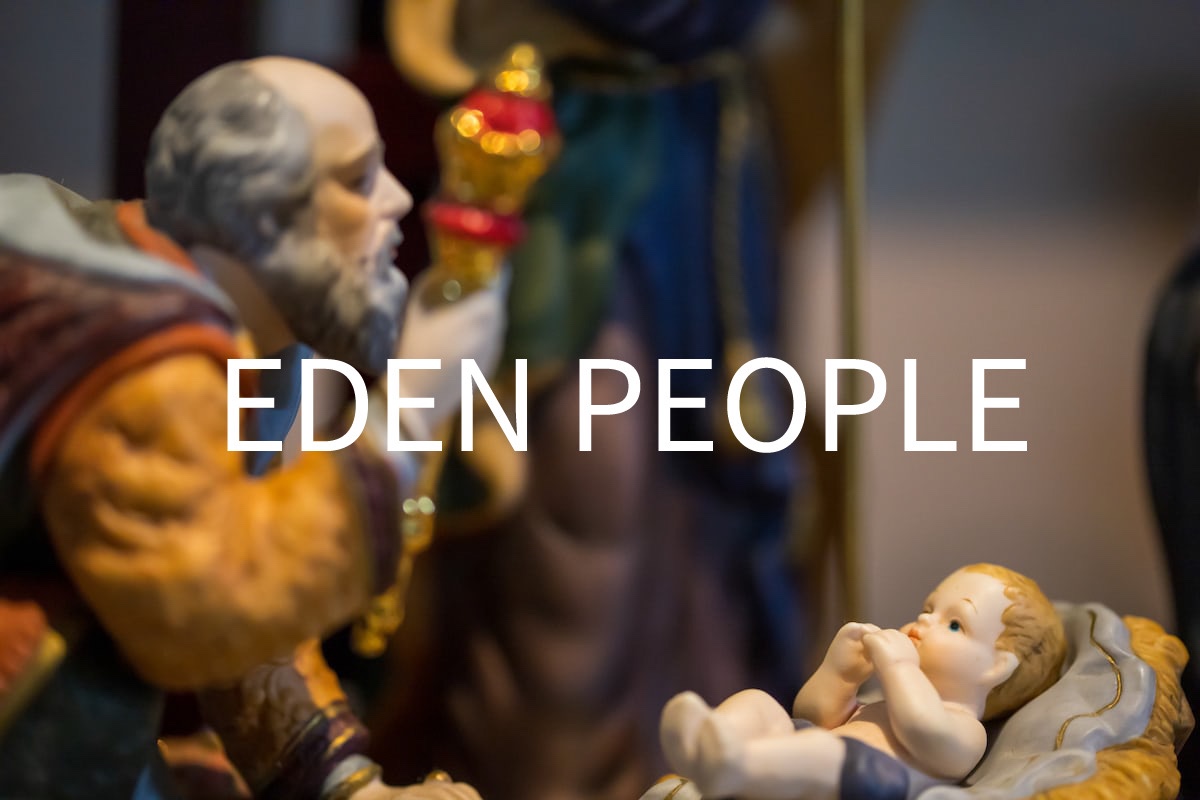
They are looking for the king of the Jews. They want to worship the king of the Jews. They are gentiles, outsiders, but they see Messiah just on the horizon, and they are moving through wilderness to honor and adore him.

These wise men from a long-lost Eden, Kneel before a baby, a child, the most powerless and innocent creatures. Oh, how Herod must have sneered when these travelers walked back out of his palace onto the dusty Road taking their treasures with them.

These gifts were meant for messiah.

These gifts were meant for the one who could rule with justice and equity — for one who leads goodness in triumph over evil.

These gifts were meant for one in tune with God, a holy arbitrator who reconciles his people.

These gifts were meant for the one who brings healing and life, not brutality and slaughter.

These gifts, well, these gifts were meant to adorn a body for burial, the body of the king of the Jews willingly sacrificed, utterly humiliated, and buried in a tomb.

And where are you in this story? And where am I in this story? Do we sit in the halls of power, conspiring to ensure our own security, and our own position at the top of the political order by trampling anyone weaker? Maybe, sometimes, in ways that we’d rather not admit.

But on our best days, in those moments, we are captivated by a light shining in the darkness – We can be like the magi.

We are called to be like the magi. We are called to be Eden People. We are called to be Heralds of the Kingdom of God. The spirit moves us to speak truth, seek goodness, and champion justice without fear or regard for those in power. We are to bring our best gifts and our best selves to the feet of Jesus.

And we are not distracted by the magnetism or ruthlessness of false kings.

And there are a lot of false kings.

I encourage you to think about these wise men, about the kind of people they are. The sort of religious movement they represent. The place from where they traveled and the star which showed them the way. Think about the people they upset and the gifts that they brought, and, most importantly, the child whom they adored. The Messiah, the King of the Jews, Jesus Christ, the Son of God, our savior.
Part of the Tapestry

All of these new things are from God, who reconciled us to himself through Christ and who gave us the ministry of reconciliation. -2 Corinthians 5:18 CEB

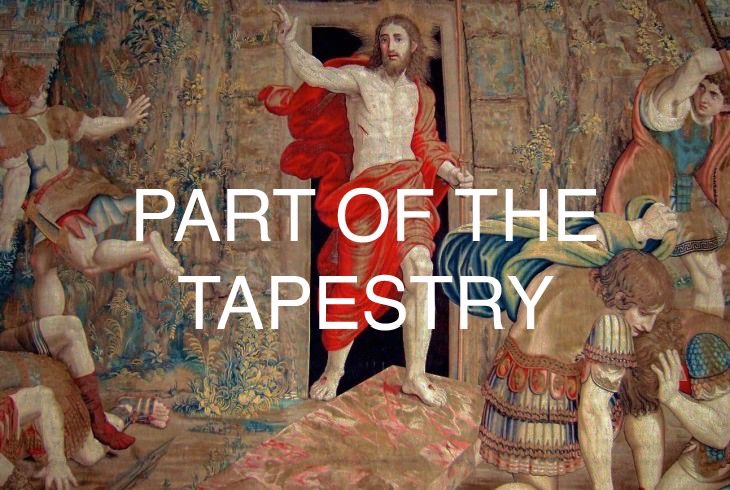
In the Vatican Museum, there are several beautiful tapestries, some of which used to cover the Sistine Chapel. Perhaps the most famous is The Resurrection of Christ. These works of art are so detailed that it’s easy to forget that they’re woven from tiny strands of wool thread. The Resurrection of Christ is so life like that the eye appears to follow the viewer.

I think it is interesting that these tapestries are woven from wool, the material we acquire from sheep. It is as if each little sheep has contributed a little bit of themselves to God’s plan. The Good Shepherd invites us to be woven into the tapestry of reconciliation.

But, what exactly is reconciliation?

The Methodist tradition recognizes that the world is both beautifully made and badly broken. The ties that bound humanity to God are tattered. The threads that connect neighbor to neighbor are terribly frayed by the power of sin. It is as if all creation is a beautiful tapestry, shredded by pain and suffering. 

This tapestry can only be restored through the process of reconciliation. Jesus entered into the world as the means by which we are all reconciled to God. Jesus is like the master weaver. He moves needle and thread in and out of the broken seams, putting the world back together again.

We are called to be instruments of reconciliation. We are called to be sharp needles and strong thread guided by the hand of the master weaver. God asks us to move back and forth in relationship with one another, putting the tapestry back together again.

The work of reconciliation is perhaps best captured by the words attributed to Saint Francis of Assisi, and I’ve taken some liberties here:

Lord, make me an instrument of your peace; where there is hatred, let me sew love; where there is injury, pardon; where there is doubt, faith; where there is despair, hope; where there is darkness, light; and where there is sadness, joy. Amen.

Restoration – The Messenger of Jesus

 “I will send my messenger, who will prepare the way before me. Then suddenly the Lord you are seeking will come to his temple; the messenger of the covenant, whom you desire, will come,” says the Lord Almighty.But who can endure the day of his coming?… For he will be like a refiner’s fire or a launderer’s soap. Malachi 3:1-2

We will conclude our story of scripture here, with the last book of the Old Testament. The book of Malachi was written sometime after both the temple and the Jerusalem walls had been rebuilt. Though the city and sanctuary were now in functioning order, the people of Jerusalem still yearned for the glory days when they had their own king ruling over them, if those days were any good, to begin with. Things just weren’t what they could be. The Jews longed for a Messiah, a rescuer, someone who could make their world whole.

God speaks through the Prophet Malachi to announce to the people that the “messenger of the covenant”, the Lord whom they desire, is on the way. In fact, the name Malachi means “messenger.”

The prophet announces that there is someone coming who will refine people’s hearts like fire and wash people of sin like strong soap. How will they know when he’s about to arrive? God will send a messenger ahead to prepare the way. The next chapter says that God will specifically send the prophet Elijah. You might remember that Elijah was the guy who called down fire on an altar way back when the kings were still ruling Israel.

When we turn the page from the Old Testament to the New Testament, we find out the identity of these two mysterious figures. The messenger preparing the way is John the Baptist, and the Lord who will refine and wash us clean is Jesus of Nazareth. The story of Scripture has led up to this son of a poor carpenter from a small town in Galilee. He is not rich or royal, but he is the Son of the living God, Emmanuel, God with us. He is slow to anger, abounding in love, champion of the poor, king of heaven, model of humility, savior of all humankind.

As we conclude this devotional series, could you tell someone the story of Scripture? Could you tell someone the story of Jesus Christ? Like the women returning from the tomb on Easter morning, will you be God’s messenger?

Kings and Prophets – The Real Superhero

Samuel said to all the people, “Do you see the man (Saul) the Lord has chosen? There is no one like him among all the people. Then the people shouted, “Long live the king!” But some scoundrels said, “How can this fellow save us?” They despised him and brought him no gifts. But Saul kept silent. 1 Samuel 10:24, 27     

It seems like every few months a new superhero finds its way into our culture. It used to be a Marvel movie or occasionally a DC hero that was the next blockbuster hit. However, with tons of streaming platforms, now we are being bombarded with superhero tv shows every time we sit down to watch something. As a culture, we are obsessed with the idea that an extraordinary human can save the day, can even save us.

The first king selected to rule over the people was not a very good one. God knows that all humans are sinful and flawed, so God wanted to rule over the people as King. Instead, the people requested a human king and they were given Saul. Some thought he’d be superhuman, that he would be able to save all Israel. But that is of course too much to ask of a human king. Some people immediately regretted their decision to ask for Saul to be king. “How can this fellow save us?” they asked each other. They realized that super-humans are really just fairytales.

More than 1000 years after the reign of King Saul, another guy named Saul will write a letter to a church in the town of Philippi. He will remind the church that there is still hope for God to be King, in the person of Jesus Christ. King Jesus will finally rescue God’s people, redeeming them from sin and death. God will give Jesus a name above all names so every knee should bow to Jesus, God on earth, as king and savior. Imagine Jesus on the throne of your heart as King and Savior. Allow him to rule in your life knowing that he is more powerful than any human being.

Exodus and Wandering – The Greatest Commandment

Hear, O Israel: The Lord our God, the Lord is one. Love the Lord your God with all your heart and with all your soul and with all your strength. Deuteronomy 6:4-5

This verse comes to us during the period of the Exodus, a time when the Israelites were trying to become the people of the living God. It grows into an important Creed throughout the history of Judaism. It is known as the Shema, which is the first word of the saying in Hebrew. Shema means “hear” or “listen” in Hebrew. Observant Jews would recite this verse daily and teach it to their children as a bedtime prayer. They also made an effort to have the Shema be their last words before dying.

About 1300 years after the Exodus, a popular Jewish teacher decided to set up shop in the temple courtyard to preach to the people, and they were astonished at what he had to say. Massive crowds came to hear him talk, and the established teachers became jealous of his popularity. They didn’t trust he knew what he was talking about.

One of them, who was an expert in the Law, tested him with a question, asking which is the greatest commandment in the Law? The popular teacher replied by citing the Shema, the same thing he’d been taught to say since he was a young boy. “‘Love the Lord your God with all your heart and with all your soul and with all your mind. However, he followed up the Shema with something unusual but profound. “’ This is the first and greatest commandment,” he said. And the second is like it: ‘Love your neighbor as yourself.”

Jesus Christ, the popular teacher from the temple courts, knew that the core of God’s teaching has been the same for thousands of years. Generations have recited the Shema as a form of prayer and a way to remind themselves of God’s call for our devotion. But Jesus bound the truth of the Shema to another, but similar truth found in the book of Leviticus, “you shall love your neighbor as yourself.” Jesus teaches that the entire story of Scripture hangs on these two commands. As we conclude the story of the Exodus, consider where have you seen these twin commandments show-up in our devotions so far.

Exodus and Wandering – Greatest Commandment

And God spoke all these words: “I am the Lord your God, who brought you out of Egypt, out of the land of slavery. “You shall have no other gods before me. Exodus 20:1-3      

Take a moment to think of your favorite board game or maybe your favorite sport. There’s probably a lot of rules involved, and it takes some time to learn all of them. If you had to pick the number one rule, the most important rule, what would it be? For a sport like soccer, it’s pretty clear what the number one rule is: don’t use our hands. If you’ve ever taken part in the role-playing game Dungeons and Dragons, then you know the number one rule is the Dungeon Master is always right.

Not every game or sport is that simple, and these two examples are really deceptive. Things are always a lot more complicated than that.

After the Israelites were rescued from slavery in Egypt, God led them into the desert beyond the Red Sea. These people had spent generations as slaves in Egypt, and now they were in unfamiliar territory. God decides to set down some ground rules for their relationship. Most important among these ground rules were the Ten Commandments, and the number one commandment was “you shall have no other Gods before me.” The rest of God’s laws flow from this commandment because if you put God first, then you will put the  things God cares about first.

At that time, most people believed in lots of different gods and these gods were in charge of different things. Ancient peoples would worship the god that cared what was most important to them. If you were a farmer, you would worship the gods in charge of the harvest. If you were a sailor, you might worship a god that would give you calm seas.

The way the God of Israel works is the exact opposite. The Israelites didn’t choose God. God chose them and rescued them from slavery. Moreover, the Israelites are called to put God first and the things God cares about. The same is true for us today. God wants to be our priority and to order our lives according to what Jesus thinks is important. It turns out the thing that God cares about most is for us to love one another. How can we better order our priorities to be in line with God’s priorities?

Exodus and Wandering – The Feast

Celebrate the Festival of Unleavened Bread, because it was on this very day that I brought your divisions out of Egypt. Celebrate this day as a lasting ordinance for the generations to come. Exodus 12:17

Moses was sent by God to pharaoh, king of Egypt, to negotiate the release of the Hebrew slaves. Pharaoh wasn’t keen on releasing the slaves, so God sent horrible plagues to help change the pharaoh’s mind. The last of these plagues was the death of the firstborn children in Egypt. It was a very dark and scary time for the Egyptians and the Israelites. To distinguish themselves from the Egyptians, the Israelites were instructed to celebrate a particular kind of meal. This meal came to be known as Passover, Because the plague passed over the house of anyone who celebrated it.

It may seem strange to celebrate a feast during the middle of a plague. It’s like having Thanksgiving dinner in the middle of a hurricane. However, the Jewish people continued to celebrate the festival of Passover every year as a way to remember how God rescued them from Egypt. They take time to tell the story, and retell the story, so even the youngest members of the family may know it by heart. Even during the Holocaust, Jews found ways to celebrate Passover in concentration camps. They marked out calendars on the walls of their barracks so they could know the right day. They stored up precious quantities of flour so they could bake the right bread. They celebrated in secret, knowing if they were caught they would surely be executed.

About 1300 years after the Israelites’ departure from Egypt, a Jewish Rabbi will sit down to celebrate the Passover with his disciple for the last time. They will bake the same bread, eat the same food, and drink the same wine, in the same way as their ancestors. Nevertheless, when they finish their meal the festival of Passover will be forever changed. It will become the sacrament of communion.

Passover and Communion both prompt us to remember God’s salvation and give thanks. Fewer obstacles stand between us and the celebration of our redeemer than did for the Jewish people during the Exodus or under Nazi Germany. Today, make space to remember, celebrate, and give thanks for God’s gift of salvation.

Love – Our Superhero

When you pass through the waters, I will be with you, and when you pass through the rivers, they will not sweep over you. When you walk through the fire, you will not be burned; the flames will not set you ablaze. –  Isaiah 43:2 (NRSV)

Lately, it seems as if everyone is obsessed with superheroes. There are new superhero movies out several times a year and every streaming platform has their own show following the antics of superhuman crusader. Maybe you follow Agents of Shield, The Boys, or The Umbrella Academy.

This verse from Isaiah reminds me of superheroes. It comes to us as a promise from God. It’s written as a bit of poetry and says that God will be with us in times of trial to prevent us from getting hurt. The way it is written it sounds like whenever we are confronted by a challenge God will allow us to breeze right through it like Wonder Woman or Superman. This verse reminds me of the age old saying that God won’t give you more than you can handle. By the way, that saying isn’t actually in the Bible, and I have to disagree.

The focus of today’s passage is not God’s protection from harm. Rather, we are supposed to pay attention to the five little words, “I will be with you.” Here’s the thing, there will definitely be times in life when you feel like you’ve got more than you can handle.

In the Bible, God gave people more than they could handle all the time, and, this year, everyone feels like they’ve got way more than they can handle. Instead, God promises that he will be with us when challenges come our way. He promised to walk through raging rivers and fierce flames by our side. With God we will survive. More than that, with God we will have salvation.

Despite what we see in TV and movies, there has only ever been one super human to walk the earth. That hero’s origin story includes being born in a barn and sleeping in a manger. He was a lowly peasant who suffered just like us. But the whole world knows and celebrates his story more than any hero in history. Take time today and reflect on how Jesus has been a hero in your life.

Love – Called by Name

Do not fear, for I have redeemed you, I have summoned you by name; you are mine. –  Isaiah 43:1 (NRSV)

In 2012, an independent film called Beast of the Southern Wild was released. The movie was about a little girl named Hushpuppy trying to survive, mostly on her own, in the bayou of Louisiana. The young actress who played Hushpuppy auditioned for the role at just five years old. In 2013, at age nine, she became the youngest nominee for Best Actress, first African-American child actor to earn an Oscar nomination, and the only person born in the 21st century to be nominated for an Academy Award. Her name is Quvenzhané [Kwa-Vin-Je-Nay] Wallis.

That’s probably not a name you hear a lot. In the middle of her success, Hollywood was having a difficult time making sense of her, and especially, her name. TV Personalities decided to bypass the issue by giving her the nickname “Little Q,” a nickname she did not request.

It may seem harmless, but the message was clear. Despite her enormous success and talent, her name was not worth knowing. She’s not the only actor who’s had a hard time because of their name. Actors James Rodriguez and Ramón Estévez changed their names to sound less Hispanic and be taken more seriously. You may know them by their stage names James Roday and Martin Sheen.

In Isaiah 43:1, God calls out to his people with words of tender love saying “don’t be afraid because I have made everything alright. I am calling you by name, your real name. You are my child and you are worth knowing. The real you, not the mask you put on to make others feel comfortable. I love you as you are.” To call someone by their name seems so ordinary. We do it all the time without thinking. However, when the God of creation stoops down to our level, he takes great care to refer to us by name. Jesus wants us to know that we matter and that we are loved for who we are.

As Christmas draws even closer, you might find your name written on the tags of gifts or in the address line of a greeting card. Whenever you see your name written this week take time to reflect on God’s personal call on your life. You matter. You are loved. You are the recipient of the most wonderful gift, and it’s addressed specifically to you – the gift of salvation wrapped in human skin.

Love – The Potter’s Hands

O LORD, you are our Father; we are the clay, and you are our potter; we are all the work of your hand. – Isaiah 64:8 (NRSV)

Pottery was such an indispensable part of life during the time of the Bible. Nearly everything you ate, sold, wore or enjoyed was stored in or served on pottery. Each piece of pottery was entirely unique and handmade. That’s not the case today, but back then every plate, bowl, jug, and cup was formed by a skilled artisan working with clay.

If you have any experience working with clay, you’ll know there are a few things you need to go from a lump of dirt to a lovely work of craftsmanship. The first thing you need is water to make the clay malleable. Dried out clay cannot be formed and will crumble into dust. A proud and difficult heart is like dry clay in the hands of God. It will break apart and never become the beautiful creation God has planned.

If God is the potter of our lives, that means we must present ourselves to God as well watered clay. We must be willing to be lovingly molded by God, to let God lead us and shape us and make us something wonderful.

The other thing you need to make pottery is time. If God is shaping our lives it means we must be patient. God wants us to be perfect before the end, and perfection takes time. We are called to be humble and hopeful while God is working within us.

The final stage of making pottery is the kiln, the place in which the clay is heated and hardens. What’s interesting about pottery is that it can be both beautiful and useful. We use plates to serve bread and cups to drink water.

When the master potter is finished with us we will be beautiful and valuable. We will be equipped to love our neighbor who is hungry or thirsty through humble service. We can serve as tools for the kingdom of God.

Think about your own faith journey today. Have you offered yourself to God as a malleable piece of clay? Are you letting God shape and mold you with humility and love? If not, how can soften your spirit to better accommodate God’s work in your life. Where do you need to yield to God and stop trying to have your own way? And where can you serve as a faithful piece of God’s handmade pottery?