
Understanding Blue

And I am sure of this, that he who began a good work in you will bring it to completion at the day of Jesus Christ

– Philippians 1:6

Having a dog is not like having a child. When William and I decided, or rather William decided he would let us get a dog, we knew there would be a big change and our lifestyle. We knew that responsibility towards the dog would have to take precedent over our own leisure time.

Although takeing care of a puppy does not match the responsibilities of caring for a tiny human being, this has been the first time in my life that I can really see developmental and cognitive growth in a creature day-to-day. William and I are paying attention to the little triumphs of maturity, and, at the same time, somewhat lamenting how quickly he is growing.

The week we got Blue, we were playing with him in the backyard of William’s parents home. The 10 week old pup was really getting the hang of fetch, and we were all very excited. The trouble was he was still very small and easily distracted. Sometimes he would get lost trying to bring back the ball, and he also did not yet possess the cognitive ability of object permanence. Anytime he lost site of the ball he was not able to predict where it will show back up next.

However, last week we were playing fetch in the same backyard, and the ball was thrown behind one of the patio chairs. William and I both siged and started to get up to retrieve the ball because we believe we would not understand where the ball had gone. Surprisingly, Blue bounded after the ball with perfect clarity and purpose. William and I shared an exciting cheer taking note of his new level of understanding.

My absolute favorite part of ministry, especially youth ministry, is when I get to see firsthand a young person passed to a new level of understanding in faith. I live for the “I finally get it” moment which an experiences of Jesus always provides.

Lately, I’ve been blessed to witness some wonderful moments of revelation for my students.

One student realized how vital love is to our society and got involved in promoting it within her school.

One student, upon returning home from a mission trip, said that she realize for the first time there was a hurt outside her own hurt and a world outside her own town.

One student was able to make peace with a very difficult piece of scripture and now has a better understanding of the teachings of Jesus.

I believe that every faith journey is made up of these little milestones. And I enjoy working with youth because I believe that it is in our younger years that we are more open to hearing God’s voice.

I hope that you are experiencing new understanding day-to-day. I want all of my students to engage life with perfect clarity and purpose. And I pray that we all might press on in faith, learning, growing, and flourishing in the teachings of Jesus.

It is indeed exciting to see something “click” for the first time for another person, but it’s even more exciting to experience it within your own soul.

¡ Hola de Ahuachapan !

One passages which seems to come up an awful lot in my life is a part of Jesus’ Sermon in the Mount. Specifically, the passage in which Jesus encourages the listener to consider lilies of the field and the birds of the air. He saws that’s these features of God’s creation seem small and insignificant. However, they are beautiful and dear to the creator’s heart.

The first full sermon I ever preach was on this passage. I had a plaque in my old office featuring a quotes from the passage and a bouquet of flowers. Just this past Lent, I spoke at our weekly church lunch about the lilies and birds.

Today, while we were visiting home and speaking with residents, we encountered people of varying levels of poverty and suffering. The whole process seemed a little ridiculous, to be honest, and I felt rather empty offering prayer and encouragement to people from such a place of privilege.

While others in our group asked about ailments and source of income, I attempted to direct the coversation to something positive, something that might build up the person and help us connect as fellow human beings.

Also, perhaps more honestly, asking about happy things made the whole experience less awkward.

At one house I praised the beautiful flower garden, and asked how she kept them so beautiful. I purchased some roses from her gardens and at the next house gave them to the residents there.

The next house had a pet parakeet in a small wicker cage. I inquired as to the birds name, but there was none. Jokingly, one of our translators said they should name it after me.

I enjoyed these brief conversations and moments of connection. To be sure, not all of our encounters where lively. Many were full of tears, fear, and confusion. While here, we have had people welcome us with smiles and hugs. But we have also had a few people curse us and our country’s immigration policies.

I have felt shame, and I have seen shame. I have felt joy, and I have seen joy. I have seen glorious blooming flowers and chirping birds. Yet still, I have felt the anxious worries of mothers, fathers, families, and communities.

God bless El Salvador.

Why Lisbon?

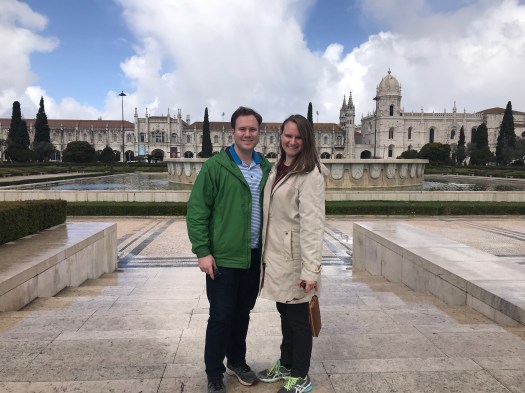
A few people have asked me why William and I decided to spend the money, time, and energy to visit Lisbon, Portugal. Well, there are a few reasons.

One reason is that it’s simply the trendy place to go. It’s a tourist destination that’s on the rise, and the people there are going above and beyond to make people feel welcome.

The city itself is lovey and the culture is wonderful. Plus, there’s many spectacular castles, churches, and monasteries.

But the biggest reason I wanted to see Lisbon is because of its tragic history in shaping theology.

In 1755, on All Saints Day when most the citiznes where gathered in church for worship, a nearly 9.0 earthquake struck the city. The quake then triggered a series of devastating tsunamis and knocked over scores of candles lit for the occasion of All Staints Day. The city was reduced to rubble and then burned. Casualty estimates range from 10,000-100,000, and cost nearly half the country’s GDP to repair.

The effect on European thought was profound. For the first time modern philosophers and theologians launched into an intense discussion about the goodness of God in the presence of suffering. This theological problem is know as theodicy. After the earthquake, it was no longer a given that God was benevolent. It was as if the whole continent discovered, or rediscovered, the problem of Job.

Immanuel Kant wrote three different essays on the incident. Voltaire penned an existential poem wresting with the problem of evil. He passionately engages the question saying:

But how conceive a God, the source of loveWho on man lavished blessings from aboveThen would the race with various plagues confoundCan mortals penetrate His views profound?Ill could not from a perfect being springNor from another, since God’s sovereign king;And yet, sad truth! in this our world ’tis foundWhat contradictions here my soul confound!The city of Lisbon took decades to rebuild. The citizens took generations to recover. However, the collection consciousness of Wester Christianity was forever changed. Today, we still wrestle with this same question. Hundred of books have been written, sermons spoken, and arguments waged in attack of this issues. Nevertheless, the nagging pain remains. And the question hangs in the air. Why Lisbon? Why me? Why God?I don’t know how to answer these questions, but sometimes I try. Mostly, we just to listen when someone asks because the answer cannot fill the void. As Christinans, we confess that only Jesus can, and he, more than anyone, knows how it feels to innocently suffer.

Living in Fear

And they went out and fled from the tomb, for trembling and astonishment had seized them, and they said nothing to anyone, for they were afraid. ‭‭Mark‬ ‭16:8‬ ‭ESV‬‬

The more historical ending to Mark, the one found in the oldest manuscripts, ends with fear and trimbing and silence.It’s not the joyful proclamation and loud excitement found in other Gospels. It’s certainly not the spectacle found in our churchs on Easter morning.

What is strange is that so often in the gospels when the miraculous happens, Jesus has a difficult time keeping a lid on it. Those who experienced the transformation from blindness to sight or lameness to leaping tended to tell people.

There are may questions and theories surrounding the end of this Gospel. Perhaps, these women were finally overwhelmed with the miraculous to the point of fear and silence.However, just this year I’ve begun to wonder how much their femininity influenced their silence. In the ancient Jewish world, the testimony of a woman was not acceptable in court. It’s very poignant, then, that the first people to bare witness to the resurrection in other Gospels are women.

Still today, in many places there the testimony of a woman is counted as worthless. Still today, in many churches the testimony of a woman is considered second class. Still today, in early every context women are afraid to speak. I believe the current social awareness about sexual harassment has born that out.

Although I personally cannot point to any harassment in my ministry experience, I can point to patronization. I can point to an experience of bearing witness in a context where my word is discounted. I can certainly point to a feeling fear and keeping silent.

As Christians, we are called to be bold and to speak up on behalf of our faiths. I am called to rise above my fear to give voice to justice and peace. We are called to witness and proclaim the marvelous.

Grief & Greed

Photo by Kevin Horstmann on Unsplash

Someone in the crowd said to him, “Teacher, tell my brother to divide the inheritance with me.”  Jesus replied…And he told them this parable: “The ground of a certain rich man yielded an abundant harvest.  He thought to himself, ‘What shall I do? I have no place to store my crops.’ “Then he said, ‘This is what I’ll do. I will tear down my barns and build bigger ones, and there I will store my surplus grain. And I’ll say to myself, “You have plenty of grain laid up for many years. Relax; eat, drink and be merry.”’

 “But God said to him, ‘You fool! This very night your life will be demanded from you. Then who will get what you have prepared for yourself?’ “This is how it will be with whoever stores up things for themselves but is not rich toward God.”

– Luke 12:13-21 

In this passage, Jesus is preaching to a crowd thousands of people, and the theme of his sermon seems to be about fearless faith in God.  Just then, a man jumps up from the massive crowd to ask Jesus to settle a family dispute about money.   This guy must have had some moxie to address Jesus like this in front of thousands of people.

Now the sermon is off the rails as this man seems to have hijacked the topic.  Jesus chooses to address this man’s concerns about his inheritance.  During this time, it was customary for the older son to receive two-thirds of the father’s estate and one-third would go to the younger son, so this man felt slighted by his brother after the death of his father.

I wonder if the man went to hear Jesus preach that day specifically to ask him about his brother.  I wonder if he was even listening at all to Jesus sermon about courage and faith and the Holy Spirit.  Maybe he was just waiting for a gap in the sermon to jump in.  I wonder what his finical saturation will be if his brother never gives him part of the estate.  I mean, more literally, did he really need the money? Or did he really want the money? Or was he still overwhelmed with grief?

The death of a loved one is always a challenging thing.  Especially, when that loved one has an estate that needs to be distributed. It is immeasurable frustrating to have to deal with the legal ramifications and logistics of the deceased while simultaneously experiencing grief and trying to mourn the loss of a life.   I wish I could say that it always brings out the best in people. But if we’re honest with ourselves, sometimes grief and greed can sometimes get mixed up.  To the foolish man’s credit.  Maybe he was just mixed up.

When this passage is presented in Matthew’s Gospel, it is a part of the Sermon on the Mount.  Jesus’ speaks to the crowed in a beautiful, uninterrupted monologue.  Although there are numerous sermon illustrations and metaphors, the presence of any parables is conspicuously absent.

This changes the tone of the passage considerably.  Whereas the sermon in Matthew might be construed as an exhortation to those without means to trust in God, Luke’s account seems to function as a warning to those with means.  To those individuals living comfortably and with excess. To people like first world Americans.

Regardless, Jesus addresses this foolish man by means of a parable. This parable is not flattering towards the main character who is simply dubbed The Rich Man. When The Rich Man is blessed by God with an abundance of resources, he decides to hoard his blessing and wealth.

To be sure, there is a difference in saving and hording. The way we know this is an example of hording is that he tears down his existing barns only to build new one.  Now he can sit on his crop allowing him to wait for a price increase before selling.

“All that’s left is to relax, eat, drink, be merry,” he says.  This was likely a common phrase at the time and appears a few times in the Bible.  One ironic reference from Isaiah 22:13 which reads ““Let us eat and drink, for tomorrow we die.”  This is ironic of course because in the parable the next day The Rich Man will die.

The Rich Man’s identity is so tied to his possessions, status, and/or achievements he can easily become a caricature which we point to and mock rather than allow to be a point of self-examination.  I wonder if The Foolish Man who address Jesus that day took the time to examine his motives.  I wonder if he was able to separate his grief from his greed. I wonder if he ever got his inheritance.  But most of all, I hope the Foolish Man traded his grief and greed for the riches of God.  And I hope that I am able to do the same.

Jesus Sees Us

Lent is a pretty long time.  I mean, it’s 46 days, 40 days if you don’t include Sundays, and the whole season is dedicated to sacrifice and reflection.  To be honest, Lent sometimes feels like a long trudge down a dirt road.  It is not as exciting as Advent and most of the time we practice some kind of sacrifice.

In Mark 8, about halfway through the Book of Mark, Peter guesses correctly that Jesus is the Christ, the Son of God.  Since the cat’s out of the bag, Jesus begins to tell his followers plainly what it means that he is the Christ.  He explains to them privately that he would be persecuted, executed, and resurrected. He gives them a road map of their long trudge down the dirt road to Jerusalem and eventually to Golgotha.

31 And he began to teach them that the Son of Man must suffer many things and be rejected by the elders and the chief priests and the scribes and be killed, and after three days rise again. 32 And he said this plainly. And Peter took him aside and began to rebuke him. 33 But turning and seeing his disciples, he rebuked Peter and said, “Get behind me, Satan! For you are not setting your mind on the things of God, but on the things of man.”

Mark 8:31-33

This is too much for poor Peter. Rejection, suffering, and death were not what he had in mind. Peter correctly identified Jesus as the Christ, but it seems to Peter that Jesus does not have a clear understanding what this means.  Jesus is confused, and Peter will set the record straight.

Yet, as the reprimand is taking place, something critical happens. Jesus, listening to the dreams and opinions of Peter, hears in his voice the temptations once offered to him by Satan.  The same promises of glory and power and comfort and honor that he once refused when he was tested by Satan in the wilderness.

Peter was describing to Jesus a message of triumph. He used his words to paint a picture of kingly honor and messianic fulfillment.  You can almost see the montage playing in Jesus’ mind.

But, for a moment, Jesus’ gaze shifts.  His eyes leave the passionate face of Peter and he turned to see the rest of his followers. Mark 8:33 says it was this act of turning his head, of seeing the face of those closest to him, that Jesus was jolted back into the present reality.  It was the sight of his beloved followers which reminded him of the will of God,  that he was sent to Earth for us and for our salvation.  That for our redemption he would suffer many things, even death.  And that his glorification would be bound up with the restoration of God’s people.

In that moment, I think Jesus saw all of his disciples, not just the ones gathered on that day.  I think Jesus saw the faces of Andrew and John and all the others, the face of you and me.  He took a moment to reflect on his own love for us in order to resist the words of temptation.

During our Lenten Fast, I wonder that we are not called to do the very same thing.  We are called to turn our gaze from earthly pleasures and remember the face of Jesus.  We are to remember that our redemption came at the expense of his suffering.  And we are to recommit ourselves to the glorification of Christ and the restoration of God’s people.

3 Things About John 1 – Part 3

 For from his fullness we have all received, grace upon grace.  For the law was given through Moses; grace and truth came through Jesus Christ.

– John 1:16-17

At our church, we have been going through a sermon series which address difficult questions posed by our congregation.  People offered their questions, and then the most popular were collected to be discussed in Sunday worship.

One of the questions was “why is the God in the Old Testament so different from God in the New Testament?”  It’s a pretty common question, even as far back as the very beginning of Christianity.

People read the thousand plus years of Jewish history, poetry, and theology contained in the Old Testament taking away a message of judgment and fear.  People are sinful, God is angry, and the only way to avoid destruction was to appease God with animal sacrifice.

Meanwhile. they skip over the predictions of judgment and future violence contained in the New Testament auguring that Jesus’ loving sacrifice appease God’s anger once in for all, so no more animals have to die.

One of the fallacies that supports this view is that the people of the ancient Judaism believed they could achieve God’s forgiveness and salvation by obeying the commands of the Law.  Following this line of thinking, Jews of the Old Testament believed forgiveness from God is a mechanistic process by which animal sacrifice guaranteed forgiveness when the Law was transgressed. Thus, in the OT people were made righteous through countless animal sacrifices and in the NT people were made righteous by Jesus’ ultimate sacrifice if only a person has faith in him.

One problem with this theory is that it assumes that God is vengeful and full of wrath while Jesus is a gentle sheep or cares for us.   Another problem is that it assumes that in the past God forgave people because they followed the law, but now God forgives people because they have faith.  These two ideas not only muddy the consistency between God in the OT and God in the NT, but also split the character of the Godhead divorcing Jesus from God.

The Law was never meant as a mechanistic means of forgiveness for Jewish people. People did not believe that preforming sacrifices and offering prayers made them righteous.  Rather, these laws made them ritualistically clean and able to be a part of the community.  The ancient Jew who tried to achieve righteousness through his or her own efforts by obeying the Law without having faith in God was considered a self-righteous fool.   Rather, the purpose of the Law (and Jesus’ amplification of it) is to show us how far we have fallen into sin and to motivate us to throw ourselves on God’s mercy.

Jewish people The God in the OT operated through Grace just as much as God in the NT. Which is why I love this verse from John 1.  We, as God’s people, have received “grace upon grace.” That is the Grace was given by God in the Old Testament and by God in the New Testament.  That is the Grace which comes to us because of the life, death, and Resurrection of Jesus Christ. A Grace which is extended by the Holy Spirit to all who accept regardless of circumstance or context.

Our God is a God of Grace for all people.

3 Things about John 1 – Part 2

And the Word became flesh and lived among us, and we have seen his glory, the glory as of a father’s only son,full of grace and truth

John 1:14 NRSV

Gosh, it’s been a wonderful but crazy last few weeks! Last weekend, I lead a spiritual retreat for the young people at Fayetteville First UMC along with a dozen or so other wonderful Youth Shepherds.  This retreat, which they call Renovatus, is the event which the youth look forward to all year long.

Spiritual retreat is an interesting part of Christian formation.  It has been a practice since the time of Christ, who withdrew by himself to pray and reflect.  One could argue that spiritual retreat is even more necessary and challenging today due to the prevalence of technology and media.

Methods of retreat differ across time and Christian practice.  Some retreats are silent while some are full of noisy worship.  Some have a purposeful goal, while some people enter into retreat without expectation.

The one constant feature of retreats is that they are temporary.  They don’t last forever, unless you become a hermit, and when a believer returns to everyday life they expect themselves or their circumstances to be transformed.

The passage I wanted to explore from John talks about retreat of sorts. John 1:14 says “the Word became flesh and lived among us.”   The word “lived” is sometimes translated as “dwelt” as to suggest Jesus/The Word spent time and made his home among us lowly humans.

The Greek word here is ἐσκήνωσεν / eskēnōsen.  Although, this is the only usage of this form of the word in scripture, the dictionary form of this word is frequently translated as tabernacle in English.  Tabernacle is just a fancy Biblical word for a holy tent.

When the Hebrew people wandered in the desert they did not yet have a homeland nor a place to build a Temple to worship God. Instead, God command that they construct and carry with them a tent or tabernacle to house the Arc of the Covenant and serve as a place for sacrificial worship wherever they camped.  The tabernacle was the temporary location for the real presence of God within the Hebrew community.

A better translation of John 1:14 might be “the Word became flesh and pitched his tent/tabernacle among us.”  Rather than ‘making a home,’ ‘pitching a tent’ suggests temporarily lodging in a unfamiliar and possibly wilderness like place.  This language also evokes the imagery of the ancient tabernacle of the Hebrews who wandered in the wilderness and stayed only briefly in places until they found their true home.

Jesus’ stay here on this earth was always going to be temporary.  Jesus pitched a tent here on the first go around, but when he returns he will built a glorious, permanent Temple.  And those of us who find joy and rest in a temporary spiritual retreat will be able to experience eternal closeness with our savior.

3 Things about John 1 – Part 1

 In him was life, and the life was the light of all people.  The light shines in the darkness, and the darkness did not overcome it.

John 1:4-5 NRSV

The opening of John’s gospel is perhaps one of the most memorable passages of Scripture. It is also a beautiful piece of theology and hymnody.  Around this time of year, this passage pops up in the lectionary to remind us of new beginnings.  The beginning of the new year and the beginning of Christ’s story in the church calendar.

Over the next few blog posts, I would like to examine some of my personal favorite parts of this passage, and I’d like to start with Verses 4-5.

The first few verses draw a connection between The Word, God, and The Light, which are  different identites manifest in the person of Jesus Christ.

A shining light is the ideal metaphor for the virtue of hope.  Like a lighthouse for a seafaring vessel, a light in the darkness is meant to guide, encourage, and inspire.  It is through this connection of hope and light that Christians began to celebrate Christmas by putting candles in the windows, a tradition which has become lost in the mania of Christmas light decor.

What is intriguing about this verse is not that the light of Christ pointed to hope and new life, but the darkness reacted so curiously to the light.  In Verse 5 is says “the darkness did not overcome it.” Other translations, such as the King James Version have the word “understood” rather than “overcome.” One might crock this discrepancy up to the antique language of the KJV, but still other versions have a different translation.  The Common English Bible and New Living Translation have the word “extinguish.”

These three different translations have very different meanings in English.  The NRSV points to a struggle for power.  The KJV personifies the darkness and seems to play off the pseudonym “The Word” giving us something like ‘the darkness didn’t understand the Light/Word.’ Finally, the more colloquial translations of CEB and NLT focus on the light-dark metaphor making our Light/Word something like a flame burning in the darkness.

The thing is, all of these translations are somewhat correct.

The word in Greek is katelaben/κατέλαβεν, which means something like ‘to take hold of.’  The two words that make up the Greek dictionary form are kata/κατα which means ‘with’ and λαμβάνω /lambanó  which means ‘to take/grasp.’

OK.  Now that may all have been a bit confusing, so let me tell you why I love this word so much.  It is because the translations “understood” and “overcome” and “extinguish”  are all different translation but valid translations nonetheless.

You see, John’s gospel is trying to mesh together several over lapping metaphors, and it is in the word katelaben/κατέλαβε inwhichall three metaphors come crashing together!

These metaphors describe Jesus as

  • “The God” which could not be overcome
  • “The Word” which could not be understood
  • The Light” which could not be extinguished

None of the other three translations preserve the ambiguity of the original meaning because the translator has collapsed the original three names for Jesus into one meaning. I believe the ambiguity of the original text was intentional because katelaben fits with all three of Jesus’ personas: God, Word, Light.

The complexity of John’s Gospel has wonderful hidden gems. It is a beautiful, multifaceted, presentation of the hope and triumph of Jesus Christ. The Grace he offers cannot be overcome, understood, or extinguished by the darkness.

A New Thing, A New Year

“Forget the former things; do not dwell on the past. See, I am doing a new thing! Now it springs up; do you not perceive it? I am making a way in the wilderness and streams in the wasteland.”

‭‭Isaiah‬ ‭43:18-19‬ ‭NIV‬‬

I’ve always thought it was intersting that Christmas and New Year’s day were only a week apart. This is such a fun time of year when you’re young because school is out and hopefully you have a whole slew of new toys to play with. Perhaps you are able to visit with grandparents and cousins.

As an adult, the week between Christmas and New Years is a little frustrating. A lot of us have to work, but even when in the office productivity is pretty low. One has the impression that the last week of the year is just us spinning our wheels waiting on the excitement of something new.

While my parents were visiting over Christmas, my mom brought out a list of goals that each member of the family set back in 2009. We used to have a family tradition of writing down 10 goals at the beginning of the new year.

Some of the goals were amusing, including my brother’s goal to get six-pack abs. Some of the goals we achieved and brought us great joy, like getting good grades in AP History. Some of the goals were disappointing because we did not achieve them, like getting good grades in math.

Finally, some of the goals were saddening because, despite having achieved our goal, all our efforts didn’t make a difference in the long run. You may have experienced this yourself. For example getting a good grade on the SAT did not translate into getting into your dream college. Or redoing your small business’s website didn’t matter in the long run because you went bankrupt anyway.

My 10 goals from 2009 turned out to be a mixed bag of all of these things. Some joyful success and some disappointing failures.

Looking into the New Year, I do feel like I’m spinning my wheels ready to get started on a new set of goals. However, I’ve also been thinking about the verse above. There are lots of things I want to check off my list in 2018, but I feel that if I am not careful I may be missing out on what God is going to do.

In this passage from Isaiah, Israel is encouraged to forget the pains of the past. We, as God’s people, should not dwell on our failures. Instead, we are called to look and see what God is doing. By faith we are emboldened to approach the future with anticipation. As children of God we are to wait with bated breath and search with keen eyes to find God’s grace springing up from the lifeless earth.

On January 1st, I will likely set a few goals which I’d like to achieve in the New Year. However, I must acknowledge that God’s will and intentions must outweigh my own. We must create margins in our lives so that we are not too busy to see where God is working. We must go into the quiet and deserted places to attune our eyes and equip our hearts to serve Jesus and his people.

And this is very exciting. We serve a living and active God, a God whose grace reconciles our past, present, and future. Our God is always doing a new thing.