A Seven Word Sermon

After John was put in prison, Jesus went into Galilee, proclaiming the good news of God. “The time has come,” he said. “The kingdom of God has come near. Repent and believe the good news!” -Mark 1:14-15

My homiletics class was taught by Dr. Smith at Candler, as a part of his class we were required to submit a few different types of sermons. We were warned at the beginning of class that our final sermon would be delivered in person in front of the entire lecture hall in one class period. We would be able to fit them all into the allotted hour and a half easily because each sermon could only be seven words or less. Seven words.

When my turn came, I approached the lectern confident that I had cracked the system. My sermon, the Kingdom of God is at hand. I was a bit proud to see the smile on Dr. Smith’s face, but more importantly, I believed in the few words I had preached. 

The overwhelming and awe-inspiring news that God’s dominion, over all creation, over life and death, is closer than we can imagine. The just rule of God over all things means we as God’s children are able to realize our inheritance as heirs to The Kingdom: the bodily resurrection and life eternal in perfect relationship with our Creator and the rest of creation.

So how would someone define the Kingdom of God? The Kingdom is established in individuals and communities anytime the self-revelation of God is made incarnate. Theologian Wolfheart Panaenberg makes the distinction that we do not bring about the rule of God; we do not bring the Kingdom despite our best works of charity and acts of piety. We are reminded of this fact every time we pray the prayer which Jesus taught us: “Thy Kingdom come, Thy will be done.”  

Through this prayerthe children of God ask for the Kingdom, and God brings forth the realm of the Kingdom through the self-revelation in the person of Jesus Christ, God made flesh. This is why John the Baptist and Jesus begin their ministries proclaiming “The Kingdom of God is at hand.” At the same time, Jesus’s ministry and passion were just the beginning, just the foundation, of the in-breaking of God’s Kingdom. 

Through the power of the Holy Spirit, God is made flesh again, albeit less perfectly than in the person of Christ. With each new heart that is baptized by the Holy Spirit, the realm of God expands. With each act of justice and mercy, God’s will is done. Slowly, like a city being built, brick-by-brick, The Kingdom advances.

Lessons From a Lock-In

A friend loves at all times, and a brother is born for a time of adversity. – Proverbs 17:17

There’s something special about staying up all night with dozens of your favorite teenagers.  This year’s back-to-school lock-in was nearly canceled due to some logistical nightmares, but in the end, we were able to host two other churches in our new youth space for worship before staying up all night at a skating rink.

I thought for sure our kids would be cranky and burnt out on skating by 2 AM, mostly because I was grumpy and burnt out before we even got to the skating rink.  I hate skating, and our lock-in didn’t change that fact. But I was delighted to discover the skating talents of our students and adult leaders!

Covered in blisters, bruises, and begging for sleep, we returned to the church. Half of our students drifted off on the ride home while some started laughing deliriously.  By the time we made it back, everyone was ready to crash on giant bean-bags before getting picked-up.

Later that day, my husband was laughing, saying there’s something special about staying up all night.  It a situation which bonds you, and I can see what he means. When people are grumpy or goofy from fatigue, then our guard is down.  Conversations are looser and more honest.  Something as simple as lack of sleep can serve as a shared struggle perfect for forging relationships.

The thing is, it’s a new school year for our students, and there will be a lot of real struggles and challenges which go along with the new year.  Failing a test, getting cut from the team, losing a friendship. We all experience individual struggles and challenges, but there’s something about a shared burden which bonds us together.  And, perhaps, if we have experienced a few of the same burdens together, like lack of sleep, we are more open to sharing our individual burdens when times get tough.

Proverbs 17:17 is true, a brother or sister in Christ is born for a time of adversity.  We need Jesus-centered friendship to make it through the challenges of life. However, the bonds of Christian friendship are also born during a time of adversity, even if that adversity is a lack of sleep and some skating blisters.

May God’s blessing be with all of the students, teachers, and life-long-learners starting a new season of education, and may we all stick together through the challenges ahead as brothers and sisters in the Kingdom of God.


Reflections on St. Louis

There is no fear in love. But perfect love drives out fear, because fear has to do with punishment. The one who fears is not made perfect in love.  – 1 John 4:18

Since my last post, I took care to censor any comments concerning The UMC General Conference in St. Louis this week.  I watched and read and texted friends, but I held off posting anything because I wanted to formulate my words carefully.  Well,  here is my story.

I was a religion major in college, and as part of my degree requirements, I was supposed to take an ethics class. At the end of the course, we were to write a paper on any ethical dilemma we wanted to choose.  I chose to write my essay on a topic on something I was genuinely conflicted about: the ordination of gay clergy.

This was an issue that hit home for me because I was raised in the Presbyterian Church USA, which was deliberating that next year on the subject.  PCUSA ultimately decided to accept gay clergy causing the expected split in the church.

I spent hours on my paper, trying to figure out what the PCUSA was on about with accepting LGBTQ people.  I had not experienced many gay people, especially gay people of faith.  When all was said and done, I turn in my passionate research paper with the following carefully worded conclusion:

‘…At this time, I cannot endorse the acceptance of LGBTQ people in church leadership.’

That was my honest opinion as a freshman in college, and, as God would have it, that was the same year a good friend of mine tearfully came out to me as gay.

I was one of the first people outside his family to know, and his family had not been taking it well. My friend, who was a devoted Christian, was sent by his parents to faith-based conversion therapy.  He’d spent the better part of the summer in counseling in an attempt to make him straight.  The result was depression, self-loathing, and the contemplation of suicide.

Eventually, he changed schools to put distance between himself and his parents, and we ended up drifting apart. The impact on our relationship left a lasting impression.  I could see in him the strong presence of the Holy Spirit and passion for Jesus mixed with confusion and frustration over his sexuality.

Through our relationship, I learned more about faith and ethics than my any class had ever taught me. My mind changed, and I knew that God would never have intended my friend to go through such agony in deciding between faith and sexuality.

As God would have it, that was not the last person of faith who ‘came-out’ to me as gay or questioning their sexuality.  Being affirming of a person’s sexuality and faith has been a critical part of my ministry, primarily as a minister to young people.

Needless to say, I was upset by the vote on Tuesday for the Traditional Plan which condemns LGBTQ leadership in the church and reinforces sanctions on those who officiate same-sex weddings.  Although having studied Methodist polity and history, I also think a crucial problem for The UMC is conferencing on an international level (Dr. Jan Love has a great article on this.) It destroys the ability to contextualize ministry and follow the movements of the Holy Spirit.

I was also upset because a conservative hard line makes ministry with young people nearly a non-starter. Young people represented an overwhelming minority of people seated at the Genera Conference, so their voices were effectively silenced despite being the future of the church. (Bishop William Willimon also has a lot to say on this issue.) Moreover, I worry about my ability to minister to young people who are discovering their sexuality and increasingly more invested in diversity. I currently work in an area that offers very few options for LGBTQ people of faith and their allies, and I’m not sure where they would go.

However, I woke up on Wednesday filled with new hope for a few reasons.  First, I know that my Methodist LGBTQ friends and those who are allies are devastated by the dark night of this decisions. I’ve been down this road before in the PCUSA, so I know there will be an end to this current season of suffering. Right now, people are hurting, but I know from personal experience that there will be a resolution. This General Conference has created some open wounds, but now real work can begin.

Second, I was marvelously encouraged by the outpouring of LGBTQ support that I saw on Social Media, within North Georgia leadership and in meetings in my local church. It warms my heart to see love and acceptance reaching out against exclusion and bigotry. Not everyone feels that way. I was addressed by some conservative-leaning people on Wednesday who wrongfully assumed I was as joyous as they were at the result of the vote. Regardless of your stance on the matter, I not sure celebration at the expense of another is the right response anywhere in the United Methodist Church right now. Nevertheless, my friends, leaders, and role models in ministry have responded in affirming love.

Finally, I feel hopeful because I see a kind of affirmation from Jesus in being on the “losing side.” Jesus, whose mantra was the “the first shall be last,” and “blessed are those who mourn” and “love your neighbor” and “take up your cross,” never promised that following him would be easy. If this current moment is a struggle, it means the convictions we are striving for are real and significant.

As I write this, our local church is preparing the for its first step in processing this vote, a service of prayer and communion. I know there will be many broken hearts and worried minds at their service. Yet, I know in my soul God is still working here.


The Church Struggle

I spent President’s Day weekend with nine of my favorite preteens on the FFUMC Confirmation Retreat to Saint Simons Island.  A big part of this retreat was discovering and testing out the Spiritual Gifts of these young people.  As they begin the process of joining the church, we want them also to start thinking about what their roles will be in the body of Christ.

One of the ways we did this was by having them engage in several different team-building activities, the first of which left tempers heated and emotions high. Our students were tasked with making a specific structure out of toothpicks and gumdrops. The catch was that only one of them could see the structure and had to describe it to a mediator who delivered messages but was unable actually to help put the gumdrop creation together.

It sounds like fun, and it could be fun and enjoyable if everyone had been using their gifts lovingly. As it was, some were overstepping, some were disengaged, some were spoken over, some were distracting, and some were not being heard.  It was a perfect example of how churches seem to work.

All of us who belong to the Body of Christ are tasked with the job of ministry. But what is ministry? What is it supposed to look like? How is it supposed to work?

Just like the gumdrops and toothpicks, every church begins with the same materials for ministry: worship, service, community, scripture.  But each church puts those materials together in a unique way.  Well-functioning churches can understand God’s plan, organize effectively, and work together towards God’s vision for their community.  Well-functioning churches are able to first and foremost practice love, and only after this harness their gifts to do ministry.

Paul famously calls this “the more excellent way” in 1 Corinthians 12, and encourages people to desire love above all else.

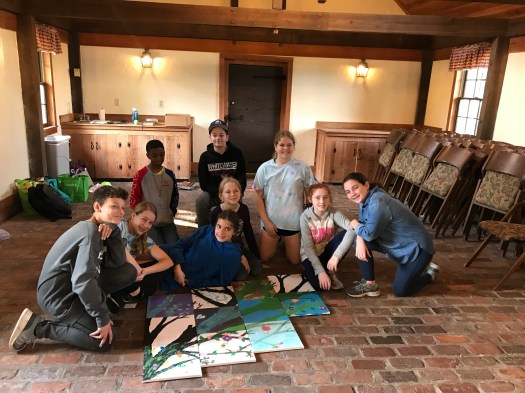
As the weekend went on, our students became much better at the other team-building challenges.  Students began to internalize the values of teamwork, communication, listening, but ultimately they were better understanding how to love each other.  They finished their final challenge of putting together pieces of a painting with cheerful attitudes and extreme patience.

This weekend, there is a Called General Conference in The United Methodist Church, and I have spent a little time preparing my students for what this conference will mean for the church.  When I think about the tears, frustrations, and apathy our Confirmands experienced building a simple gumdrop structure, I cannot fathom how difficult this event will probably be.

My prayer is that Conference attendees will ultimately attend to a more excellent way.  I hope that the cacophony of loveless, fearful gongs and cymbals will be silenced. That we would have equal concern for one another.  I hope that we would protect one another, trust one another, and persevere with one another. And I pray, just as I prayed for our Confirmands, that a generous unity would win the day so that the Lord’s will can be done.

Do We Minimize Our Pain?

Photo by Alexander Possingham on Unsplash

I’m writing this blog post the darkness of my bedroom with an ice pack on my head. I’m primarily using the talk to text feature because I can hardly open my eyes. The brightness of my screen is difficult to handle.

I have a migraine. I get migraines a lot, and I’ve been getting migraines and headaches since around first grade.

I’m pretty used to them now. I work through migraines when I can and try to ignore them until they become too debilitating.

Migraines are a chronic illness, and chronic illnesses function so much different than any severe or curable disease. If you have any kind of chronic illness you can understand the feeling of reluctant acceptance in dealing with your pain.

For the most part, I try to minimize the impact migraines have all my life when discussing them. I don’t want people to feel bad for me or make exceptions for me. I’m not writing this post to make excuses.  There are people with severe and/or life-threatening illnesses, and I don’t want my migraines to garner sympathy from them, I really don’t need it.  However, when I try to contextualize my headaches or any chronic illness, I am always drawn to the story of the woman with hemorrhaging who was healed when she reached out to touch Jesus.

Mark 5:25-34 tells the story of the woman who spends all of her fortunes trying to find a cure for her chronic disease which caused her to bleed uncontrollably for twelve years. When nothing worked, she pushed through the crowd around Jesus just to touch the fringes of his robe. For this last-ditch effort taken in faith, the woman is finally rewarded with healing.

“Daughter, your faith has made you well,” says Jesus, “go in peace, and be healed of your disease.”

What’s even more amazing about this story is that Jesus is actually on his way to heal a young girl who is terminally ill.  Everyone’s attention in the story is focused on getting Jesus to the young girl’s bedside, but Jesus stops to acknowledge the healing of this woman whose life was not endangered, but whose quality of life was in ruins.

Many commentaries are quick to point out that the woman’s bleeding disorder caused her social isolation because it meant she was ritualistically unclean. People avoided her because of her chronic illness making it all the more tragic. But, I’ve always found this anecdote to be rather unnecessary.  Illness always fosters social isolation, and chronic illness fosters chronic isolation, even for people today. We don’t need to import an ancient purity code for this to be true.

Isolation is caused in many ways. It can be caused when people don’t understand the illness, such as with depression or mental illness, or because the person suffering is unable to fully engage with others due to pain or diminished ability, such as migraines or arthritis. Life-threatening illness set a person apart too due to the frailty of the person or even the inability to fully connect with others because they simply cannot relate.

As for myself, I have spent countless hours in dark rooms with ice packs.  I’ve missed parties and struggled through obligations in terrible pain. Again, I don’t really want sympathy. What I do want to be an advocate for my own healing.

In the past, I have often looked at 2 Corinthians 12:7-9 when trying to understand my migraines. In the passage, Paul says that he pleads with God to be relieved from mysterious suffering he calls “a thorn in my flesh.”  God does not relieve him. Instead, he is told: “My grace is sufficient for you, for my power is made perfect in weakness.”

This is one way to think about chronic illness, but I’m starting to think it should always be read in conjunction with the story of this woman. She had been suffering for 12 years, and likely everyone he used to be invested in her healing has grown weary or become distracted. She doesn’t receive get-well-soon cards, and her problem isn’t flashy.  But she never gave up on being healed and becoming whole. She lived with tenacious hope.  Her illness may have never made the prayer list at church, but she didn’t give in.  She was the strongest advocate of her own healing. She took charge and sought out Jesus, she didn’t wait for others to bring Jesus to her.

To be honest, I am not as sure as this woman that I will be healed of my migraines. I wish I had faith like her.  But for now, I am inspired by her story.  I love that she was her own advocate.  She pushed through the crowd.  She reached out for Jesus. I hope I can be as bold as her in working towards wholeness in Christ. And I look forward to the day when no one will experience isolation or pain.


Trusting with Both Hands

“Many proclaim themselves loyal, but who can find one worthy of trust?”

‭‭Proverbs‬ ‭20:6‬ ‭NRSV‬‬

Lately FFUMC Youth, we’ve been discussing Wisdom, so I’ve been looking back over some of my favorite proverbs. Trust is something you hope to find in a good friend, but especially a spouse. I’m blessed to be surrounded by good, trustworthy people, but it seems to be a waning personal virtue. Mostly, I only hear the word associated with Fortune 500 companies and the government, and primarily it’s used to talk about how untrustworthy these entities are.

Trust between regular people isn’t really talked about much. People are flaky nowadays, and I’m no exception. We consider ourselves loyal and trustworthy, but we disrespect others when we cancel plans or fail to show up for the small things. We talk behind each other’s back, and we prioritize our own agendas.

Sometimes, we even take a little pride or humor in it. Bragging about canceling plans or gossiping in the background.

Whenever I think about trust, I think of one moment in particular. At the rehearsal for our wedding, our coordinator made a huge deal about how we should walk up the steps to the altar. I wore a chapel length train and cathedral length vale, so it was Williams job to hold my hand and elbow to make sure I slip. We practiced this several times to make sure.

It just so happened, as we left our reception late that night after all the dancing and carrying-on, William prevented me from slipping and falling again. We were in the middle of running through the tunnel of sparklers and cheering guests when he stopped me, holding my hand and my elbow, and told me to step down off the curb before I tripped and fell.

For those of you who were there, you know my grandparents were not as observant.

However, that simple gesture, that small act of helping me down a step is one of the highlights of my wedding day. It illuminated a feeling of trust within me. It was far more critical than a tunnel of sparklers, as impressive and fun as that was!

Who are the people that look out for you? Who are the people that you trust, and do you trust them too?

Trust isn’t built on grand gestures. It’s built, brick by brick, with small incremental acts of dependability. Showing up, doing what we say we will do, and holding on with both hands. Whole-hearted commitment in the little things builds a healthy relationship, between friends or family or spouses. And when that house is built strong in the small stuff, then the storms of life will never be able to shake it.

A Bad Business Model – The Parable of the Lost Sheep

Photo by Sam Carter on Unsplash

 Suppose one of you has a hundred sheep and loses one of them. Doesn’t he leave the ninety-nine in the open country and go after the lost sheep until he finds it? – Luke 15:4

When I was hired on at Fayetteville First UMC, the name of their Wednesday night youth program was 1:99.  This was a reference to the Parable of the Lost Sheep found in Luke 15.  The title served as a reminder to the students every week that no matter what they did, whatever went on in their lives, Jesus was looking to bring them back.

I’ve since updated the name and changed the branding mostly in anticipation of the new youth space.  Sometimes you just need a fresh look.  But the idea is still vital to our youth, and really this parable is still important to me.

Actually, it’s rather convicting and ludicrous to me.

In the story, Jesus seems to suggest that leaving 99 faithful sheep unattended in the wilderness is the logical answer, so the good shepherd can chase after one wayward sheep.  Honestly, that doesn’t make good business sense.

But it reminds me of something I read recently in an article about a new church plant.  On their wall they had painted a little reminder to their congregation:

We care more about the people we reach than the people we keep. 

Wow. What a gutsy move.

As I scrolled through the article, I wondered how that sign impacted the church congregation every day.  I wondered how it influenced the visitors.  They really didn’t expand on the sign, so I was left to wonder, but I was still impressed.

In a lot of churches, I am not sure our attention and resources are directed toward primarily reaching the people outside.  Mostly, we tend to take care of each other, which is lovely.  There is something to be said for that.  In fact, Jesus said something about it, “by this everyone will know that you are my disciples, if you love one another,” John 13:35.

However, loving one another does not mean we get to keep to ourselves.  It’s a hard and difficult truth to realize that you cannot retire from the Great Commission.  It’s a lifelong commitment.

I can already tell you, it’s not a good business model to focus the resouces and energies of the church on the people who are not even members yet, but to some extent, it seems like a faithful business model.

And really, we’re called to be faithful disciples.

Lifting Your Head Makes all the Difference – A Lesson from Istanbul

…straighten up and lift up your heads, because your redemption is drawing near. 

Luke 21:28

There are a lot of mosques in Turkey.  Maybe that seems a little obvious a statement, and I seem foolish for mentioning it.  I did expect there to be quite a lot of mosques in Turkey.  I mean I have seen the Turkish flag, and it was the seat of the Ottoman Caliphate for nearly 500 years.

The mosques in Turkey are spectacular; covered in brilliant calligraphy and mesmerizing medallion artwork for which they Ottoman Turks became famous.  The Koran prohibits depictions of faces, so abstract flowers and patterns are standard decor in places of prayer, as are the impressive minarets which are used to announce the five times daily prayers.

To the Turks we spoke to, it seemed important that these calls sound; however, we saw very few local observing prayers. Mostly, it was Muslim tourists who had traveled to Turkey to site-see just like us, further underscoring modern Turkey’s secular nature.

AEAEC028-A345-4CED-9D65-FEBE6B3E8312

The thing is, for nearly 1000 years, the area now known as Turkey was full of churches. This seems unfair until you remember that 1000ish years before that the city was full of pagan temples.

It’s funny. Many of the pagan temples were torn down and the materials used to build churches or public works. Then under the Ottomans, many of the churches were torn down or converted into mosques.

In Istanbul, there were only a few standing buildings from the Byzantine period were salvaged as church-museums, most notably the Hagia Sophia and Hagia Irene. There are one or two more which are condemned buildings and a few more that are in states of ruin.

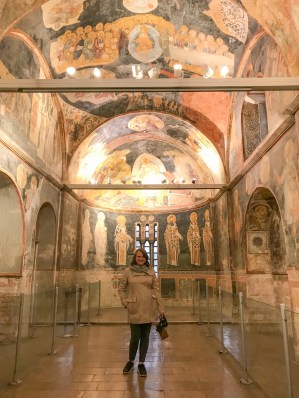
The one pictured above is called The Church of the Holy Saviour in Chora. It has the second most mosaics and frescoes from Byzantine era in Istanbul, and really there were very few which survived the Ottomans and the earthquakes.

I don’t mind telling you that I found this place utterly overwhelming.

IMG_6566I spent about an hour, mouth agape, head thrown back, in awe at these glorious images. The life and ministry of Jesus were tiled into the edifice with brilliant gold accenting.  There was also an area which presented the life of Mary.
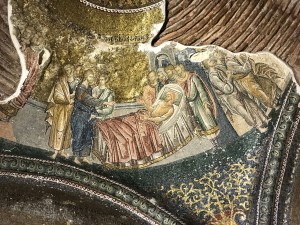
However, It was the frescoes which I found the most breathtaking.  The one pictured above is of the Anastasis, the Easter Theological term for the resurrection of Jesus and his. This chapel area is covered in depictions of Christ’s resurrection, second coming, the resurrection of the faithful and the final judgment.

What I love about this image is that Jesus has shattered chains surrounding his feet.  He grabs the wrists of Adam and Eve who are being wrenched from their burial coffins.

And their faces seem to suggest they surprised and actually a bit reluctant.

In the course of our journey through mosques and ruins and museums, it was a surprise to me to find Jesus, Adam, and Eve rising before me, chains broken, battle won, death defeated.  I plastered my eyes upwards; glued to the resurrected Christ moving heavenward with his beloved children.  The atmosphere in that church was glorious.  Even in ruins and buzzing with tourists you could feel the triumph of Christ over death.

It felt so much different than every other place we had been.

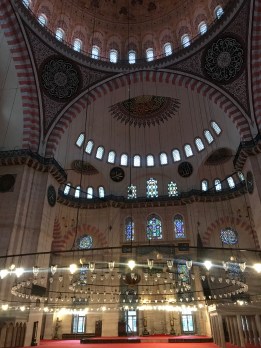
IMG_6543The etymology of the term Muslim is ‘one who submits’ which means Islamic Holy Places are designed to bring you down and inward. For example, even in the grandest mosques in Istanbul, there were low hanging lamps to make the room feel lower.  There is of course carpet so that kneeling for prayer is better facilitated. Every time we entered a mosque I was supposed to veil my head (which I did not mind at all), but it was another way to draw one inward.

There are many Christian places and traditions which capitalize on the idea of submission and conformity. It could be conformity to a worship style or monastic order or even the use of Scripture.

However, if in our conformity we are not moved to the hope of resurrection, then that conformity is not something that is from Jesus.  Jesus claims these beautifull life-giving things which surprised those around him.

Things like:

  • I am the Resurrection and the Life… John 11:25
  • The Lord has anointed me to proclaim Good News to the poor. Luke 4:19
  • Come to me, all you who are weary and burdened, and I will give you rest. Matthew 11:28

These sayings are designed to send the heart soaring, just like the frescos in the Chora Church.  In Christ, we have the hope of glory, the hope of salvation.

We hold a promise that the end is not the end, and that means we can hold our heads a little higher.

What Makes a Leader – A Response

This is a response to the political climate on Saturday, October 6th, 2018. 

A person may think their own ways are right, but the LORD weighs the heart.

Proverbs 21:2

It is quite timely that I have just emerged from a week-long vacation followed by a life-giving conference designed to empower leaders.  Otherwise, I might have been far too disenchanted to engage the past few weeks event. I sat down to blog today about both of these events and ended up saving those drafts to post later.

I strive to look at political events through the lens of a disciple of Jesus, but I can never shake implications that I am also a leader in the local church specifically with young people.  I am that particular kind of disciple. I work and vote and study because I love Jesus who has entrusted me with a ministry to young people.

And the tangled story of our new Supreme Court Justice took place in the years when he was a young person.   It took place with girls who are the same age as the students I work with. That’s heartwrenching for me, as I hope it is for many of us.

There is a lot that could be said about the dangers of a party lifestyle. It’s a culture that’s been around for decades if not centuries past. People party and people have taken parting to extremes since before Jesus. To be sure, sexual assault is not excessive partying; it is a crime, not a vice. Yet the two do frequently appear together.

I have been in ministry with teenagers, college students, and adults who have been a part of all sides of this culture.  People who were aggressors, alcoholics, victims, survivors, who all began with the intention of having a good time. People whose lifestyle forced them to recovery or counseling, and people who simply grew up and walked away.

I am not here to judge anyone.  The church isn’t here to judge anyone. The past is indeed the past, as are the tragic events of which our new Supreme Court Justice has been accused.  The events of the past do not matter in a court of law or to me as a Christian, but something else does matter: character.

The fact is, our culture has incredibly low standards for leadership.  We do not ask what kind of a person someone is, we only ask what they have done and what they will do. For some reason, we believe this is now a better or more reliable measure than character.

During the 2016 Presidential election, I remember the great argument from Christians who recognized Trump’s moral failings made excuses to continue to vote Republican because they wanted a conservative Supreme Court Justice appointed. They wanted particular action taken in the future, and I suppose they got what they wanted at the expense of character.

I also remember going into my high school girls Bible study the morning after the election.  One of my girls said something I still carry with me: “well, I don’t like that we have a bully for a president, but I guess that’s where we are.”

That moment crushed me.

We may never know if what happened at a drunken party in 1982; although, I personally think the assault likely.  But as terrible as it sounds the certainty of this event really does not matter as far as the nation is concerned.

What we do know and can know in 2018 is the character of our newest Justice.

He could have admitted to many things when being interrogated.  He was questioned about drinking, partying, and sexual encounters, and he admitted very little. Instead, when proof based questions were put to him, he frequently evaded them with a prideful and entitled attitude.  He misdirected Senators by pointing out to what he did in school, sports, church or volunteering.

He demonstrated none of the humility of someone acknowledging the wrongs of their past, or even the ability to believe he could be wrong. It is unfortunate that it had to come about in such a public spectacle, but the stakes are high therefore his character should have been higher.

Leadership is not only about what you did or did not do, neither should we choose our leaders solely based on what they say they will do and not do.

Good leadership is essentially a moral act; it stems from a person’s character.

Moreover, we must choose leaders based on their character because we do not know what the future holds.  A good leader is able to navigate through any unforeseen challenge because they have the internal compass and emotional skills to do so.  They do not railroad their will but synthesize their vision with the environment around them.

This is why God looks on the heart, even choose his leaders this way.  God does not want a leader who will do things only his or her own way.  I know many church leaders with difficult pasts. Today they are church leaders because they have character.  They are humble, honest, and open.  They have addressed the sins and pains of the past and do not use their record of accomplishments as an excuse or justification for anything.

I am a disciple of Jesus who has been given a ministry with young people. Today, nearly two years later, I wonder what that young girl from my old Bible study would say today.  I wonder how she would access the character of the man whose decisions will shape the country of her future.  I wonder what these leaders are teaching her.


Fighting for Good News

There’s nothing like the feeling of home. Recently, I was actually able to share my new house with my family from Raleigh, and really, it’s the people who make it feel like home. That is, unless you get into an argument.

Now, my family loves to argue, not fight, argue. Which can be a bit of an adjustment for anyone trying to spend time with us. Most of the time we keep things civil, and even when things get out of hand we always forgive each other. We’ve also learned to stay away from some topics, at least during holidays.

In Luke 4, Jesus returns home for his first big sermon in his hometown synagogue, and things turn into a fight pretty quickly. One has to assume, Jesus knew what he was getting into.

News has spread across the country about his preaching and healing, and when we pick up the story in verse 16 he his leading worship in his hometown. He is handed a scrolls and the passage says:

The scroll of the prophet Isaiah was given to him. He unrolled the scroll and found the place where it was written, “The Spirit of the Lord is upon me, because he has anointed me to proclaim good news to the poor. He has sent me to proclaim liberty to the captives and recovering of sight to the blind, to set at liberty those who are oppressed, to proclaim the year of the Lord’s favor.” And he rolled up the scroll and gave it back to the attendant and sat down. And the eyes of all in the synagogue were fixed on him. And he began to say to them, “Today this Scripture has been fulfilled in your hearing.””

‭‭Luke‬ ‭4:17-21‬ ‭ESV‬‬

I love the power behind this text, and I love the familiarity of a weekly worship service in which Jesus seems to be situated. At first, I tend to read my own Sunday morning church experience into the ancient Jewish synagogue setting. The people are gathered together in their customary fashion in the local place of worship, and this is a bit of a special service because Jesus has come home to preach.

However, Jesus is reading from a scroll, not a book as we do today. A book makes it quite easy to flip through pages and find a certain passage. It takes seconds to find chapter and verse compared to an ancient scroll. It is much easier to read a scroll in order, which is typically how scrolls are read in Ancient worship.

In fact, in modern Jewish worship the Torah is only read in order throughout the Jewish calendar year. The cantor or rabbi opens the Torah a little bit at a time sliding the parchment from one post to the other. These posts are called the eitz chaim or “trees of life.”

Now, The Scroll of Isaiah is not the Torah, but for him to have found a particular passage he would have to unravel yards and yards of parchment, and it would be quite cumbersome and unceremonious to do during worship.

Yet, it seems this is what Jesus does. He shows up like a big shot in his hometown and disrupts worship to read a well known messianic passage in front of people who have known him all his life. In no uncertain terms he tells them he is the messiah, the anointed one, for that is what messiah means.

Moreover, he shatters their idea of what the messiah should be because he doesn’t finish reading the passage in Isaiah! He stops mid-sentence deliberately subverting their expectations. Isaiah 61:2-3a reads:

…to proclaim the year of the Lord ‘s favor,

and the day of vengeance of our God;

to comfort all who mourn;

‭‭Isaiah‬ ‭61:2‬ ‭ESV‬‬

According to the hometown audience, Jesus forgot the best part of the passage. Isaiah 61 goes on to talk about comforting Israel and rebuilding after the exile. But Jesus stops short of this and does not mention “the day of vengeance.” The “Year of the Lord’s Favor” is not just favoring the Jews.

Rather, Jesus is sent by God to minister to the poor, the captive, the blind, and the oppressed. God’s favor extends to the marginalized not necessarily those who customarily go to worship each week.

Jesus’s ‘sermon’ in Luke reinforces this point, and his hometown is so enraged that they try to kill him.

This passage is easily one of my favorites and one of the most difficult for us regular worshipers to cope with. Most days, I believe I’m entitled to the Lord’s favor, and, to be honest, these days I really do feel favored.

The issues arise when we forget that God’s favor should be good news to those on the fringes of society. It should be good news to those who are poor and oppressed. And, it should be good news to those who may not be sitting in church on Sunday. Who might not be in our group.

I pray that my selfishness would not hinder the proclamation of the Messiah’s gospel to reach the captive, oppressed, and broken in order to bring them into the light.