Fishing for Fish

Photo by Michael Yero on Unsplash

Do you ever wonder why Jesus does thing the way he does things? I mean, are you ever reading scripture, and do you ever stop and ask the question “why did it happen this way rather than any other possible way?”

In Matthew 17:24-27, Jesus and the disciples’ travels once again bring them back to Capernaum, that fishing village on the Sea of Gellelie which is the hometown of the disciple Matthew and close to another fishing village of Bethsaida, hometown to Peter, Andrew, James, and John.  Early in the Book of Matthew, Jesus began his public ministry here preaching and performing miracles.

Now that Jesus is back in town he again draws the attention of tax collectors:

24 After Jesus and his disciples arrived in Capernaum, the collectors of the two-drachma temple tax came to Peter and asked, “Doesn’t your teacher pay the temple tax?” 25 “Yes, he does,” he replied. When Peter came into the house, Jesus was the first to speak. “What do you think, Simon?” he asked. “From whom do the kings of the earth collect duty and taxes—from their own children or from others?” 26 “From others,” Peter answered.  “Then the children are exempt,” Jesus said to him. 27 “But so that we may not cause offense, go to the lake and throw out your line. Take the first fish you catch; open its mouth and you will find a four-drachma coin. Take it and give it to them for my tax and yours.”

These guys seem really preoccupied with money in this passage, but it should be noted that the tax wasn’t too steep, only about two days wages.  Yet, for Peter and the rest of the disciples, who had quit their regular jobs to wander from town-to-town following a would-be-messiah, any amount of money was a lot of money.

When these religious tax collectors sought them out and accused Jesus of not paying-up, they essentially accused all of them of being irreligious, of having no faith, of dishonoring God.  That probably didn’t sit well with Peter, but he stands resolute insisting that Jesus does pay the Temple tax (although, hadn’t yet?).

Once Jesus comes back from wherever he was, he begins to ask Peter questions. We can gather from the conversation that Jesus does not believe that either himself or the rest of his disciples need pay this temple tax. This rag-tag group has been wanding from around for months living off of the good graces of God and others.  For Jesus, the Son of God, to pay a tax to God does indeed seem ludicrous for those who understand.

However, the real teachable moment comes when Jesus says  “but so that we might not cause offense…” Jesus understands that two-drachma is not something to get worked up over.  Jesus does not actually want to get into an argument over principle. The Son of God exercises wisdom and illustrates to his disciples the importance of choosing which battles to fight. Even though the money should not need to be paid, the money is still going to a good cause  The situation is foolish but harmless.

Moreover, Jesus crafts this whimsical miracle for a specific purpose as well! Peter is a poor out of work fisherman who cannot himself pay the temple tax, and he cannot pay the fee because he has spent all of his working days following Jesus in discipleship.  If Jesus had never called him away from his nets, then Peter would likely not be in this situation.  He would have been able to pay.

Now, Jesus could have conjured up the necessary coins from behind Peter’s ear to pay the tax.  I’ve seen people do this all the time today, and it would have been much more straightforward.

But Jesus, exercising even greater wisdom, sends Peter fishing.  He sends him to make money using the skills Peter knows best. He sends him back, just for a moment, to be a fisher of fish.

In this way,  Peter’s dignity is fortified  He provides for both Jesus and himself using the skills he’d practiced his whole life.  For months, Jesus had been teaching Peter how to fish for people, but for one afternoon, Peter served God’s Kingdom another time by merely fishing for fish.

I pray these two friends enjoyed this silly but wise moment together, and I hope Peter cherished Jesus’s request for him to again fish for fish.  Maybe someday, each of us may use our expertise in just such a humorous way.

God of the Whirlwind

Recently, I was trying to imagine what it would be like if I were in the boat with the rest of Jesus’s disciples when he walked on water.

In the story, you do get several words that suggest it was quite a frightening experience. For one it says the disciples were “afraid,” and for another, it says the disciples thought they “saw a ghost.” It seems they were so scared they were crying out. They were screaming.

This story is a curious one because, to be frank, it seems like Jesus is showing off. With Jesus’s other miracles there appears to be a better reason. Most miracles are usually about helping people like healing the sick or feeding of the 5000.

When Jesus walks on water, it seems like a fancy way to get from Point A to Point B. Is it just that the son of God is trying to impress his friends?

Maybe that is not how you feel about it. But I was trying to imagine how the disciples felt after Jesus climbed into the boat and said that their feelings of terror were a result of “little faith.” When I try to imagine the disciples’ feelings, I recall the most terrifying moment of my life. It happened just last fall traveling home from a wedding in North Carolina mountains.

William had finally agreed to let me drive on our five-hour road trip home. As he was dozing in the passenger seat, suddenly, out of nowhere an old black Jeep launched itself into oncoming traffic just a few cars ahead on the interstate.

I watched the jeep slam into the vehicles ahead of me, and I began to pump my brakes and lay on my horn. I didn’t want anybody to hit me from behind as I started to dodge shredded pieces of car and chunks of bumpers.

By the grace of God, no one was hurt. We found out after that the woman driving the Jeep was high and drove onto the interstate the wrong way from the offramp totaling several cars.

That moment was laced with adrenaline and high with emotion. The moment after was defined by a massive emotional crash which had me on edge for the rest of the day. When I read that the disciples were so terrified they were crying out, I don’t think we should not take those words lightly.

When Jesus walks on water towards his disciples across the sea of Galilee, it is a moment of terrifying power, and it is remarkable that amid the fear, the waves, and the night, Peter should even fathom to say the words ‘if it is you Lord call me out upon the waters.’

What sort of faith is this? And what kind of confidence does Jesus require of us that he calls even Peter’s actions “little”?

Finally, what kind of God is this? This Jesus of power and glory who walks on water?

Honestly, I don’t know for sure, but I do wonder if what Jesus meant by the term “little.” For example, did he mean little as in small and in impressive or did he mean little as in childlike and endearing.

The Biblical text is again void of details, but for the first time I think Jesus was actually being loving in thing moment.

As we enjoy the peace and blessings of discipleship, we should never forget the glory and power of our God. This God who walks on water, who can conjuring up real fear and trembling, will also extend a hand to us and invite us on the water too.

Finally, we may also need go be reminded that our faith, however gallant, will always pale in comparison to the grace offered to us in Jesus Christ.

Hidden in Plain Sight

“He told them another parable: “The kingdom of heaven is like a mustard seed, which a man took and planted in his field. Though it is the smallest of all seeds, yet when it grows, it is the largest of garden plants and becomes a tree, so that the birds come and perch in its branches.” He told them still another parable: “The kingdom of heaven is like yeast that a woman took and mixed into about sixty pounds of flour until it was worked all through the dough.”

Jesus spoke all these things to the crowd in parables; he did not say anything to them without using a parable. So was fulfilled what was spoken through the prophet: “I will open my mouth in parables, I will utter things hidden since the creation of the world.””

‭‭- Matthew‬ ‭13:31-35‬ ‭NIV‬‬

In Matthew’s gospel, the parable of the mustard seed and the parable of the yeast are set right beside each other. I was reading these two passages earlier trying to compare them and find a few points a similarity. Of course, there is one big point of similarity if you think about it.

For most modern readers, the biggest point of similarity is that we really don’t have a lot of interaction with either mustard seeds or yeast. I have, in fact, never used yeast. Also, the spice set I received as a wedding gift actually came with mustard seeds, and I have never used them.

But I’ve been affected by yeast and mustard seeds. I’ve eaten bread and, though I am not a nesting bird, I have enjoyed mustard.

Now, there are people that interact with yeast and mustard. One such person in my brother.

At our last social gathering, my brother brought scratch made yeast rolls and cinnamon rolls which he baked fresh in my oven and presented to all the guests. The result was delicious. However, he’s pretty much the only person I know who works with yeast, and even he only does this on special occasions.

Most of the time we all just buy bread. We just experience the satisfying finished product. We never see the process.

Even in the ancient world, if you were not the baker then you likely did not see the yeast working with your own eyes.

As far as mustard seeds go, honestly, I don’t know anyone who grows mustard plants. Although, I’m sure these people do exist. From what I understand about mustard plants, most gardeners consider them an unruly plant, a weed if you will. And from what I understand about weeds, if the gardener in the story had caught sight of the sprout earlier then the would have probably pulled it out by the root.

You see, in these stories both the yeast and seed spread quickly, rise without much notice, and, in a short amount of time, mature enough to satisfy the needs of God’s creatures. They provide habitat for birds and sustenance for people.

For those who don’t pay attention, you will never see yeast at work. You will never see it warm and grow. You will never realize that bread is a miracle.

For those who don’t keep an eye on their garden, you will never notice the mustard plant at work. Although, if you did see it you might even mistake the plant for a nuisance.

God hides the work of the Kingdom from those who would not appreciate it. Jesus speaks in parables to hide the mysteries of God in plain sight.

If you’re watching closely you can see the new Kingdom of God springing up all around you. Like a weed growing in your own garden, it just cannot be stomped out. Like yeast baked into your own meal, it rises up bringing the whole world with it.

I pray Jesus gives us eyes to see this new Kingdom and hands to till the soil and strength the kneed the bread so that one day all needs might be satisfied. Amen.

Marriage Update

I really like being married. I feel like my schedule is indeed hectic and frequently unpredictable. Being married means, for the most part, I am guaranteed at a least a little bit of time when my husband each day.

Lately, that time has been spent falling asleep rewatching one episode of Downton Abbey. (Well, I’m rewatching, it’s William’s first watch through.) This is not really quality time, but it is together time.

This week I was listening to a radio intewfoew from the author of a new book on Adam and Eve. I hav not read the book, and honestly probably won’t in the future, but the author has one of he most amazing philosophies about marriage that I have heard.

He says that the biggest difference between marriage and dating is that in marriage the default is always a win. When you’re dating, every bump in the road, every challenge brings to mind a moment of doubt. There is no covenant between you and your partner, so at any point one obstacle is allowed to be too great for you to overcome.

Ideally, marriage is the opposite. In a true covenant relationship any challenge, obstacle, argument, difference, or down-right fight should have a predetermined conclusion. However long it takes, however upset you have become, however dark the night there is always the promise that your love will win the day.

I love my husband, and I would never have married him if I thought there was any shimmer of doubt that we could overcome anything together. I would never have married him if I wasn’t willing to commit to work through all of our issues and challenges.

I hope most people enter into marriage with that mindset. But we are all human.

I love this idea of marriage because I believe it is a beautiful example of the gospel. For those of us who follow Jesus, we can enter into any dark and desperate situation with the hope and assurance that death does not have the last word! We don’t have to fear the darkness because dawn comes in the morning.

And this covenant we have through Jesus is not humanly fallible. It is not subject to the sin and weaknesses of earthly hearts, but is ensured by the blessings of the Holy Spirit.

I really like being married, and this short message from the guy on the radio reminded me how wonderful a blessing and how crucial a responsibility it is to care for my marriage. And ya know what, I really like being a Christian. I love that ‘death has lost its sting.’ I love that I have the assurance of joy in the morning. I love that love wins no matter what.

Racism South of Atlanta

The last few days have been a wild and confusing ride for residence south of Atlanta. A few weeks ago it was announced that a white supremacist rally would be held in the city of Newnan, Georgia not far from where I currently work. I was in El Salvador when the announcement was made, and I remember the words of the 13-year-old girl who is a member of our mission team. “Why can’t they just leave us alone. “

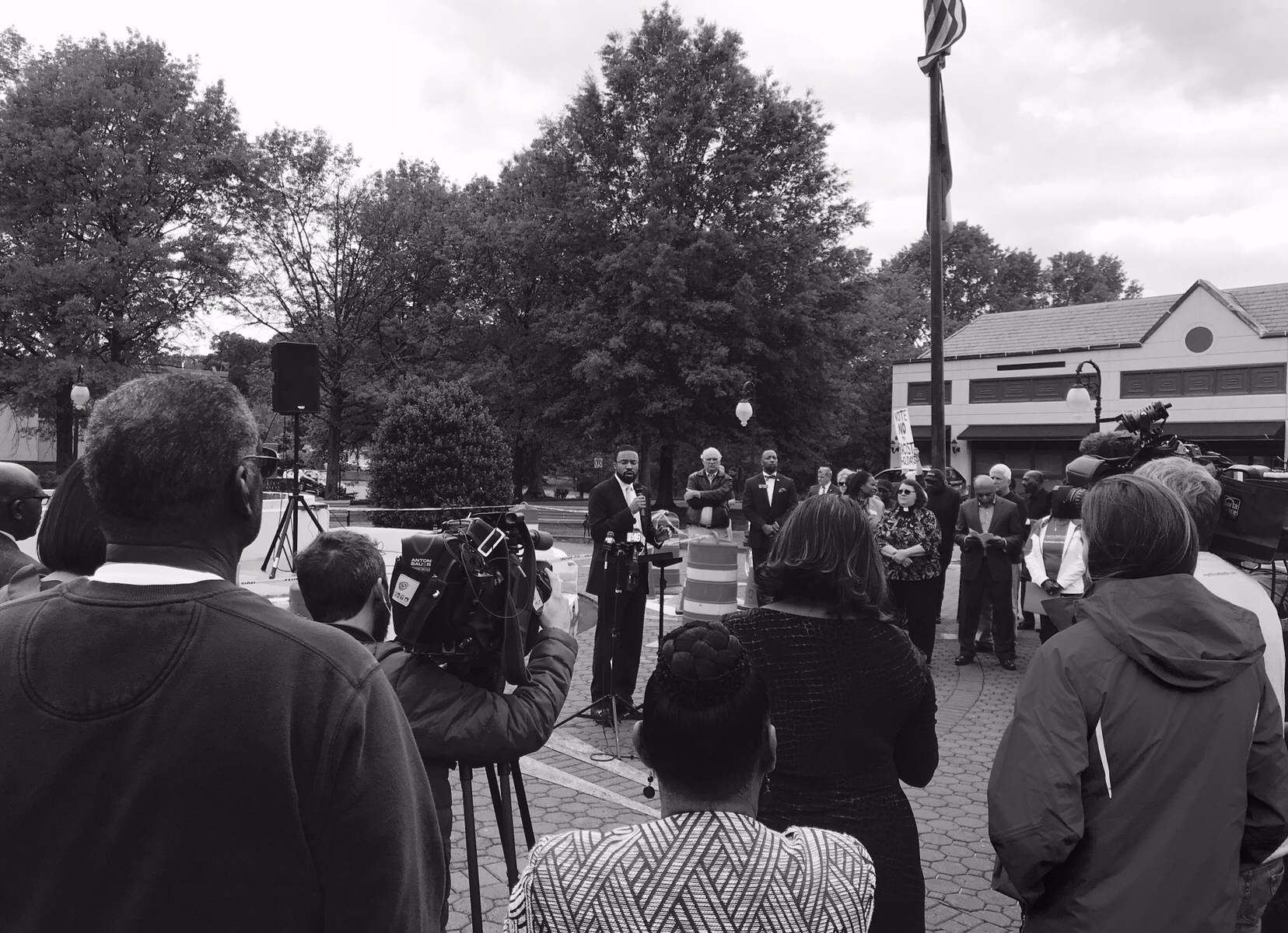
I spoke with church leaders in the area, and they were asked by law enforcement to host police officers in their building but not get involved. Instead, they held a worship service counter to the protesters down the road.

Later in the evening, Neo-Nazi groups burned swastikas on a hill side in Temple, GA.

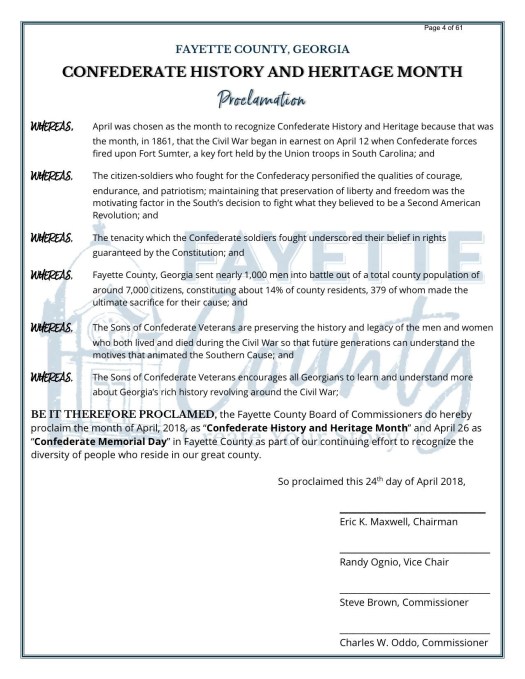
Then this week, on the heels of the rally, the Sons of the Confederacy organization pushed forward proclamations in the surrounding municipalities requesting a month dedicated to honoring Confederate History and Heritage. The timing of course could not be ignored but the language was worse. The proclamation, which you can read in the featured image, whitewashes the civil rights atrocities which led to the Civil War. It is also down right deceptive claimining that the confederacy waged war for “the preservation of liberty and freedom,” blatantly ignoring the fact that the liberty and freedom which was fought for by the Confederacy was ability to steal the liberty and freedom from African Slaves.

To those who would argue otherwise, it seems like it should go without saying that The Georgian Declaration of Succession lists the following as their chief grievances:

The prohibition of slavery in the Territories, hostility to it everywhere, the equality of the black and white races, disregard of all constitutional guarantees in its favor.

In addition they list the North’s failure “to surrender fugitives from labor,” and the issue that a “ [slave-holding] citizen cannot travel the highway with his servant who may voluntarily accompany him, without being declared by law a felon and being subjected to infamous punishments.”

Although the Declaration of Succession was full of reference to slavery, the Proclamation of Confederate History and Heritage made no mention.

In Griffin Georgia on March 27, the proclamation was passed in a shameful display. During the debate, former Commissioner Larry Johnson used the n-word several times with only censure and objection from the one person, one of the two current Black commissioners, Rodney McCord.

This incident is all the more frustrating because the city of Griffin has been the location for IMPACT, the youth mission week hosted by Square Foot Ministries. The youth of Fayetteville First UMC have developed a heart for the community of Griffin through this mission program.

Yesterday, the proclamation came to in Fayette County. When the document was released the names of the four white county commissioners were listed, intentionally excluding the only Black commissioner.

To be honest, I did the bare minimum to stand up to this injustice. I sent a few emails made a few posts on social media and went to a rally. But I was thankful for the opportunity to do even this little.

As a youth minister, I fear that I might be criticized for my activism. However, the lens of all my ethical choices is shaped by what I believe would benefit the younger generation the most. I tell my boss all the time, and I am intentionally biased towards the interest and spiritual development of young people inside and outside our congregation.

A 2016 Newsweek article surveyed over 700 teenagers with the following result:

The most compelling findings show that race and discrimination are crucial issues for teens today. In 1966, 44 percent of American teens thought racial discrimination would be a problem for their generation. Now nearly twice as many—82 percent—feel the same way. The outlook is more alarming among black teens: Ninety-one percent think discrimination is here to stay, up from 33 percent in 1966.

It is indeed an older generation’s mentality to allow language such as that featured in this proclamation to continue. No generation is a monolith, no generation speaks with a single voice. However, I could not in good conscience teach our students on Wednesday about the love of Christ and doing what’s right if I do not live the gospel on Tuesday when it was so easy for me to do so.

How am I to tell a student to resist peer pressure if I do not resist the peer pressure of racism? How am I to tell a student to reach out to the unloved at school if I do not stand with persons of color humiliated by local laws? How am I to tell a student to love God if I am unwilling to love God’s people?

Some have thrown up their hands in disappointment that this was a political exercise and no place for the church. However, I cannot think of a worse fate for the church or a more unappealing institution for young people, if the church ceased to be of consequence in advocating for love, unity, and justice.

Understanding Blue

And I am sure of this, that he who began a good work in you will bring it to completion at the day of Jesus Christ

– Philippians 1:6

Having a dog is not like having a child. When William and I decided, or rather William decided he would let us get a dog, we knew there would be a big change and our lifestyle. We knew that responsibility towards the dog would have to take precedent over our own leisure time.

Although takeing care of a puppy does not match the responsibilities of caring for a tiny human being, this has been the first time in my life that I can really see developmental and cognitive growth in a creature day-to-day. William and I are paying attention to the little triumphs of maturity, and, at the same time, somewhat lamenting how quickly he is growing.

The week we got Blue, we were playing with him in the backyard of William’s parents home. The 10 week old pup was really getting the hang of fetch, and we were all very excited. The trouble was he was still very small and easily distracted. Sometimes he would get lost trying to bring back the ball, and he also did not yet possess the cognitive ability of object permanence. Anytime he lost site of the ball he was not able to predict where it will show back up next.

However, last week we were playing fetch in the same backyard, and the ball was thrown behind one of the patio chairs. William and I both siged and started to get up to retrieve the ball because we believe we would not understand where the ball had gone. Surprisingly, Blue bounded after the ball with perfect clarity and purpose. William and I shared an exciting cheer taking note of his new level of understanding.

My absolute favorite part of ministry, especially youth ministry, is when I get to see firsthand a young person passed to a new level of understanding in faith. I live for the “I finally get it” moment which an experiences of Jesus always provides.

Lately, I’ve been blessed to witness some wonderful moments of revelation for my students.

One student realized how vital love is to our society and got involved in promoting it within her school.

One student, upon returning home from a mission trip, said that she realize for the first time there was a hurt outside her own hurt and a world outside her own town.

One student was able to make peace with a very difficult piece of scripture and now has a better understanding of the teachings of Jesus.

I believe that every faith journey is made up of these little milestones. And I enjoy working with youth because I believe that it is in our younger years that we are more open to hearing God’s voice.

I hope that you are experiencing new understanding day-to-day. I want all of my students to engage life with perfect clarity and purpose. And I pray that we all might press on in faith, learning, growing, and flourishing in the teachings of Jesus.

It is indeed exciting to see something “click” for the first time for another person, but it’s even more exciting to experience it within your own soul.

¡ Hola de Ahuachapan !

One passages which seems to come up an awful lot in my life is a part of Jesus’ Sermon in the Mount. Specifically, the passage in which Jesus encourages the listener to consider lilies of the field and the birds of the air. He saws that’s these features of God’s creation seem small and insignificant. However, they are beautiful and dear to the creator’s heart.

The first full sermon I ever preach was on this passage. I had a plaque in my old office featuring a quotes from the passage and a bouquet of flowers. Just this past Lent, I spoke at our weekly church lunch about the lilies and birds.

Today, while we were visiting home and speaking with residents, we encountered people of varying levels of poverty and suffering. The whole process seemed a little ridiculous, to be honest, and I felt rather empty offering prayer and encouragement to people from such a place of privilege.

While others in our group asked about ailments and source of income, I attempted to direct the coversation to something positive, something that might build up the person and help us connect as fellow human beings.

Also, perhaps more honestly, asking about happy things made the whole experience less awkward.

At one house I praised the beautiful flower garden, and asked how she kept them so beautiful. I purchased some roses from her gardens and at the next house gave them to the residents there.

The next house had a pet parakeet in a small wicker cage. I inquired as to the birds name, but there was none. Jokingly, one of our translators said they should name it after me.

I enjoyed these brief conversations and moments of connection. To be sure, not all of our encounters where lively. Many were full of tears, fear, and confusion. While here, we have had people welcome us with smiles and hugs. But we have also had a few people curse us and our country’s immigration policies.

I have felt shame, and I have seen shame. I have felt joy, and I have seen joy. I have seen glorious blooming flowers and chirping birds. Yet still, I have felt the anxious worries of mothers, fathers, families, and communities.

God bless El Salvador.

Why Lisbon?

A few people have asked me why William and I decided to spend the money, time, and energy to visit Lisbon, Portugal. Well, there are a few reasons.

One reason is that it’s simply the trendy place to go. It’s a tourist destination that’s on the rise, and the people there are going above and beyond to make people feel welcome.

The city itself is lovey and the culture is wonderful. Plus, there’s many spectacular castles, churches, and monasteries.

But the biggest reason I wanted to see Lisbon is because of its tragic history in shaping theology.

In 1755, on All Saints Day when most the citiznes where gathered in church for worship, a nearly 9.0 earthquake struck the city. The quake then triggered a series of devastating tsunamis and knocked over scores of candles lit for the occasion of All Staints Day. The city was reduced to rubble and then burned. Casualty estimates range from 10,000-100,000, and cost nearly half the country’s GDP to repair.

The effect on European thought was profound. For the first time modern philosophers and theologians launched into an intense discussion about the goodness of God in the presence of suffering. This theological problem is know as theodicy. After the earthquake, it was no longer a given that God was benevolent. It was as if the whole continent discovered, or rediscovered, the problem of Job.

Immanuel Kant wrote three different essays on the incident. Voltaire penned an existential poem wresting with the problem of evil. He passionately engages the question saying:

But how conceive a God, the source of loveWho on man lavished blessings from aboveThen would the race with various plagues confoundCan mortals penetrate His views profound?Ill could not from a perfect being springNor from another, since God’s sovereign king;And yet, sad truth! in this our world ’tis foundWhat contradictions here my soul confound!The city of Lisbon took decades to rebuild. The citizens took generations to recover. However, the collection consciousness of Wester Christianity was forever changed. Today, we still wrestle with this same question. Hundred of books have been written, sermons spoken, and arguments waged in attack of this issues. Nevertheless, the nagging pain remains. And the question hangs in the air. Why Lisbon? Why me? Why God?I don’t know how to answer these questions, but sometimes I try. Mostly, we just to listen when someone asks because the answer cannot fill the void. As Christinans, we confess that only Jesus can, and he, more than anyone, knows how it feels to innocently suffer.

Living in Fear

And they went out and fled from the tomb, for trembling and astonishment had seized them, and they said nothing to anyone, for they were afraid. ‭‭Mark‬ ‭16:8‬ ‭ESV‬‬

The more historical ending to Mark, the one found in the oldest manuscripts, ends with fear and trimbing and silence.It’s not the joyful proclamation and loud excitement found in other Gospels. It’s certainly not the spectacle found in our churchs on Easter morning.

What is strange is that so often in the gospels when the miraculous happens, Jesus has a difficult time keeping a lid on it. Those who experienced the transformation from blindness to sight or lameness to leaping tended to tell people.

There are may questions and theories surrounding the end of this Gospel. Perhaps, these women were finally overwhelmed with the miraculous to the point of fear and silence.However, just this year I’ve begun to wonder how much their femininity influenced their silence. In the ancient Jewish world, the testimony of a woman was not acceptable in court. It’s very poignant, then, that the first people to bare witness to the resurrection in other Gospels are women.

Still today, in many places there the testimony of a woman is counted as worthless. Still today, in many churches the testimony of a woman is considered second class. Still today, in early every context women are afraid to speak. I believe the current social awareness about sexual harassment has born that out.

Although I personally cannot point to any harassment in my ministry experience, I can point to patronization. I can point to an experience of bearing witness in a context where my word is discounted. I can certainly point to a feeling fear and keeping silent.

As Christians, we are called to be bold and to speak up on behalf of our faiths. I am called to rise above my fear to give voice to justice and peace. We are called to witness and proclaim the marvelous.

Grief & Greed

Photo by Kevin Horstmann on Unsplash

Someone in the crowd said to him, “Teacher, tell my brother to divide the inheritance with me.”  Jesus replied…And he told them this parable: “The ground of a certain rich man yielded an abundant harvest.  He thought to himself, ‘What shall I do? I have no place to store my crops.’ “Then he said, ‘This is what I’ll do. I will tear down my barns and build bigger ones, and there I will store my surplus grain. And I’ll say to myself, “You have plenty of grain laid up for many years. Relax; eat, drink and be merry.”’

 “But God said to him, ‘You fool! This very night your life will be demanded from you. Then who will get what you have prepared for yourself?’ “This is how it will be with whoever stores up things for themselves but is not rich toward God.”

– Luke 12:13-21 

In this passage, Jesus is preaching to a crowd thousands of people, and the theme of his sermon seems to be about fearless faith in God.  Just then, a man jumps up from the massive crowd to ask Jesus to settle a family dispute about money.   This guy must have had some moxie to address Jesus like this in front of thousands of people.

Now the sermon is off the rails as this man seems to have hijacked the topic.  Jesus chooses to address this man’s concerns about his inheritance.  During this time, it was customary for the older son to receive two-thirds of the father’s estate and one-third would go to the younger son, so this man felt slighted by his brother after the death of his father.

I wonder if the man went to hear Jesus preach that day specifically to ask him about his brother.  I wonder if he was even listening at all to Jesus sermon about courage and faith and the Holy Spirit.  Maybe he was just waiting for a gap in the sermon to jump in.  I wonder what his finical saturation will be if his brother never gives him part of the estate.  I mean, more literally, did he really need the money? Or did he really want the money? Or was he still overwhelmed with grief?

The death of a loved one is always a challenging thing.  Especially, when that loved one has an estate that needs to be distributed. It is immeasurable frustrating to have to deal with the legal ramifications and logistics of the deceased while simultaneously experiencing grief and trying to mourn the loss of a life.   I wish I could say that it always brings out the best in people. But if we’re honest with ourselves, sometimes grief and greed can sometimes get mixed up.  To the foolish man’s credit.  Maybe he was just mixed up.

When this passage is presented in Matthew’s Gospel, it is a part of the Sermon on the Mount.  Jesus’ speaks to the crowed in a beautiful, uninterrupted monologue.  Although there are numerous sermon illustrations and metaphors, the presence of any parables is conspicuously absent.

This changes the tone of the passage considerably.  Whereas the sermon in Matthew might be construed as an exhortation to those without means to trust in God, Luke’s account seems to function as a warning to those with means.  To those individuals living comfortably and with excess. To people like first world Americans.

Regardless, Jesus addresses this foolish man by means of a parable. This parable is not flattering towards the main character who is simply dubbed The Rich Man. When The Rich Man is blessed by God with an abundance of resources, he decides to hoard his blessing and wealth.

To be sure, there is a difference in saving and hording. The way we know this is an example of hording is that he tears down his existing barns only to build new one.  Now he can sit on his crop allowing him to wait for a price increase before selling.

“All that’s left is to relax, eat, drink, be merry,” he says.  This was likely a common phrase at the time and appears a few times in the Bible.  One ironic reference from Isaiah 22:13 which reads ““Let us eat and drink, for tomorrow we die.”  This is ironic of course because in the parable the next day The Rich Man will die.

The Rich Man’s identity is so tied to his possessions, status, and/or achievements he can easily become a caricature which we point to and mock rather than allow to be a point of self-examination.  I wonder if The Foolish Man who address Jesus that day took the time to examine his motives.  I wonder if he was able to separate his grief from his greed. I wonder if he ever got his inheritance.  But most of all, I hope the Foolish Man traded his grief and greed for the riches of God.  And I hope that I am able to do the same.