Living in the Labyrinth – Honest Thoughts on Quarantine Life

I don’t have to tell you that the last week and a half has been rather extraordinary. It’s not every generation that a crisis disrupts the entire human population. Like many others, I am now homebound, leaving the house only to walk the dog and occasionally go to the grocery store. My calendar full of ministry and social events has dwindled to nearly nothing.

Making things worse, the news is full of alarmist predictions and panicked uncertainty. There is a delicate balance to be struck between being informed and being overwhelmed.

Making things more confusing social media seems overburdened with opinions of all sorts, voices shouting to be heard over one another. I’ve seen many people jump at the chance to offer encouraging words and distracting activities. The occasional positive anecdote punctuates the opinionated post. I have started to think that sifting through for the cheerful stories isn’t worth the effort.

A week ago, we received in the mail a wooden finger labyrinth made by talented woodworking, pastor friend of Williams. I was thrilled by the surprise gift, and it got me thinking that lately, my life feels a lot more like a labyrinth.

A labyrinth, unlike a maze, has only a single path you can follow. There are no false paths or dead ends, and there are only one entrance and exit.

Like a labyrinth, I begin and end my day in the same place. I only navigate the relatively small area of my home, weaving back and forth from room to room. I have just a few tasks to do and a lot of time in which to do them, which leaves a lot of time for thinking.

Sometimes these thoughts are positive and optimistic. Sometimes my thoughts are of thanksgiving for those on the frontlines of healthcare. Sometimes I am encouraged by the positive messages and creative encouragement from friends online.

However, I still feel the need to lament. I don’t want to get stuck in a place of darkness or hopelessness, but I want to be honest about my feelings and not just gloss over them with forced happiness.

But I am sad. I want permission to be sad, and I know others are sad too. There are brides that have postponed their weddings, seniors that have missed out on prom, new mothers who are not allowed visitors, churches that won’t have Easter egg hunts.

We all understand that these sacrifices are necessary to keep people safe. But they are still sacrifices, and they do hurt.

We need space to feel the hurt and loss caused by this crisis, and the labyrinth, either real or imagined, provides a limited space to lament. The labyrinth allows us to travel inward, in order to dwell on those things that are deep and meaningful. On the way in, we can spend in mourning what we have lost and acknowledged our feelings. We can speak our fears aloud to God, as petty and as foolish as they may seem.

We can spend some time on these things, but we’re not supposed to get stuck there. We have to move back out.

On the way out, we are encouraged to celebrate God’s goodness. We can begin to celebrate more time at home, the flowers of springtime, and the opportunity to learn and do new things.

If you need the space to mourn, extend yourself some grace. Embrace the labyrinth in which many of us now live. Be sad if you need to and let those around you be sad too. Then, when you’re done, take a breath and find your way back out again.

A Job Well Done

I studied religion in college, and one professor, in particular, was especially challenging. His tests were difficult, and his standards were high. Moreover, he was the most respected professor in the department.

His wisdom and dry wit gave him a certain Yoda-like quality. This impression was only enhanced by his age and a medical condition which made him dependent on a motorized scooter and microphone to teach.

In our class on John, we were assigned an exegesis paper as our final project. I immediately went to the library to get all the books I would need before the stacks were cleared out by my classmates.

I stuffed a dozen books in a sack, then proceeds to carry the sack around for a month, squeezing in reading and writing in every spare moment. I had never before worked so hard on an assignment, and I was incredibly anxious the day I turned it in.

A week or so later I visited my professors office to receive my final grade and look over my notes. I was elated to find a final grade of 98 scrolled in the corner of my well worn essay. But nothing compared to the smile he game me when he said the words ”Kena, your paper was splendid!”

That moment was a mix of relief, joy and pride. I left his office misty eyed, and I have often thought of his simple words and kind smile.

In Matthew, Jesus tells a similar story about servants of a rich man who were entrusted with gold to invest. Two of the servants were successful and received from the master loving praise: Well done, good and faithful servant!

Like the master in Jesus’s story, my professor’s words were powerful. The praise was not just critical because it was positive, but because it was earned through hard work and came from some with authority and great respect.

In our world of likes, upvotes, and comments, others are continually judging us. It’s difficult to sift through the voices and strive for the praise that matters, but it is so worth the challenge to hear words praise from someone who knows what they are talking about.

Are You Listening?

A few weeks ago, I had the pleasure of getting to know our confirmation on retreat to Saint Simons Island. It’s a long, wonderful weekend spent learning about spiritual gifts and bonding through team building.

I taught our young glass several new games and led them in writing their class creed. Each new session of recreation or education was, of course, met with enthusiasm and frequently a lot of extra chatter.

It’s a tradition for this group to have an intimate time of sharing at the end of the weekend, and for this retreat, that means taking turns talking about each other’s spiritual gifts. Adults and leaders participate too, and when it was my turn, one young girl said something very insightful.

“I think you’re a good teacher, Kena, ” she said. “And I like how you say to us ’are you listening’ when your teaching because it makes me think ’am I listening?’ And then I think ’no, I’m not.’ So then I listen!”

I was both amused and amazed by the young girls honestly. Every teacher has a trick or phrase they use to get the room’s attention. Though I had only meant to use the phrase to quiet the rowdy bunch gently, it had sparked a brief moment of introspection for her, which I thought was rather interesting.

It’s funny when Jesus had one of those teacher phrases too. Over and over, he uses the phrase: If anyone has ears to hear, let him hear.

Mostly, when I read, I skip over that phrase. It sits as a kind of filler text before or after relevant teaching. But entering into this season of lent I am struck by my tendency not to listen. Not to listen to God and not to listen to other human beings.

Among other spiritual disciplines, I’ve decided to make that small question my internal refrain for the season on Lent. The phrase “are you listening?” will sit as a gentle reminder to be open to the things of God instead of preoccupied with my agenda.

I am thankful for my student’s reminder that we do indeed have ears to hear if we would simply quiet down.

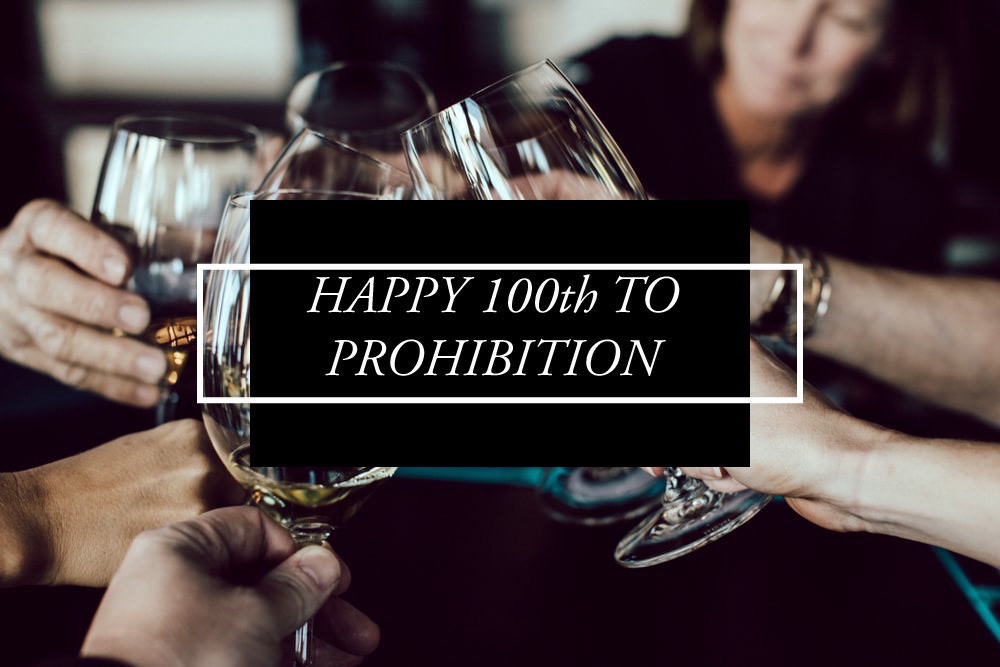
Happy 100th to Prohibition

100 years ago, on January 17th, 1920, the 18th Amendment to the US Constitution went into effect prohibiting the sale and consumption of all “intoxicating beverages”

Prohibition was a fascinating experiment pointing to very different attitudes which are now a minority in our country today.

Alcohol abuse became chronic in this country towards in the 19th Century because of the increasing availability of high gravity liquor.

Prohibition began first as a religious than as a women’s rights movement. Many women lived in fear and in want because of the reckless behavior of their drinking husbands.

Interestingly, the women’s vote wouldn’t come until after prohibition.

One thing I find fascinating is that the process of federally implantation prohibition culminated in an actual constitutional amendment. The social change came through the protests, meetings, and arguments of prohibitionists convincing the voters and elected representatives to pass a new law.

Today, most social change seems to be pushed through the judicial branch, with special attention being placed on finagling the right judges to make decisions. 

The 13 years of prohibition would see the blossoming of organized crime, an abundance of government corruption, and, by the end, essentially the same amount of alcohol consumption.

The church in America, for the most part, stood on the “dry” side of the debate, signaling to the country that alcohol consumption of any kind was utterly immoral. Many Prohibitionists did indeed feel they were specifically called by God to destroy the institutions of alcohol in order to save people’s souls.

It seems strange today, when so much of the Biblical narrative, and the history of Christian worship, is oriented around alcohol. Jesus’ first miracle in The Book of John is not just to turn water into wine, but to provide good quality wine to people who were already wasted.

To be sure, there are also lessons and warnings in the Bible against the overindulgence in festive beverages, specifically as it manifests as habitual drunkenness. Also, there are still Christian groups who are staunchly anti-drinking. I myself went to a Baptist university which was a ”dry campus.”

However, I believe there is a lesson to be learned in the experiment of prohibition for the church today.

I believe the church should be cautious of drawing a hard line in the sand on moral issues. When we as believers take a hard stance we tend to excommunicate anyone who does not toe the line. There are hard lines we should observe, but they still must be approached with a healthy dose of humility, with an eye towards the actions and teachings of Jesus.

Jesus was constantly confronted by religious authorities who chastised him for not taking a hard line. Healing on the sabbath, eating with sinners, even consorting with foreigners were all hard lines that Jesus crossed for the good of the Kingdom.

The church has indeed changed. I serve a congregation with a highly active AA program which also hosts several Bible studies at a growler shop. I’ve also been to more that one church service that meets in a bar.

Overall, I would advise any Christian to be wary of feeling morally superior when so much of our world is not black and white, but shades of gray.


On the subject of amendments, as recently as January 15th, Virginia became the 38th state to ratify the Equal Rights Amendment guaranteeing  women and men equal protection and treatment under the law. The vote gave the amendmentenough state support to have become law had the deadline not expired in 1982.

Why Jesus was Really Born in Bethlehem

Ok, so I don’t actually know the real reason that Jesus was born in Bethlehem. But it’s a part of the Christmas story I think is worth exploring because the reason given in scripture is historically problematic.

Let’s take a look at the text in question from Luke 2:

In those days Caesar Augustus issued a decree that a census should be taken of the entire Roman world. (This was the first census that took place while Quirinius was governor of Syria.) And everyone went to their own town to register. So Joseph also went up from the town of Nazareth in Galilee to Judea, to Bethlehem the town of David, because he belonged to the house and line of David. 

So here’s the good news, there IS historical evidence of a census taking place. According to the 2nd Century history Josephus, in 6 CE Herod Archelaus, a puppet king in Judea, was ousted and Quirinius was made governer for the new consolidated province of Judea. As the newly appointed governor, he was assigned to carry out a tax census.

However, there are some problems with Luke’s account.  It was not a “census of the entire Roman world,” as the text would suggest. The Romans were pretty good record keepers, and, as far as records show, that kind of census really didn’t happen.

Luke 1:5 places the pregnancy of Mary and her cousin Elizabeth under the reign of Herod the Great. Herod the Great’s reign ended in 4 CE, two years before the alleged census took place. Matthew 2:1 also places the location of Jesus’ birth in Bethlehem under the reign of Herod the Great.

Some people chalk this up to a historical misrepresentation or mistake in the Bible. The coming Messiah needed to be born in Bethlehem to confirm the prophecy of Micah 5:2. The census might be an attempt to explain why a man who grew up in Nazareth was actually born Bethlehem.

And maybe he was actually born in Nazareth. That is mostly likely.

But I wonder if there is another reason that Mary, an unwed pregnant woman, might find it a good idea to take some time away from her hometown.

I would imagine that, as Mary began to show the people in Nazareth would have begun to talk. It might have been a welcome change for the Holy Family to go away for a while, somewhere new, somewhere not many people would know them.

It might have even been a reprieve to retreat to the relative privacy of the barn outback. At least the only prying eyes would be animals, and they probably wouldn’t be very judgemental.

A lot of the Nativity story has been characterized as a hardship for Mary and Joseph. The requirement to travel, the location of birth in a barn, but I do wonder how much of a retreat it would have been to a woman living as a cultural pariah to be alone in a new land with God.

Learn more about the historicity of the Nativity story here.

Values for Ministry: Part Three – Inclusivity

The final value which I believe is important for effective ministry is inclusivity or acceptance. By inclusivity I mean the unconditional love extended to a person even before they believe in Jesus Christ.

I think this value has become even more importing with the recent shifts in culture. Years ago, people would first investigate and then adopt the beliefs of the organization. Church membership wasn’t just handed out arbitrarily. It was required that people attend classes before they were accepted into the community.

Today, most people don’t pick a church or small group because they agree with everything the group believes. Nowadays, people join a group because they feel accepted because they feel included. People even officially join a church at all, it is not because of what the church believes, but because the church makes them feel like they belong.

A couple years ago, I had our youth leadership team put together a set of values that they thought were important for the ministry. We brainstormed for about an hour and came up with four values: acceptance, trust, dedication, and honesty. These values were intentionally shaped around our small group ministry.

When I asked our students to put these values in order, acceptance was presented as number one. For teenagers, belonging is the first step in developing an identity. It is within a supportive community that a young person can safely “try-on” different identities and discovers the one that fits best.

Acceptance may be the defining value of the post-modern age. It is easy to see the push back against its advancement in the resurgence of racism, nationalism, and anti-immigration sentiments.

Inclusivity is exceptionally important for the people called Methodist. It is through the loving acceptance of a community of faith that new believers experience God’s prevenient grace.

Also, inclusivity itself is named is a critical virtue for The United Methodist Church in the Constitution which states that “all persons are of sacred worth.” Of course, this value is placed so highly because of the church’s history of segregation, exclusion, and even support slavery.

I believe we need to take our church’s commitment to an Open Table seriously and break down any barrier, whether intentional or unintentional so that people can experience the love of God.

Three Values for Ministry: Part Two – Empowerment

What is Empowerment?

According to Dicionary.com, Empowerment is simply the “authority or power given to someone to do something.” This can mean power is transferred from one person to another or it can mean that previously untapped power is internally claimed by those who once felt powerless.

The push back to empowerment comes when we view power in the church as a zero-sum game. This means we view another person’s acquirement of power as threatening because it means we will lose power.

Sometimes it does mean that those in power must sacrifice some authority, and sometimes they get pretty upset. Rev. McAurhter recently made his feelings clear on this issue saying, “empowering women makes men weak.” He clearly views power as a finite resource, so that when women’s have some power, men have less power.

Honestly, this is not how my marriage works. My husband and I share power taking the lead in certain issues based on the situation. When we understand power as a shared and unlimited resource, any power one of us has, whether in our jobs or community, actually benefits us both as a couple.

For the church, Empowerment is particularly important in the areas of foreign and domestic missions. How many scores of well-intentioned missionaries have poured their money and time into helping their neighbor, only to make never the make any long-term difference? We try to help people in the short term by distributing clothes and offering feeding programs but hurt them in the long-term by not fighting for decent wages or fair treatment under the law, things that would give them more power.

Keeping powerless people powerless often makes us feel more powerful. This can even be true of the church’s discipline ministries. It is the church’s responsibility to nurture people into spiritual maturity, to be able to thoughtfully engage scripture and serve as the hands and feet of Jesus.

Overall, empowerment is a core value for me because it was a core value for Jesus.  In Acts 1:8 Jesus says to his disciples before he is taken up into heaven, “you will receive power when the Holy Spirit comes on you; and you will be my witnesses in Jerusalem, and in all Judea and Samaria, and to the ends of the earth.

The Holy Spirit is the ultimate empowering force in our lives as Christians. God has chosen people to be his actors in this world and to give them the power of the Holy Spirit through which to act.

I don’t know about you, but I believe the power of the Holy Spirit to be infinite, there’s more than enough empowerment to go around.

Currently, I try to foster empowerment through a Youth Leadership Team. Students must apply, attend training, and participate in meetings in order to be a part of this team.

It has borne fruit as our students are now taking leadership roles on church-wide committees. By empowering these students, there is an even greater chance that they will enter the next phase with a lifelong faith.

How do you see Empowerment working in your Faith walk? Who in your orbit could use some Empowerment?

Three Values for Ministry: Part One – Courage

Every few years it’s good to re-evaluate. I remember my first ministry internship at 20 years old sitting down to write a philosophy of ministry. Since then, a lot has changed.

Lately, I’ve been doing a lot of reflection in preparation to go before the Board of Ordained Ministry. I’ve been asked in my paper work to identify three values which are I’m portent for me in ministry today.

So as of this season of life, I’d like to share with y’all what my top three values are for doing ministry.

Ministry Value #1 – Courage

Courage has not always been a big value for me. Honestly, I once thought of courage as the juvenile lesson superimposed on Bible stories make them more applicable to young children.

Daniel and The Lion’s Den, David and Goliath, all the most fanciful Bible stories seemed to be about courage. Also, these stories seemed very similar to the fairytales I learned as a kid. I think this made ‘Couragedifficult to differentiate as a Christian virtue.

Even as a kid I knew I would never been in danger from literal lions or giants, so I tended to dismiss the idea of courage as something I wouldn’t actually need.

But I have had to be courageous.

I’ve come to know crippling effect of fear on God’s ministry, and I have become frustrated by people too scared to step out in faith. A lot of times that timid person was actually me.

About a year ago, one of my students was responsible for delivering the weekly testimony. She shared her favorite Bible verse, 1 John 4:18 “there is no fear in love, but perfect love casts out fear…”

During her testimony, I realized for the first time how much of our political and religious divisiveness was motivated by fear. Every wedge issue, every “us-verse-them” argument is designed to make us afraid, to make us fearful of the unknown and of our neighbor.

But courage is a value intimately close to God’s heart. By some counts, the Bible says to “fear not” more than 100 times. And in nearly every divine encounter the first words spoken by God or God’s messenger is “fear not.”

We are told ” fear not” because Courage, especially that sort of fearless love John talks about, is counter to our nature. We are predisposed to fear. We are all frail, finite mortals afraid of getting hurt, so we structure our societies with walls and boundaries to keep danger, whether real or imagined, at bay.

Courage is counter to our nature as humans, but it is indispensable if we are to be called children of God.

We need courage to be strong leaders, to follow God’s vision, to step out in faith, and event to admit when we’re wrong.

The best way I have found to nourish this value within myself is through being a part of a weekly table. In thoughtful conversations, I am able to emotionally strain out all the fear which heaped upon me by news outlets and through social media. I can breakdown the fearful rhetoric, and begin to faithfully love those who are ‘other.’ And I can quite the persistent voice on fear in my own heart.

There’s strength in numbers, and I best feel the reassurance of my calling to love fearlessly when engaged in a community of believers who actually loves fearlessly.  

What about you? How has fear and Courage played a role in how you love others? Do you feel like Courage is important to ministry?

It’s Cruise Ship – Is our ‘Ministry’ Really Ministry?

Last week I was in a meeting discussing possible upcoming events for our church. A new, exciting ministry opportunity was being discussed but it would interfere with an established tradition with one of the existing ministries of the church.

I explained that I’d be willing to forgo the establish to traditional ministry (or find a way to work around it) in order to make the new opportunity happen.

“We can change what we’re doing that day,” I said. “I mean this thing is a tradition, but it’s ‘cruise ship.'” Heads nodded in understanding.

For those who don’t know, the phrase “cruise ship ministry,” it doesn’t actually mean you’re working on a cruise ship (although cruise ship chaplains do exist). It is a phrase commonly used to refer to ministry programs designed purely to entertain an established group. It’s a party or trip or event dressed up as ministry.

Let me be clear, I actually enjoy event planning. Not all people in ministry do. I’ve been doing large scale event planning since college, and I’ve even written before about the importance of events like overnight lock-ins. But we always have to be careful about planning ministry events.

Recently, at a training retreat for youth leaders, the retreat coordinator made an off-hand comment that a better job title for us might even be “youth event planners.” He said it with a bit of a joking tone, but it is something I really wrestle with.

I hesitate to think about all the day trips and block parties I’ve organized in which not even a prayer was said before the meal. I sometimes allow myself to slip back into the role of event planner because I actually find it easier. There’s less at stake in event planning than in real ministry.

Also, more honestly, I am afraid that Jesus might not be enough for some people.

And there is something to this in scripture, Jesus taught and healed but he also fed the 5,000, offering them the modern equivalent of free pizza. He attended banquets, weddings, and even suggests that heaven is one big party (Luke 15:7).

A few weeks ago, I sat down with my Youth Leadership Team and asked for input on our upcoming retreat. I did get the typical request to organize events like a basketball tournament and a late-night round of manhunt. But I also received requests for fireside worship and space for quiet time and a prayer service.

To believe that Jesus isn’t enough is a lie from straight from the pit. But, to belive that Jesus never enjoyed a good party is a lie as well.

Like a ship navigating rough waters, we must be careful not to steer too close to each extreme.

Celebrating the Harvest – Thoughts on Women in Ministry

I remember sitting in one of my religion classes during college and realizing for the first time that I was following my calling into one of the only fields left in the US in which my gender was an issue. I mean a real, line in the sand, you’re not welcome here issue.

In college, I double-majored in Communication and Religion, and it was interesting to bounce back-and-forth between worlds. My Comm classes we full of brilliant young women who have since become leaders in their field. My religion classes harbored select individuals who still held resentment toward women in leadership.

Campbell University is ambiguously Baptist, welcoming people from the far-right and somewhat left. Of course, it was not the faculty or religious authority which stood against women; they were very supportive. Rather, it was some of my fellow students who took issue. It was my classmates from whom I received the side-long glances and patronizing comments.

Having found my way to the Methodist church I enjoy a lot more support as a woman in ministry. In fact, I will go before the Board of Ordained Ministry in March to seek approval for commissioning as a provisional Elder.

But I have become keenly aware of the way sexism still presents challenges for me. I routinely attend inter-denominational meetings in which I am the only woman in the room.  I have had lay-people tell me “you’d look prettier if you smiled more.”  I have felt the wrath of men who were threatened by me (I even checked with another clergywoman I trusted who reassured me that I wasn’t alone in feeling this way).

Somedays, it feels like death by a thousand cuts, but, on the bright side, I’ve become pretty good at reading between the lines of sexism dressed-up as spirituality.

The wonderful preacher Beth Moore has been attacked by the leadership of her own denomination numerous times for serving Jesus, and some men have responded with blatant, and probably jealous, put-downs.

But the comment that still hangs in my mind is one from Pastor JD Greere, pastor of Summit Chruch in Atlanta and now Presendiet of the Southen Baptist Convention. You see, Greear actually graduated from Campbell University, and many of my dear friends and classmates were passionate members of his congregation. These were the same classmates with those side-long glances and patronizing comments.

So when people like Greear attempt to offer kindly tweets saying things like “Dear , you’re welcome in our home any time,” it’s quite easy for me to pick up on the fact he did not say “pulpit.”

There is a difference in accepting women in ministry and not accepting women in ministry. But, as someone working in the trenches, there’s an even bigger difference between accepting women in ministry and celebrating women in ministry.

Women in church leadership really do make the church better, and we should listen to them, celebrate them, not just accept them.

I have learned that the only person who gets to choose who serves Jesus is Jesus. The Holy Spirit is like an unpredictable wind, and when God calls someone our only question should be “do they have fruit?”

It is my hope that someday every who is called into ministry would be accepted and celebrated. Of course, people don’t go into the ministry to be celebrated, at least they shouldn’t. But ministry is challenging, and if our clergy are producing good fruit, then we should all be celebrating God’s glorious harvest.