Lenten Prayer

With just a short time left before Easter, I thought I’d share a series of prayer stations I put together for the Wesley Foundation at Georgia Tech.  They are all based around Isaiah 53, the last of the Servant Songs which are traditionally read around this time of year in reflection on the crucifixion.

Contemplative or creative prayer exercises like these area great way to connect with God.  I am always amazed to see God move in experiences like prayer stations.  Feel free to use them in your own setting or simply explore them on your own.


Isaiah 53:1-3

1Who can believe what we have heard,1307230939-statue-religion-sculpture-jesus-christ-wallpaper
and for whose sake has the Lord’s arm been revealed?
He grew up like a young plant before us,
like a root from dry ground.
He possessed no splendid form for us to see,
no desirable appearance.
He was despised and avoided by others;
a man who suffered, who knew sickness well.
Like someone from whom people hid their faces,
he was despised, and we didn’t think about him.

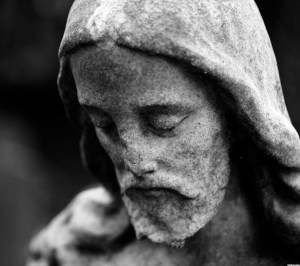
Before you sits a laptop with a series of images. For centuries, Christians have created artwork and imagined what Jesus would have looked like.  Cultures from various times and locations of course created their artwork to reflect a different understanding of what he may have looked like.  All of these works of art are beautiful in their own way.

As Isaiah 53 begins, we are told that the suffering servant was not beautiful.  Jesus, God’s ultimate suffering servant, was a man who suffered.  He was a man who was despised, and many people didn’t think much of him.

As these images scroll by, take a moment to reflect on what the true face of Jesus might be for us today.  Consider how Jesus was mistreated and misunderstood by religious and political authorities.  We can never know in this life the true face of Jesus.  However, perhaps there are faces we can see.  There are the faces of the sick, suffering and despised to whom we owe our attention.


Isaiah 53:4-6

It was certainly our sickness that he carried,
and our sufferings that he bore,
but we thought him afflicted,
struck down by God and tormented.
He was pierced because of our rebellions
and crushed because of our crimes.
He bore the punishment that made us whole;
by his wounds we are healed.
Like sheep we had all wandered away,
each going its own way,
but the Lord let fall on him all our crimes.

In Isaiah 53, Jesus as the servant takes on the punishment for our crime, even though he doesn’t have to.  The text uses a number of violent words to describe the way in which Christ takes on our sin making the passage very rich with movement.

Taka a moment to observe the drama of the verbs in this passage (“carried,” “pierced,” “bore” etc). Consider what they communicate about your salvation through Christ.

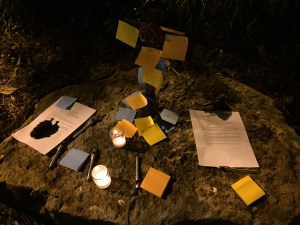
Before you are index cards.  Draw a response or representation to one of these verbs.  When you are finished, take a thumb tack and attach the card to the cork board.

image1 (1)

Isaiah 53:7

 He was oppressed and tormented,
but didn’t open his mouth.
Like a lamb being brought to slaughter,
like a ewe silent before her shearers,
he didn’t open his mouth.

It is easy to forget that Jesus didn’t want to die. On the night before he gave himself up for us, he prayed asking that God let the ‘cup of suffering’ pass from him.  Luke tells us he prayed so earnestly that he begins to sweat blood.

Yet, on the day of his prosecution before Pilot, Jesus offered no defense.  He submitted to the cross for our sake. Jesus did not speak.

Imagine you can speak across the void of time.  You can throw your voice back to the moment of Jesus’ trial before Pilot and the Jewish authorities. If you could say one thing to Jesus at the time just before his death, what would it be?

Take a moment to write whatever it is on a sticky note.  When you are done, post it to the cross.


— 

Isaiah 53:10

But the Lord wanted to crush him
and to make him suffer.
If his life is offered as restitution,
he will see his offspring; he will enjoy long life.
The Lord’s plans will come to fruition through him.

Jesus endured suffering and death on a cross in order to bring about our salvation.  God as Creator laid a plan for our restitution, for our redemption, and Christ saw the plan through in obedience.

Through Christ, now we are all free to participate in God’s work of reconciliation for the entire world.

Take a moment to contemplate your salvation in Christ.  Travel back in your mind and reflect on your own testimony.  What has God done life that has brought you to where you are today?  How has God been working out a plan in your life?

Consider a single word that describes or responds to your testimony as it is right now.  Then use the letter tiles provided to write out word.  Make you word connect to the words of others “Scrabble-style” as a reflection of how all our lives connect.


 —
IMG_5424

Isaiah 53:11

After his deep anguish he will see light, and he will be satisfied.
Through his knowledge, the righteous one, my servant, will make many righteous, and will bear their guilt.


The beauty of the story of Christ is that it doesn’t end in the dark.  Our sin and guilt, Jesus’ suffering and death, they are only a portion of the great story of God’s work of redemption.

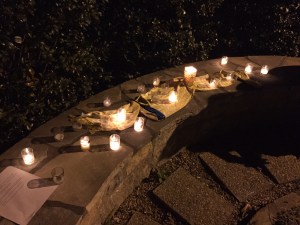
The story of God doesn’t end in death. The story begins in resurrection. There is a light. Take a moment to light a candle in honor of the hope of resurrection.

Isaiah 53:12

Therefore, I will give him a share with the great,
and he will divide the spoil with the strong,
in return for exposing his life to death
and being numbered with rebels,
though he carried the sin of many
and pleaded on behalf of those who rebelled.

Jesus ‘exposed his life to death’ and pleaded with God on our behalf in order that we might gain forgiveness.  Jesus carried the weight of our sin and rebellion and made it possible for us to reunite with God our Creator.

Consider you own life.  Is there something you regret?  Is there sin in your heart that gets in the way of relationships?  Whatever the sin is, take a moment to write about it on the chalkboard in front of you.  Say a prayer giving this sin over to God, and ask for forgiveness for what you have done.

When you are finished, take the eraser and wipe away what you have written.  Know that because of the love of God, the sacrifice of Jesus Christ, and through the power of the Holy Spirit we have confidence in the forgiveness of sins.


 

Come and Listen

Psalm 63:1
water-rocks.jpg
63:1 O God, you are my God, I seek you, my soul thirsts for you; my flesh faints for you, as in a dry and weary land where there is no water.

Isaiah 55:1-3
Ho, everyone who thirsts, come to the waters…Incline your ear, and come to me; listen, so that you may live. I will make with you an everlasting covenant, my steadfast, sure love for David.

My sweet fiance proposed to me by the Chattahoochee River. It’s a place where we like to go walking, and in the middle of January it was a quite and beautiful setting. We walked along the water’s edge for about a mile, side by side, until we came to a clearing in the woods.

The only sound you could hear as he dropped to one knee was the gentle movement of the river.

Rivers of course hold a special significance in this world. Water is the source of life.  No creature can survive without access to fresh, clean water. Ancient cities, and even cities today are usually founded near the banks of a river that can supply the inhabitants with water.


Scripture tells us that the Word of God is life giving. It satisfies the soul and gives life where there is none. And it may seem an often repeated truth, but it’s one we must hear when it feels as if our spirits feel stranded in a dry and weary land where there is no water.

Really, it is better to meditate on this truth, to allow it to saturate our hearts and satisfy our soul. During Lent, God is calling us gently to the river’s edge. Come; drop to your knees and listen, so that you may live.

Below is a song by David Crowder which I have found a wonderful meditation tool for God’s love. I hope you find it as encouraging as I have. 

Edges

O Lord, you have searched me and known me.
You know when I sit down and when I rise up;
you discern my thoughts from far away.
You search out my path and my lying down,
and are acquainted with all my ways.
Even before a word is on my tongue,
O Lord, you know it completely.
You hem me in, behind and before,
and lay your hand upon me.
Such knowledge is too wonderful for me;
it is so high that I cannot attain it.

Psalm 139:1-6

If you haven’t heard, there’s a huge trend out there of full grown adults sincerely enjoying coloring books. You can now find adult coloring books on sale in bookstores, airports, and even in the checkout line at the grocery store.

For a while, I found it difficult to see the appeal. Granted, the coloring pages are usually more abstract and complicated than a typical child’s coloring book, but they are coloring books nonetheless. The process of coloring in between the lines is still the same, and it seemed confusing to me that people would want to limit their creative ability to a prefabricated outline. 

Coloring pagesRecently, I learned of an adult coloring class that a friend of mine has been hosting as part of her work in a local church. Once a week, a small group gathers in a small room. Most of her students are elderly, and many of them have endured the death of a loved one or a recent illness.  In the class, they listen to music as they move crayon across paper and create unique artwork through the rhythms of coloring.


There is a certain peace in knowing one has boundaries. So often we worry about the future and fret about the past. We cultivate anxiety when we dwell on things we cannot change and lose ourselves as our minds wander beyond that which demands our immediate attention.

Psalm 139 has become an important resource for me during the season of Lent because of the perspective it offers. The poem begins by meditating on the unfathomable expanse of God.  Theologians call this God’s omnipresence which is another way of saying God’s everywhere-ness. God is present in our every movement and perceives our every thought.

The heavenly Father is so far beyond us that the Psalmist says in verse 6 “such knowledge is too wonderful for me; it is so high that I cannot attain it.” It is as if God’s everywhere-ness overwhelms the writer of this poem. God is so far beyond we can’t begin to understand it.

I think people like adult coloring pages for the same reason this Psalm was written. When we reflect on the limitlessness of God we can’t help but be aware of our own limitedness. We live a finite existence in a finite world for a finite period of time. We have boundaries and edges that are like the lines on a coloring page.

But God doesn’t. God is omnipresent, and, although it is an overwhelming thought, it is also comforting because it means that God creates our edges. Or, better yet, God can be our edges. God can ‘hem us in, behind and before’ and give our lives definition. It is as if our lives are a coloring sheet and we need only be concerned with what what goes on in between the lines.

We are finite creatures. We have a lifespan and an environment that is not endless. We cannot control death and we cannot avoid tragedy. However, our Creator is limitless, and our Creator cares, and our Creator is eagerly waiting and watching to see us color in between the lines.

Sacrifice

The sacrifice acceptable to God is a broken spirit;
a broken and contrite heart, O God, you will not despise. Psalms 51:17

I once heard of a man who gave up shoes for Lent. There was some sort of social justice concern embedded in his actions in addition to spiritual practice. Without shoes the man could better understand the difficulties of those in poverty who had to do without shoes because they couldn’t afford them. For over 40 days, this man walked about on gravel and in snow with only socks and, occasionally, a bit of duct tape to keep the socks dry.

When I first heard of this man, I remember being fascinated by him. I was impressed with his dedication and sacrifice, and I began to feel like my own Lenten practice was inadequate. Giving up sweets or social media doesn’t seem to be on the quite the same level as giving up shoes.broken-heart 2

I think there’s a lot we Christians seem to get wrong about sacrifice. One thing in particular I think we misunderstand is how the Jewish people interpreted sacrifice in the Old Testament. There’s a tendency for us to generalize and say that Israel understood sacrifice as the primary means of achieving forgiveness from sin. We concoct a narrative which says the Jews sacrificed in order to achieve forgiveness, but now we have Jesus, the perfect sacrifice. And since we have Jesus we no longer have to keep sacrificing animals or food or drink in order to be forgiven.

The verse above is from Psalm 51 and is traditionally read during Lent. The Psalm is
mostly about asking for God’s forgiveness. The author calls on God in order to be washed of sin and be given a clean heart.

Verse 17 is particularly moving because it says that what God really wants us to sacrifice is not sugar or livestock. God really desires the sacrifice of a broken heart.

You see, God doesn’t want us to sacrifice any-thing. God want us to sacrifice our very self, to lay down our life, take up our cross and follow Jesus. God longs for us to present our very heart and soul, broken and humble and ready to be made new.

When we give things up for Lent it’s not about achieving anything like health or holiness. The season before Easter is a time of humbling. It is a time of laying our hearts broken before the Lord, so that we may be made new when the sun rises on Easter morning

Discernment

“Please give your servant a discerning mind…” 1 Kings 3:9 CEB

When I was young, and my Sunday school teachers taught me the story of Solomon’s wisdom, I think I was supposed to be impressed.

The way the story goes is that King Solomon, David’s son, inherits the throne of Israel and is poised for greatness.  Just as he is beginning his reign, God approaches Solomon in a dream saying “ask whatever you wish, and I’ll give it to you.”

Now, Solomon could have asked for money or health or military might, but instead he asks for wisdom or, as the CEB translates it, discernment.  He wants to be able to govern Israel as best as possible and make good decisions.  In order to do that, Solomon needs wisdom.

God is so pleased Solomon ask for wisdom instead of something else that God decides to King-Solomon-Russian-icongive him riches, health, and power in addition to discernment.


When I was a kid, I think I was supposed to be impressed that Solomon didn’t ask for lots of superficial stuff, and I guess I was.  Certainly eight-year-old Kena would have requested a later bedtime or more friends at school.

But in Sunday School, the story of King Solomon made me think that if God ever granted me one wish, I could get even more wishes if I pretend to want something holy or spiritual.  I decided that if it ever came up I would lie to God about wanting wisdom so that I could get the cool stuff too.

Lately, I’m beginning to think God isn’t going to grant me a wish.  It’s still possible, but I think it unlikely that I will awake one night to God saying “ask whatever you wish, and I’ll give it to you.”  And that’s a shame.

It’s a shame because I’m older.  It’s a shame because I know better know.  It’s a shame because, after just a few years journeying through this life, my deepest heart’s desire is truly for the wisdom of God, even if I don’t get riches and health and power thrown in.

A thirst for wisdom is probably how I wound up in seminary.  It’s probably why people show up at church on Sunday morning, especially when the week before was full of unforeseen heartache.  We want to understand our pain.

When Solomon wakes up after his encounter with God he doesn’t make some big political decision or fantastic judgment call.  In fact, the first thing he does is go to Jerusalem, to the place where God’s covenant resided, in order to celebrate and sacrifice to God.

In other words, the wisest thing Solomon can think to do is enter into the community of God and engage in worship.

And, like the people who show up on Sunday morning weary from life’s journey, I think that the instinct to worship is always very impressive.

Why do you work in ministry?

I was asked recently to reflect on this question for a mini-staff retreat, and I thought I’d post the answer since, as true as it is, my reasons still confuse me….

20140918-170409.jpg

I do not so much feel called to ministry, as I feel created for ministry. Not long ago, I was discussing this topic with some fellow seminary students. We discussed our relationships with friends outside the seminary bubble and how frustrated we were sometimes not to have the same luxuries and clarity as them. One of my friends even confessed, quite rightly, that it was sometimes even embarrassing. And yet, we all shared a general notion that there is nowhere else we could. We were supposed to be here at Candler, studying the Bible and theology, and generally preparing for religious leadership.

Reflecting back, I am reminded of the Peter’s confession in John 6 after the feeding of the 5000. Jesus gives a difficult teaching concerning eating of his body and drinking of his blood, and most of the crowds turn away from him. Jesus asks his disciples if they will abandon him as well, to which Peter replies “Lord, to whom shall we go? You have the words of eternal life, and we have believed, and have come to know, that you are the Holy One of God.” (John 6:68, 69 ESV)

I sometimes feel like I wound up on this journey by accident, or at least so far back I don’t remember the beginning. It’s like hiking an unmarked trail deep into the woods, vague as to the destination, but sure it will be worth it.

(Photo By: https://www.flickr.com/photos/liebermann/)

Wisdom: A Definition

Below is short expert from This Odd and Wondrous Calling by Lillian Daniel and Martin B. Copenhaver. It is a definition of wisdom I have turned back to from time to time. I hope you find it as insightful as I have.

“Philosophers, theologians, and social scientists alike have all found wisdom notoriously difficult to difine. In part, this is because wisdom is more that a single attribute. It is more like a cluster of attributes, including a clear-eyed view of human behavior, coupled with a keen since of self-understanding; a certain tolerance for ambiguity and what might be called the messiness of life; emotional resiliency; an ability to think clearly in circumstances of conflict or stress; a tendency to approach a crisis as an intriguing problem to be solved; an inclination to forgive and move on; humility enough to know that is is not all about you; a gift for seeing how smaller facts fit within an larger pictute; a mix of empathy and detachment; a knack for learning from a lifetime of experiences; a way of suspending judgement long enough to achieve greater clarity; an ability to act coupled with a willingness to embrace judicious inaction.”

20140615-234846.jpg

Navigating Conflict

Exploring conflict management technics has been a kind of pass time for me. Last year I led an educational session for managing conflict within organizations. Many of us run for cover at the first sign of an agrument, and I used to be one of those people. Others run into conflict headlong, looking to plant their flag on whatever they consider to be the moral highgound, refusing to budge.

20140615-231019.jpg

Now, it should be obvious that the best method lies somewhere in the middle. During any conflict, it’s best to give any extreem a wide birth. But there’s more we should keep in mind when neavigatinge conflict.

Conflict it isn’t necessarily bad. That’s right, conflict within any relationship or organization is not necessarily an indication of sickness. Just the opisite, we experience conflict because that which was once in agreement between two or more people is now in dispute. These disputes arise because we differ in our understanding of the situation. We differ because we have either grown in our understading, or we are exploring a new a facet of the relationship we have yet to explore. In either situation, we are demonstrating that our relationship is experiencing growth. It means we are different that we were before.

Nevertheless, if we do not address conflict in a timely manner it will eat away at our organizations and relationships until they are unreparable.

There are lots of excellent guides for navigating conflict, but good conflict resolution skills are developed through practice. The success of our churches, careers, friendships and family relationships depend on our ability to do conflict well.

For more resources on conflict resolution check my Prezi which uses cartoon characters as teaching tools.

Seek first to understand

I would like to continue to explore some life lessons from the last four years of college. The proverb I will discuss derives from a catholic prayer which made it way into United States churches in the early part of the 20th Century.

Lord, make me an instrument of Your peace;
Where there is hatred, let me sow love;
Where there is injury, pardon;
Where there is discord, harmony;
Where there is error, truth;
Where there is doubt, faith;
Where there is despair, hope;
Where there is darkness, light;
And where there is sadness, joy.
O Divine Master, Grant that I may not so much seek
To be consoled as to console;
To be understood as to understand;
To be loved as to love.
For it is in giving that we receive;
It is in pardoning that we are pardoned;
And it is in dying that we are born to eternal life.

This particular prayer has had a great influence on my own life, and it is the emphasis on understanding which I take most to heart. Just as this prayer operates first in negation, then in affirmation, it is helpful for us to discuss what understanding is not, in order to make sense of proverb.

Understanding is not knowledge. Knowledge is a terminal activity of the mind, and in its pursuit mankind looks for singular answers to singular problems.

On the other hand, the pursuit of understanding is limitless and elusive. It is an activity of the mind and soul in which a person’s worldview is continually reshaped around the experience and stories of others. We as Christians must make a good faith attempt at understanding, while also acknowledging that we can never completely understand another’s circumstances. It is a strange paradox, but any grief counselor worth his or her stock will undoubtedly affirm, there should be great hesitation for any of us to say “I know how you feel.”

Nevertheless, we must humbly seek to understand the worldview of others as an activity of holy peacemaking and reconcilation. To seek understanding first is to be quick to listen and slow to speak (James 1:19). It is to allow others the more prestigious seat at the heavenly banquet in full assurance that the truth of Christ will win out in the end. This does not mean we accommodate falsity or compromise the truth, nor does it mean we remain silent in the face of injustice. However, it does mean that we first look for the truth of Christ in others, before we assume we have all the answers.

Ten Kernals of Wisdom

It has been over a week since I walked across the stage at Campbell University Commencement. I throughly enjoyed my time in undergrad, and I am looking forward eagerly to seminary in Atlanta and starting work in ministry with Northside UMC.

As I move forward in life, I’d like to share some brief proverbs that I took from my undergrad expirence. I treasure these saysing, though for most of them I cannot recall their initial orgin. These short maxims have cemented in my thoughts, and I can only assume that they are truths which God thought I needed to learn. So, here we go: Continue reading “Ten Kernals of Wisdom”